
Charlottetown in Queens County, Prince Edward Island — The Atlantic Provinces (North America)
Great George Street Historic District
⎯⎯⎯
L’arrondissement Historique de la rue Great George
Photographed by Barry Swackhamer, July 8, 2014
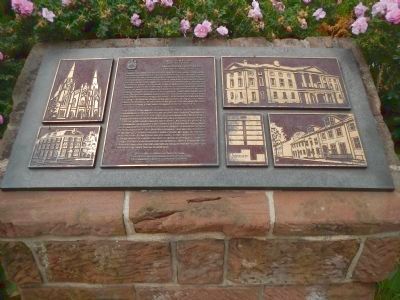
1. Great George Street Historic District Marker

English:
Great George Street is richly evocative of both its 18th-century origins and its subsequent development as one of Charlottetown's principal streets. Clearly focused to Province House, the seat of Island government and the birthplace of Confederation, the street has traditionally been lined with homes and public buildings. In 1864 the Fathers of Confederation attending the Charlottetown Conference landed on the wharf at the bottom of this street, and some delegates stayed in the nearby Pavilion Hotel. Houses influenced by British classicism were the first buildings on Great George Street. Over the years, structures designed in a variety of styles gradually joined and complemented them. The graceful architectural evolution of the street has allowed soaring stone church towers to mingle successfully with simple wooden and brick buildings. A harmony in use, scale and setting among its structures, cohesively meshed with memories of the great events the street has seen, continues to convey a clear sense of its place in our national history.
French:
this page online
Erected by Historic Sites and Monument Board of Canada/Commission de lieux et monuments historique du Canada.
Topics and series. This historical marker is listed in
Photographed by Barry Swackhamer, July 8, 2014
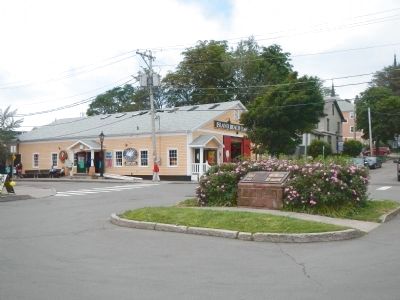
2. Great George Street Historic District Marker
Location. 46° 13.952′ N, 63° 7.366′ W. Marker is in Charlottetown, Prince Edward Island, in Queens County. It is on Great George Street, in the median. Touch for map. Marker is at or near this postal address: 9 Great George Street, Charlottetown PE C1A 1A6,, Canada. Touch for directions.

Regionally, this marker is in Central Coastal P. E. I. It is also in the Maritimes and in Atlantic Canada. Globally, it is in the North Atlantic Region, North America, the Western Hemisphere, the Western World, and the Anglosphere. Historically, it finds itself in what was once a British colony, the Viceroyalty of New France, and Acadia.
Other nearby markers. At least 8 other markers are within walking distance of this marker: William Henry Pope (1825 – 1879) (within shouting distance of this marker); Where the Money Was / Là où il y avait de l'argent à faire (within shouting distance of this marker); The Gainsford House (within shouting
Photographed by Wm. Notman & Son, 1916
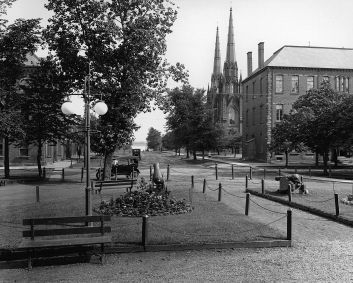
3. Great George Street
St. Dunstan's Basilica is in the background.
More about this marker. This marker is near Peake's Quay.
Also see . . . Great George Street Historic District National Historic Site of Canada. On August 31st and September 1st 1864, the Fathers of Confederation arrived at Peake’s Quay Charlottetown to attend the Charlottetown Conference. The event was hosted at Province House, the historic seat of Island government, which sits at the end of Great George Street. The discussions at this conference resulted in the confederation of four provinces of British North America into the Dominion of Canada on July 1, 1867 in Québec. Since 1864, Great George Street has retained its original colonial plan, its close association with the water, and its regular ascent to the central square and seat of government at Province House. (Submitted on January 9, 2015, by Barry Swackhamer of Brentwood, California.)
Credits. This page was last revised on October 22, 2025. It was originally submitted on January 9, 2015, by Barry Swackhamer of Brentwood, California. This page has been viewed 964 times since then and 93 times this year. Photos: 1, 2, 3. submitted on January 9, 2015, by Barry Swackhamer of Brentwood, California. • Andrew Ruppenstein was the editor who published this page.
