Greenville in Greenville County, South Carolina — The American South (South Atlantic)
Richard Pearis
Reede River Falls Historic Park
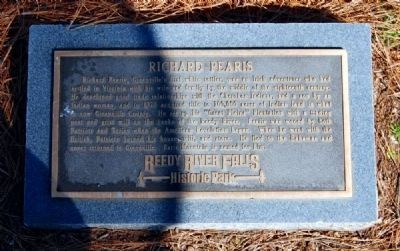
Photographed by Brian Scott, February 28, 2010
1. Richard Pearis Marker
Topics. This historical marker is listed in these topic lists: Indigenous Peoples and Communities • Settlements & Settlers • War, US Revolutionary. A significant historical year for this entry is 1770.
Location. 34° 50.691′ N, 82° 24.031′ W. Marker is in Greenville, South Carolina, in Greenville County. It is on Falls Street near Camperdown Way (South Carolina Highway 124). This marker is located in Greenville's historic
this page online

Regionally, this marker is in Upstate. It is also in the American South, specifically in the Deep South, in Appalachia, and specifically in Southern Appalachia. Globally, it is in North America, the Western Hemisphere, the Western World, and the Anglosphere. Historically, it finds itself in what was once the original Cherokee Nation, the territory of the Mississippian Culture, one of the original Thirteen Colonies, one of the Confederate States of America, and the Antebellum South.
Other nearby markers. At least 10 other markers are within walking distance of this marker: Camperdown Mill (here, next to this marker); Cradle of Greenville (here, next to this marker); The Falls and Industry (a few steps from this marker); The Falls Forgotten (a few steps from this marker); The Falls Reclaimed (a few steps from this marker); Liberty Bridge (within shouting distance of this marker); The Reedy River (within shouting distance of this marker); Falls Place (within
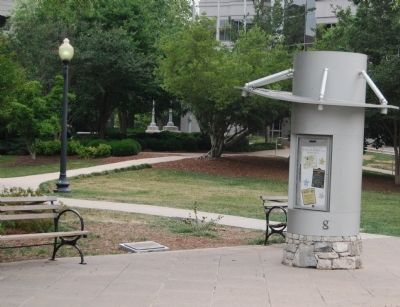
Photographed by Brian Scott, June 1, 2008
2. Area Immediately Around the Richard Pearis Marker
Other markers no longer nearby. The Falls and Industry 1800’s – 1960 (was a few steps from this marker but has been replaced with another marker now near it); The Falls Forgotten 1960 - 2002 (was a few steps from this marker but has been replaced with another marker now near it); Falls Reclaimed and the Liberty Bridge 2004 (was a few steps from this marker but has been replaced with another marker now near it).
More about this marker. This marker is one of a series of markers in the Historic Falls Park covering bits of Greenville's history.
Also see . . .
1. Richard Pearis. Richard Pearis (1725 – 1794) was an Indian trader, a pioneer settler of Upstate South Carolina, and a Loyalist officer during the American Revolution. (Submitted on April 11, 2010, by Brian Scott of Anderson, South Carolina.)
2. American History: Greenville County, South Carolina. While the lower
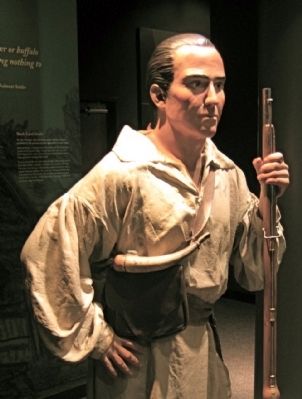
Photographed by Wikipedia
3. Richard Pearis -
Upcountry History Museum
Upcountry History Museum
Additional commentary.
1. About Richard Pearis
Richard Pearis was born in Ireland and settled in Frederick County, Virginia, before 1750. At the outbreak of the Revolutionary war he was a successful planter and Indian trader on the Enoree river in South Carolina.
An orator of rude, savage eloquence and power, he commended himself to Governor Dinwiddie by his loyalty and efficiency. He became lieutenant in the Virginia Provincial regiment in 1755 and was commissioned captain in 1756 to command a company of Cherokees and Catawbas in an expedition against the Shawnee towns west of the Ohio, under Major Andrew Lewis. Pearis served under Generals Forbes, Stanwix, Monckton, and Bouquet. He was the first to enter Fort Duquesne. His military ability was apparent in his services on the borders of Maryland, Pennsylvania, and Virginia, with headquarters at Fort Pitt.
Having married
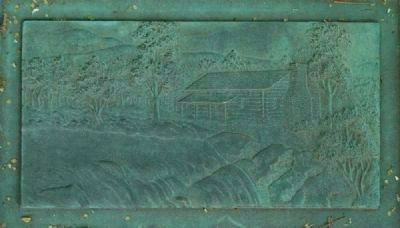
Photographed by Brian Scott, April 28, 2010
4. Artist's Representation of Richard Pearis' Home
On the "Cradle of Greenville" marker located near the Richard Pearis marker.
Click for more information.
Click for more information.
Every effort was made by the Whigs in 1775 to induce this powerful man and the Indians to join them, or at least to secure their neutrality. However, Pearis took part in the siege of Ninety- Six on the British side and many other actions.
In July, 1776, he was one of a party of 260 loyal militia and Indians which unsuccessfully attacked 450 "rebels" in a wooden fort.
According to his own narrative, his services to the crown in the same year include the dispersal of 700 "rebels" in the district of Ninety-Six. By the turn of fortune he was captured and consigned to Charleston jail, where he was a prisoner in irons for nine months. On his release, Pearis wended his way on foot, traversing 700 miles, to West Florida, through the settlements of the Indians, who supplied him with food. Arriving at Pensacola, he was on 13 December, 1777, commissioned captain in the West Florida loyalist refugees, by Colonel John Stuart, superintendent of Indians in

Photographed by Mark Parker, October 25, 2024
5. Richard Pearis Marker looking towards the falls
The romantic tale of his exploits includes the raising of 5000 to 6000 loyalists and the disarming of all rebels from the Savannah river to Broad river, near the borders of North Carolina, as well as destroying their forts and capturing men, arms and ammunition. To his mortification, this series of successes was no sooner accomplished than Colonels Innes and Balfour ordered the arms and ammunition to be returned to the "rebels" and their leaders released. Incensed by this treatment, he returned to Georgia and settled his family near Augusta.
While Pearis was a prisoner at Charleston, his wife, two daughters, and a son were surprised at home by Colonel John Thomas and 400 followers, who subjected them to abuse and punishment, as well as carrying away their portable property and burning the rest. Not content, Colonel Thomas forced the family to march on foot 25 miles a day, without food and without protection for their heads from the sun. They were also confined for three days without food, and were afterwards sent off in an open wagon a ditsance of 100 miles, to shift for themselves among "a parcel of rebels," without money or provisions. For three years Captain Pearis was separated from his family, who were in daily fear of massacre by their enemies.
A son of Captain Pearis was an ensign in the West Florida Rangers.
For the loss of his real estate in South Carolina, Colonel Richard Pearis claimed £15,576. 18s. and was awarded £5,624. An account of his property has been published. The name appears also as Paris, whence Paris Mountain, near Greenville in South Carolina.
After the war he settled in Abaco in the Bahamas, where he had a grant of 140 acres of land, and where Margaret Pearis, presumably his wife, received a grant of 40 acres. Colonel Pearis received a military allowance of £70 a year from 1783 to 1804, when he probably died. It was perhaps his son, Richard, who married Margaret, daughter of General Robert Cunningham, the South Carolina loyalist, in Abaco, 22 June, 1790. (Source: Contributions in History and Political Science, Issue 7 by Ohio State University, pgs 107-109.)
— Submitted April 11, 2010, by Brian Scott of Anderson, South Carolina.
Credits. This page was last revised on October 31, 2024. It was originally submitted on May 31, 2008, by Brian Scott of Anderson, South Carolina. This page has been viewed 4,632 times since then and 227 times this year. Photos: 1. submitted on March 27, 2010, by Brian Scott of Anderson, South Carolina. 2. submitted on June 1, 2008, by Brian Scott of Anderson, South Carolina. 3. submitted on September 13, 2009, by Brian Scott of Anderson, South Carolina. 4. submitted on May 26, 2010, by Brian Scott of Anderson, South Carolina. 5. submitted on October 27, 2024, by Mark Parker of Hickory, North Carolina. • Kevin W. was the editor who published this page.
