Leonardtown in St. Mary's County, Maryland — The American Northeast (Mid-Atlantic)
The Great House
Photographed by Allen C. Browne, January 10, 2015
1. The Great House Marker
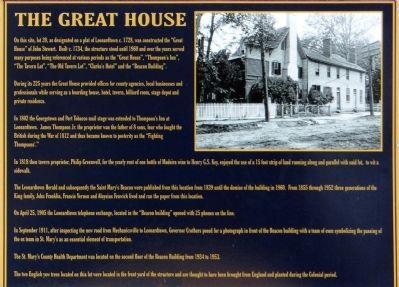
On this site, lot 39, as designated of a plat of Leonardtown c. 1728, was constructed the “Great House” of John Stewart. Built c. 1734, the structure stood until 1960 and over the years served many purposes being referenced at various periods as the “Great House”, “Thompson's Inn”, “The Tavern Lot”, “The Old Tavern Lot”, “Clarke's Hotel” and the “Beacon Building”.
During its 225 years the Great House provided offices for county agencies, local businesses and professionals while serving as a boarding house, hotel, tavern, billiard room, stage depot, and private residence.
In 1802 the Georgetown and Port Tobacco mail stage was extended to Thompson's Inn at Leonardtown. James Thompson Jr. proprietor was father of 8 sons, four who fought the British during the War of 1812 and thus became known to posterity as the “Fighting Thompsons'.”
In 1818 then tavern proprietor, Philip Greenwell, for the yearly rent of one bottle of Madeira wine to Henry G.S. Key, enjoyed the use of a 15 foot strip of land running along and parallel
this page online
The Leonardtown Herald and subsequently the Saint Mary's Beacon were published from this location from 1839 until the demise of the building in 1960. From 1855 through 1952 three generations of the King family, John Franklin, Francis Vernon and Aloysius Fenwick lived and ran the paper from this location.
On April 25, 1905 the Leonardtown telephone exchange, located in the “Beacon Building” opened with 25 phones on the line.
In September 2 1911, after inspecting the new road from Mechanicsville to Leonardtown, Governor Crothers posed for a photograph in front of the Beacon building with a team of oxen symbolizing the passing of the ox team in St. Mary's as an essential element of transportation.
St.Mary;s County Health Department was located on the second floor of the Beacon Building from 1934 to 1953.
The two English yew trees located on this lot were located in the front yard of the structure and are thought to have been brought from England and planted during the Colonial period.
Topics. This historical marker is listed in these topic lists: Colonial Era • Communications

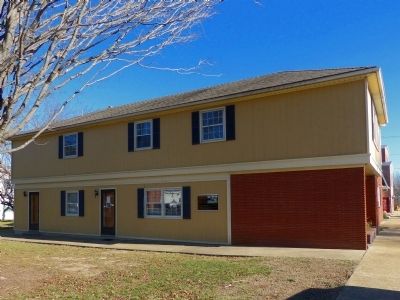
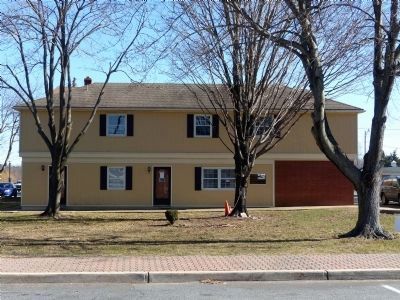
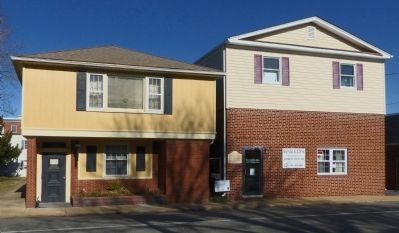
Location. 38° 17.383′ N, 76° 38.167′ W. Marker is in Leonardtown, Maryland, in St. Mary's County. It can be reached from Court House Drive when traveling east. Touch for map. Marker is at or near this postal address: 41610 Court House Drive, Leonardtown MD 20650, United States of America. Touch for directions.

Regionally, this marker is in Southern Maryland. It is also in the American South, specifically in the Upper South, in the Mid-Atlantic, in the Tidewater, in the Chesapeake Bay Region, and on the Eastern Seaboard. Globally, it is in the North Atlantic Region, North America, the Western Hemisphere, the Western World, and the Anglosphere. Historically, it finds itself in what was once one of the original Thirteen Colonies and also the Antebellum South.
Other nearby markers. At least 8 other markers are within walking distance of this marker: Lynching in America / Lynching of Benjamin Hance (a few steps from this marker); a different marker also named Leonardtown (a few steps from this marker); This Cannon (within
Photographed by Allen C. Browne, January 10, 2015
3. The Great House Marker
Another marker is no longer nearby. Leonardtown (was a few steps from this marker but has been replaced with another marker now near it).
Photographed by Allen C. Browne, January 10, 2015
4. 41610 Court House Drive
Photographed by Allen C. Browne, January 10, 2015
5. 41610 Court House Drive
Photographed by Allen C. Browne, January 10, 2015
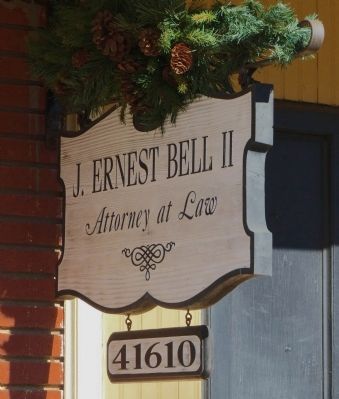
6. J. Ernest Bell II
Attorney at Law
41610
Attorney at Law
41610
Credits. This page was last revised on April 16, 2026. It was originally submitted on January 18, 2015, by Allen C. Browne of Silver Spring, Maryland. This page has been viewed 770 times since then and 49 times this year. Photos: 1. submitted on January 18, 2015, by Allen C. Browne of Silver Spring, Maryland. 2. submitted on April 16, 2026, by Devry Becker Jones of Washington, District of Columbia. 3, 4, 5, 6. submitted on January 18, 2015, by Allen C. Browne of Silver Spring, Maryland. • Bill Pfingsten was the editor who published this page.
