Vieux-Québec-Cap-Blanc-colline Parlementaire in Capitale-Nationale, — Central Canada (French-Canadian)
Do You Know Joan of Arc?
Connaissez-vous Jeanne d’Arc?
Photographed by Barry Swackhamer, July 25, 2014
1. Do You Know Joan of Arc? Marker
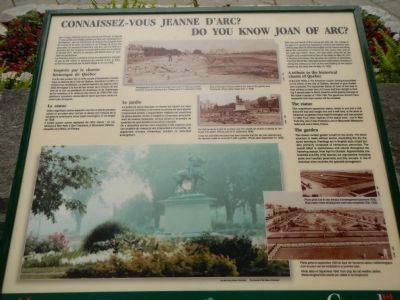
Captions (English / French): (center, top View of George VI Avenue before the Joan of Arch garden was developed. / Aménagement de l’avenue George VI alors qu’il n’était pas encore question du jardin Jeanne d’Arc.; (center) It was not until after the statue had been donated that this site was selected and the decision made to surround it with a garden. / Ce n’est qu’après le don de la statue que l’on choisit cet endroit et décida de l’entourer d’un jardin. (bottom right) Photo taken when development work was completed (Fall, 1938). / Photo prise à la fin des travaux d’aménagement (automne 1938); Photo taken in September 1940 from atop the old weather station. Meteorological instruments are visible in the foreground. / Photo prise en septembre 1940 du haut de l’ancienne station météorologique dont on peut voir les installations au premier plan.

Who has not heard of this young girl who left her village at the age of 17, guided by mysterious voices? Her mission was nothing less that to drive the English out of France and bring about the coronation of Charles VII. Two years later, just as her goal was within reach, she was taken prisoner by the English and condemned to burn at the stake on May 30, 1431. A heroine and martyr, she became the symbol of patriotism. The First World War rekindled French nationalism, thereby reviving the memory of Joan of Arc and leading to her canonization by the Holy See on May 16, 1920.
this page online
French:
Photographed by Barry Swackhamer, July 25, 2014
2. Do You Know Joan of Arc? Marker
La Première Guerre mondiale raviva le nationalisme français et par le fait même la mémoire de Jeanne d’Arc, si bien, qu’elle fut canonisée par le Saint-Siège le 16 mai 1920.
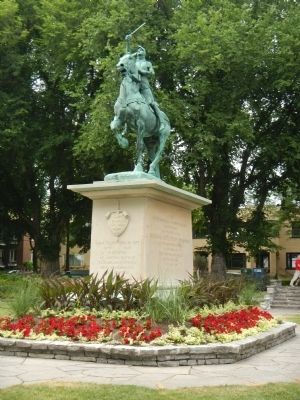
Il existe quatre autres répliques de cette statue: on les retrouve à New York, à San Francisco, à Gloucester (Massachusetts) et à Blois, en France.
Photographed by Barry Swackhamer, July 25, 2014
3. Joan of Arc statue
On y dénombre environ cent cinquante (150) espèces dont une centaine de vivaces et un cinquantaine d’annuelles. Un alignement d’ormes d’Amérique ceinture ce splendide arrangement.
Erected by The National Battlefields Commission / Commission des champs de bataille nationaux.
Topics. This historical marker is listed in these topic lists: Arts, Letters, Music • Horticulture & Forestry • Women. A significant historical month for this entry is May 1839.
Location. 46° 48.234′ N, 71° 13.049′ W. Marker is in Québec, in Capitale-Nationale. It is in Vieux-Québec-Cap-Blanc-colline Parlementaire. It is on Avenue George VI, on the left when traveling east. Touch for map. Marker is at or near this postal address: Avenue George VI, Québec G1R 3R2,, Canada. Touch for directions.

Regionally, this marker is in Central Canada. Globally, it is in North America, the Western Hemisphere, and the Western World. Historically, it finds itself in what was once a British colony, the Viceroyalty of New France, the Haudenosaunee (Iroquois) Confederacy, and Rupert’s Land.
Other nearby markers. At least 8 other markers are within walking distance of this marker: O Canada! (here, next to this marker); A Golf Club on the Plains of Abraham (within shouting distance of this marker); Jardin Jeanne d'Arc / Joan of Arc Garden (about 90 meters away, measured in a direct line); Martello Towers in Quebec / Tours Martello de Québec (about 120 meters away); Martello Towers / Tours Martello (about 150 meters away); Montcalm (about 150 meters away); Louis-Alexandre Taschereau (about 150 meters away); Le Siège de Québec, 1759 / The Siege of Québec, 1759 (about 180 meters away). Touch for a list and map of all markers in Québec.
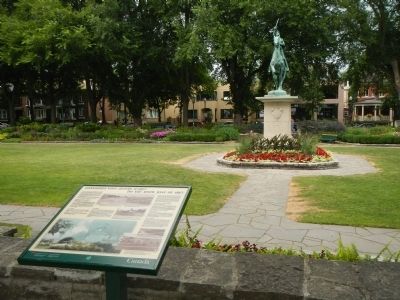
More about this marker. This marker is located in National Battlefields Park at Joan of Arc Garden.
Credits. This page was last revised on February 9, 2023. It was originally submitted on February 17, 2015, by Barry Swackhamer of Brentwood, California. This page has been viewed 585 times since then and 25 times this year. Photos: 1, 2, 3. submitted on February 17, 2015, by Barry Swackhamer of Brentwood, California. • Andrew Ruppenstein was the editor who published this page.
