St. Leonard in Calvert County, Maryland — The American Northeast (Mid-Atlantic)
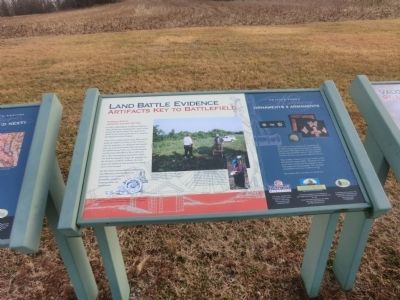
Land Battle Evidence
Artifacts Key to Battlefield
| — | Possible Site of American Cannon Battery | — |
Photographed by Don Morfe, February 10, 2015
1. Land Battle Evidence Marker
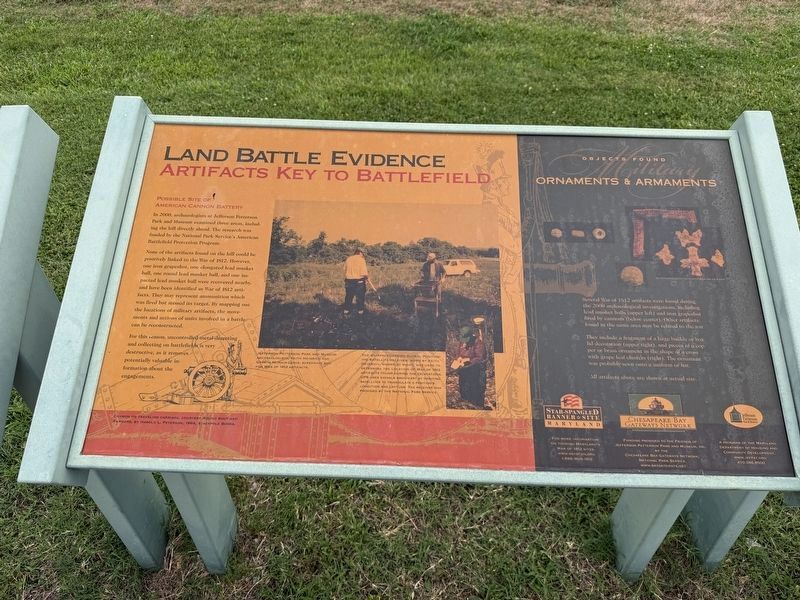
In 2000, archaeologists at Jefferson Patterson Park and Museum examined three areas, including the hill directly ahead. The research was funded by the National Park Service’s American Battlefield Protection Program.
None of the artifacts found on the hill could be positively linked to the War of 1812. However one iron grapeshot, one elongated lead musket ball, one round lead musket ball, and one impacted lead musket ball were recovered nearby, and have been identified as War of 1812 artifacts. They may represent ammunition which was fired but missed its target. By mapping out the locations of military artifacts, the movements and actions of units involved in a battle can be reconstructed.
For this reason, uncontrolled metal-detecting and collecting on battlefields is very destructive, as it removes potentially valuable information about the engagements.
[Captions:]
Cannon on traveling carriage, courtesy Round Shot and Rammers, by Harold L. Peterson, 1969, Stackpole Books.
Jefferson Patterson Park and Museum archaeologists, Keith Heinrich and Gareth McNair-Lewis, screening soil for War of 1812 artifacts. The backpack-carried Global Positioning Satellite Receiver, worn by Keith Heinrich, shown at right, was used to determine the location of War of 1812 artifacts found during the excavations. GPS uses signals broadcast by orbiting satellites to triangulate position’s longitude and latitude. The receiver was provided by the National Park Service.
Military-Objects Found-Ornaments & Armaments-Several War of 1812 artifacts were found during the 2000 archaeological investigations, including lead musket balls (upper left) an iron grapeshot fired by cannons (below center). Other artifacts found in the same area may be related to the war.
They include a fragment of a large buckle or box lid decoration (upper right), and pieces of a copper or brass ornament in the shape of a cross with grape leaf clusters (right). The ornament was probably sewn onto a uniform or hat.
All artifacts above are shown at actual size. Funding provided to the Friends of Jefferson Patterson Park and Museum, Inc. by the Chesapeake Bay Gateway Network, National Park Service.
Erected by Maryland
this page online
Topics. This historical marker is listed in these topic lists: Anthropology & Archaeology • War of 1812. A significant historical year for this entry is 2000.
Location. 38° 23.658′ N, 76° 30.413′ W. Marker is in St. Leonard, Maryland, in Calvert County. It is on Jefferson Patterson Park Road. Touch for map. Marker is in this post office area: Saint Leonard MD 20685, United States of America. Touch for directions.

Regionally, this marker is in Southern Maryland. It is also in the American South, specifically in the Upper South, in the Mid-Atlantic, in the Tidewater, in the Chesapeake Bay Region, and on the Eastern Seaboard. Globally, it is in the North Atlantic Region, North America, the Western Hemisphere, the Western World, and the Anglosphere. Historically, it finds itself in what was once one of the original Thirteen Colonies and also the Antebellum South.
Other nearby markers. At least 8 other markers are within walking distance of this marker: “The Commodore Can Beat Any…Barges…Sent Against Him” (here, next to this marker); Valor at St. Leonard Creek (here, next
Photographed by Devry Becker Jones (CC0), August 1, 2026
2. Land Battle Evidence Marker
The marker has weathered significantly.
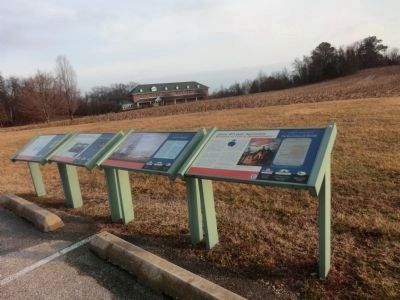
Photographed by Don Morfe, February 10, 2015
3. Land Battle Evidence Marker is one of the four markers shown above
Photographed by Don Morfe, February 10, 2015
4. Sign at the entrance to Jefferson Patterson Park and Museum
Credits. This page was last revised on August 2, 2026. It was originally submitted on February 24, 2015, by Don Morfe of Baltimore, Maryland. This page has been viewed 605 times since then and 20 times this year. Photos: 1. submitted on February 24, 2015, by Don Morfe of Baltimore, Maryland. 2. submitted on August 2, 2026, by Devry Becker Jones of Washington, District of Columbia. 3, 4. submitted on February 24, 2015, by Don Morfe of Baltimore, Maryland. • Bill Pfingsten was the editor who published this page.
