Montross in Westmoreland County, Virginia — The American South (Mid-Atlantic)
Dividends for the Future
Civilian Conservation Corps 1933-1942
| — | Westmoreland State Park | — |

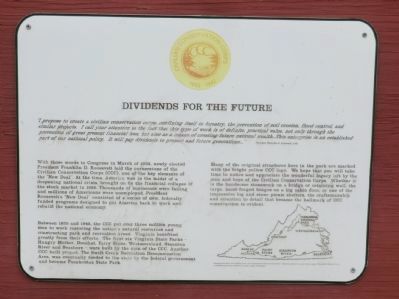
“I propose to create a civilian conservation corps…confining itself to forestry, the prevention of soil erosion, flood control, and similar projects. I call your attention to the fact that this type of work is of definite, practical value, not only through the prevention of great present financial loss, but also as a means of creating future national wealth…This enterprise is an established part of our national policy. It will pay dividends to present and future generations…” President Franklin D. Roosevelt, 1933
With these words to Congress in March of 1933, newly elected President Franklin D. Roosevelt laid the cornerstone of the Civilian Conservation Corps (CCC), one of the key elements of the “New Deal”. At the time, America was in the midst of a deepening national crisis, brought on by the financial collapse of the stock market in 1929. Thousands of business was failing and millions of Americans were unemployed. President Roosevelt’s “New Deal” consisted of a series of new, federally funded programs designed to put America back to work and rebuild the national economy.
Between 1933 and 1942, the CCC put over
this page online
Many of the original structures here in the park are marked with the bright yellow CCC logo. We hope that you will take time to notice and appreciate the wonderful legacy left by the men and boys of the Civilian Conservation Corps. Whether it is the handsome stonework on a bridge or retaining wall, the large, hand-forged hinges on a log cabin door, or one of the impressive log and stone picnic shelters, the craftsmanship and attention to detail that became the hallmark of CCC construction is evident.
Topics and series. This historical marker is listed in these topic lists: Charity & Public Work • Parks & Recreational Areas. In addition, it is included
Photographed by Don Morfe, February 12, 2015
2. Dividends for the Future Marker
This is a photo of the marker from before it was moved and before it faded.
Location. 38° 9.723′ N, 76° 52.112′ W. Marker is in Montross, Virginia, in Westmoreland County. It can be reached from State Park Road (Virginia Route 347) half a mile north of Route 686. Located at the riverside picnic area in Westmoreland State Park. Touch for map. Marker is at or near this postal address: 1650 State Park Road, Montross VA 22520, United States of America. Touch for directions.

Regionally, this marker is on the Northern Neck. It is also in the American South, specifically in the Upper South, in the Tidewater, in the Chesapeake Bay Region, and on the Eastern Seaboard. Globally, it is in the North Atlantic Region, North America, the Western Hemisphere, the Western World, and the Anglosphere. Historically, it finds itself in what was once the territory of the Mississippian Culture, one of the original Thirteen Colonies, one of the Confederate States of America, and the Antebellum South.
Other nearby markers. At least 8 other markers are within

Also see . . . Westmoreland State Park. Virginia Department of Conservation & Recreation (Submitted on March 5, 2015.)
Photographed by Don Morfe, February 12, 2015
4. Dividends for the Future Marker
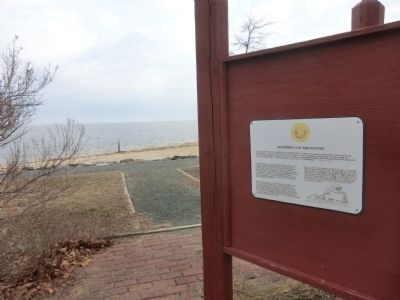
This is a photo of the marker in its prior environs.
Photographed by Don Morfe, February 12, 2015
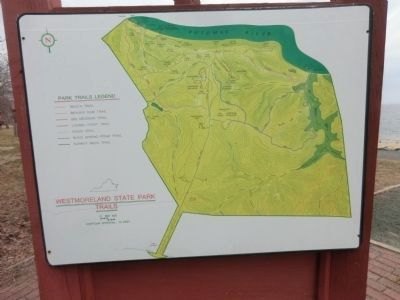
5. Map on the reverse side of the Dividends for the Future Marker
Photographed by Don Morfe, February 12, 2015
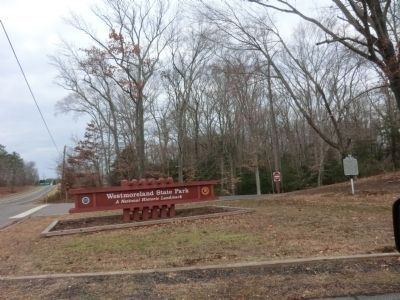
6. Sign at the entrance to Westmoreland State Park-A National Historic Landmark
Credits. This page was last revised on August 30, 2026. It was originally submitted on March 4, 2015, by Don Morfe of Baltimore, Maryland. This page has been viewed 417 times since then and 25 times this year. Photos: 1. submitted on August 30, 2026, by Devry Becker Jones of Washington, District of Columbia. 2. submitted on March 4, 2015, by Don Morfe of Baltimore, Maryland. 3. submitted on August 30, 2026, by Devry Becker Jones of Washington, District of Columbia. 4, 5, 6. submitted on March 4, 2015, by Don Morfe of Baltimore, Maryland. • Bernard Fisher was the editor who published this page.
