Downtown in Buffalo in Erie County, New York — The American Northeast (Mid-Atlantic)
Michigan Street Baptist Church
Underground Railroad Heritage Trail
Photographed by Anton Schwarzmueller, February 28, 2015
1. Michigan Street Baptist Church Marker
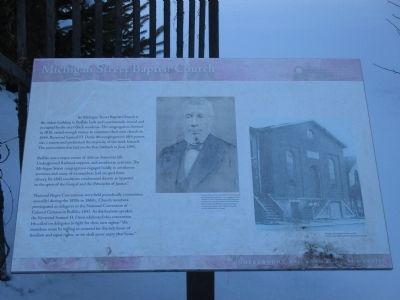
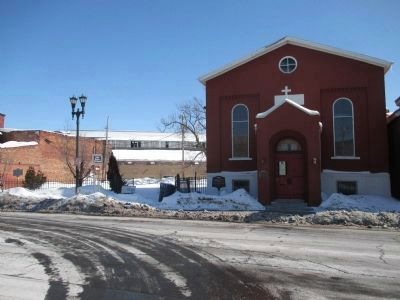
The Michigan Street Baptist Church is the oldest building in Buffalo built and continuously owned and occupied by the city's black residents. The congregation, formed in 1836, raised enough maney to construct their own church in 1844. Reverend Samuel H. Davis, the Congregation's fifth pastor, was a mason and performed the majority of the work himself. The cornerstone was laid on the first Sabbath in June 1845.
Buffalo was a major center of African American life, Underground Railroad support, and antislavery activism. The Michigan Street congregation engaged boldly in antislavery activities and many of its members had escaped from slavery. Its 1842 resolution condemned slavery as "opposed to the spirit of the Gospel and Principles of Justice."
National Negro Conventions were held periodically (sometimes annually) during the 1830s to 1860s. Church members participated as delegates to the National Convention of Colored Citizens in Buffalo, 1843. As keynote speaker, The Reverend Samuel H. Davis addressed this convention. He called on delegates to fight for their own rights: "We ourselves, must be willing to contend for the
this page online
Reverend Samuel H. Davis (1810-1907) both built the church and ministered to the congregation. Rev. Samuel H. Davis is buried in the British American Institute Cemetery, part of the Uncle Tom's Cabin Historic Site near Dresden, Ontario, Canada. Courtesy of descendants Mr. William Richardson and Ms. Martha Susan Prescod.
Michigan Street Baptist Church, ca. 1900. Courtesy of the Buffalo and Erie County Historical Society.
Topics. This historical marker is listed in these topic lists: Abolition & Underground RR • African Americans • Religion & Religious Structures. A significant historical month for this entry is June 1845.
Location. 42° 53.18′ N, 78° 52.047′ W. Marker is in Buffalo, New York, in Erie County. It is in Downtown. It is on Michigan Avenue south of Broadway, on the right when traveling north. Touch for map. Marker is at or near this postal address: 511 Michigan Avenue, Buffalo NY 14203, United States of America. Touch for directions.

Regionally, this marker is in Upstate New York and specifically in Western New York. It is also in the American
Photographed by Anton Schwarzmueller, February 28, 2015
2. Michigan Street Baptist Church and Marker
Marker by the tall evergreen bush.
Other nearby markers. At least 8 other markers are within walking distance of this marker: A different marker also named Michigan Street Baptist Church (here, next to this marker); Michigan Avenue Baptist Church (a few steps from this marker); Mary B. Talbert (a few steps from this marker); Colored Musicians Club (within shouting distance of this marker); A Melting Pot (within shouting distance of this marker); Little Harlem Hotel (within shouting distance of this marker); Moving North (within shouting distance of this marker); The Nash House (about 300 feet away, measured in a direct line). Touch for a list and map of all markers in Buffalo.
More about this marker. Michigan "Avenue" and Michigan "Street" are interchangeable, but "Avenue" seems to predominate. More markers on a path from here to the Nash House, but deep snow blocked and covered the path.
Also see . . . (1843) Samuel H. Davis, “We Must Assert Our Rightful Claims and Plead Our Own Cause”. BlackPast website entry (Submitted on March 7, 2015, by Anton Schwarzmueller of Wilson, New York.)
Credits. This page was last revised on April 11, 2025. It was originally submitted on March 7, 2015, by Anton Schwarzmueller of Wilson, New York. This page has been viewed 571 times since then and 35 times this year. Photos: 1, 2. submitted on March 7, 2015, by Anton Schwarzmueller of Wilson, New York.
