Southwark in Philadelphia in Philadelphia County, Pennsylvania — The American Northeast (Mid-Atlantic)
Stephen Decatur
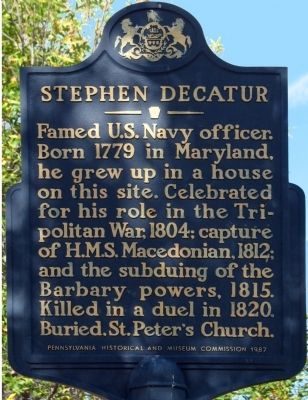
Photographed by Allen C. Browne, October 12, 2007
1. Stephen Decatur Marker
Erected 1987 by Pennsylvania Historical and Museum Commission.
Topics and series. This historical marker is listed in these topic lists: War of 1812 • Waterways & Vessels. In addition, it is included in the Pennsylvania Historical and Museum Commission (PHMC) series list. A significant historical year for this entry is 1779.
Location. 39° 56.449′ N, 75° 8.634′ W. Marker is in Philadelphia, Pennsylvania, in Philadelphia County. It is in Southwark. It is at the intersection of South Front Street and South Street when traveling south on South Front Street. Touch for map. Marker is at or near this postal address: 602 S Front St, Philadelphia PA 19147, United States of America. Touch for directions.

Regionally, this marker is in Southeast Pennsylvania. It is also in the American Northeast and in the Mid-Atlantic. Globally, it is in North America,
this page online
Other nearby markers. At least 8 other markers are within walking distance of this marker: Mason-Dixon Survey (a few steps from this marker); Exiles for Conscience Sake (about 400 feet away, measured in a direct line); Robert Smith (about 600 feet away); Queen Village / The New Market and Head House (about 700 feet away); "Associators" (approx. 0.2 miles away); U.S.S. United States (approx. 0.2 miles away); Society Hill / The New Market and Head House (approx. 0.2 miles away); Morris Rosenbaum (approx. 0.2 miles away). Touch for a list and map of all markers in Philadelphia.
Related marker. Click here for another marker that is related to this marker. This is the profile for Decatur's memorial in the graveyard at St. Peter's Church.
Also see . . . Stephen Decatur. Wikipedia (Submitted on March 9, 2015, by Allen C. Browne of Silver Spring, Maryland.)
Additional keywords. Tripolitan War
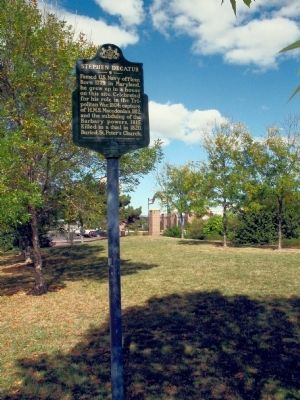
Photographed by Allen C. Browne, October 12, 2007
2. Stephen Decatur Marker
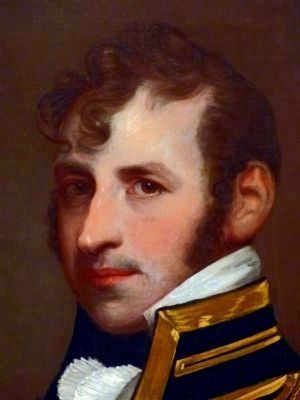
Photographed by Allen C. Browne, February 16, 2015
3. Stephen Decatur, Jr.
Charles Bird King's 1820 copy of Gilbert Stuart's portrait of Decatur hangs in the National Portrait Gallery:
“Stephen Decatur first rose to fame in 1804 during the war with the Barbary pirates, when he commanded the daring party that boarded and burned the captured frigate Philadelphia while it lay anchored under the citadel at Tripoli in North Africa. During the War of 1812, he was awarded a congressional gold medal for ‘gallantry, good conduct, and service.’ Sent back to the Mediterranean in 1815, Decatur intimidated the Dey of Algeria into signing a treaty that ended demands for tribute and brought the Barbary Wars to a final close. Feted upon his return, Decatur offered the toast: ‘Our country! In her intercourse with foreign nations may she always be in the right; but our country, right or wrong.’ Mortally wounded in a duel, Decatur died with a sigh ’that it was not in his country's cause.’” — National Portrait Gallery, NPG.87.26
“Stephen Decatur first rose to fame in 1804 during the war with the Barbary pirates, when he commanded the daring party that boarded and burned the captured frigate Philadelphia while it lay anchored under the citadel at Tripoli in North Africa. During the War of 1812, he was awarded a congressional gold medal for ‘gallantry, good conduct, and service.’ Sent back to the Mediterranean in 1815, Decatur intimidated the Dey of Algeria into signing a treaty that ended demands for tribute and brought the Barbary Wars to a final close. Feted upon his return, Decatur offered the toast: ‘Our country! In her intercourse with foreign nations may she always be in the right; but our country, right or wrong.’ Mortally wounded in a duel, Decatur died with a sigh ’that it was not in his country's cause.’” — National Portrait Gallery, NPG.87.26
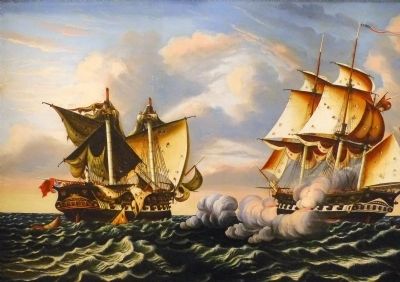
Photographed by Allen C. Browne, February 16, 2015
4. Capture of the H.B.M. Frigate Macedonian
by the U.S. Frigate United States, October 25, 1812
by the U.S. Frigate United States, October 25, 1812
Photographed by Wikipedia
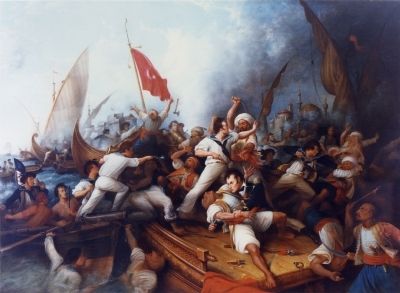
5. Decatur Boarding the Tripolitan Gunboat
Painting by Dennis Malone Carter. “Oil painting of Decatur Boarding the Tripolitan Gunboat during the bombardment of Tripoli, 3 August 1804. Lieutenant Stephen Decatur (lower right center) in mortal combat with the Tripolitan Captain.”
Credits. This page was last revised on April 20, 2024. It was originally submitted on March 9, 2015, by Allen C. Browne of Silver Spring, Maryland. This page has been viewed 950 times since then and 22 times this year. Photos: 1, 2, 3, 4, 5. submitted on March 9, 2015, by Allen C. Browne of Silver Spring, Maryland. • Bill Pfingsten was the editor who published this page.
