Hermitage in Davidson County, Tennessee — The American South (East South Central)
A home for Jackson’s Slaves
1821-1865
Photographed by Sandra Hughes, September 25, 2010
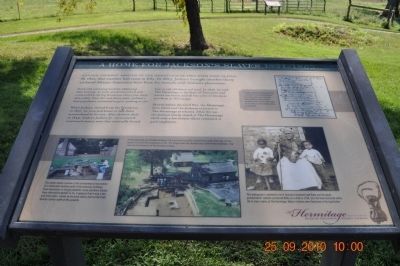
1. A home for Jackson’s Slaves 1821-1865 Marker
Faced with pressing need for additional slave housing, he built several new cabins and converted his long farmhouse into a one-story slave cabin. Over the next thirty years, Jackson’s slave population continued to grow, peaking at 150.
When Jackson retired from the Presidency in 1837, he returned home to face debts accumulated by his son. After Jackson died in 1845, Andrew Jackson Jr. encountered continued money woes that eventually forced him to sell off slaves and land. In 1856, he sold The Hermitage to the State of Tennessee and moved his family and all but a few of his slaves to a farm in Mississippi.
Shortly before the Civil War, the Mississippi farm failed and the Jacksons returned to The Hermitage as tenants. After the war, the Jackson family stayed at The Hermitage while only a few former slaves remained as paid employees.
Erected by The Hermitage.
Topics and series. This historical
this page online
Location. 36° 13.013′ N, 86° 36.663′ W. Marker is in Hermitage, Tennessee, in Davidson County. It can be reached from Rachel's Lane. Located on the Hermitage Historical Site. Touch for map. Marker is in this post office area: Hermitage TN 37076, United States of America. Touch for directions.

Regionally, this marker is in Middle Tennessee and in Greater Nashville. It is also in the American South and specifically in the Upper South. Globally, it is in North America, the Western Hemisphere, the Western World, and the Anglosphere. Historically, it finds itself in what was once the territory of the Mississippian Culture, one of the Confederate States of America, and the Antebellum South.
Other nearby markers. At least 8 other markers are within walking distance of this marker: Abandonment and Preservation (a few steps from this marker); The Hermitage Landscape (a few steps from this
Photographed by Sandra Hughes, September 25, 2010
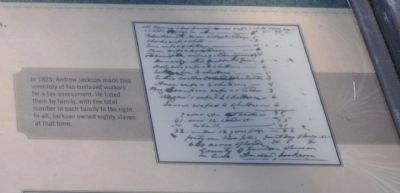
2. Jackson's Inventory
In 1825, Andrew Jackson made this inventory of his enslaved workers for a tax assessment. He listed them by family, with the total number in each family to the right. In all, Jackson has owned eighty slaves at that time.
Photographed by Sandra Hughes, September 25, 2010
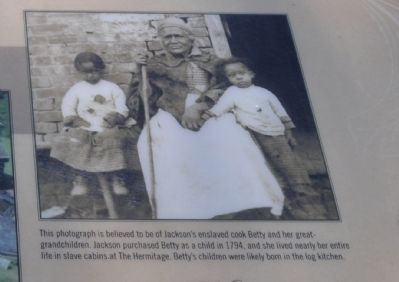
3. Jackson’s enslaved cook, Betty, and her great-grandchildren.
This photograph is believed to be Jackson’s enslaved cook, Betty, and her great-grandchildren. Jackson purchased Betty as a child in 1794, and she lived nearly her entire life in slave cabins at The Hermitage. Betty’s children were likely born in the log kitchen.
Photographed by Sandra Hughes, September 25, 2010
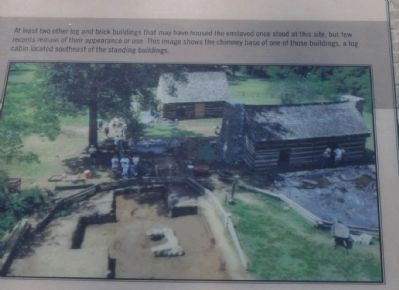
4. Enslave buildings
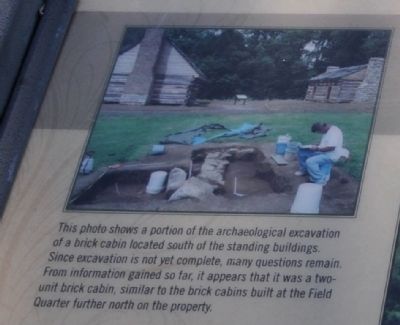
At least two other log and brick buildings that may have housed the enslaved once stood at this site, but few records remain of their appearance or use. This image shows the chimney base of one of those buildings, a log cabin located southeast of the standing buildings.
Photographed by Sandra Hughes, September 25, 2010
5. A home for Jackson’s Slaves 1821-1865
This photograph is believed to be Jackson’s enslaved cook, Betty, and her great-grandchildren. Jackson purchased Betty as a child in 1794, and she lived nearly her entire life in slave cabins at The Hermitage. Betty’s children were likely born in the log kitchen.
Photographed by J. Makali Bruton, June 14, 2015
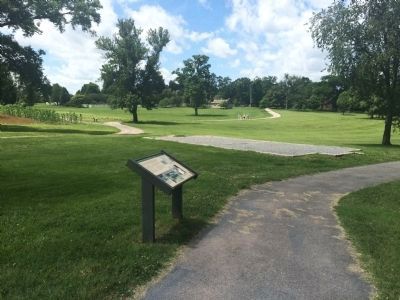
6. Wide view of A Home for Jackson’s Slaves Marker
Credits. This page was last revised on February 7, 2023. It was originally submitted on February 10, 2012, by Sandra Hughes Tidwell of Killen, Alabama, USA. This page has been viewed 1,029 times since then and 47 times this year. Last updated on March 13, 2015, by J. Makali Bruton of Washington, District of Columbia. Photos: 1, 2, 3, 4, 5. submitted on February 10, 2012, by Sandra Hughes Tidwell of Killen, Alabama, USA. 6. submitted on July 12, 2015, by J. Makali Bruton of Washington, District of Columbia. • Bill Pfingsten was the editor who published this page.
