Hermitage in Davidson County, Tennessee — The American South (East South Central)
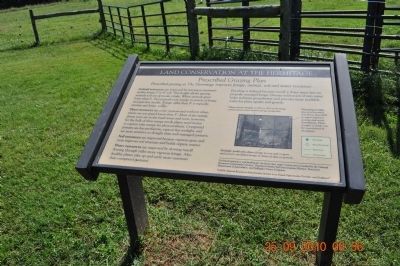
Land Conservation at The Hermitage
Prescribed Grazing Plan
Photographed by Sandra Hughes, September 25, 2010
1. Land Conservation at The Hermitage Marker
Animal resources are improved by striving to maintain quality forge 3” to 8” tall. This height allows graze animals to have optimum intake. When animal graze lower than 3” they expend more energy in search of forage and gain less weight. Forage taller than 8” is typically stemmy and lower quality.
Plant resources are more vigorous and resilient when plants are not grazed lower than 3”. Most of the energy plants store are in the basal stems and roots, however, for the bulk of their energy needs plants need leaves to capture solar energy for photosynthesis. Overgrazed pastures are less productive, capture less sunlight, and are more sensitive to drought than well-managed pastures.
Soil resources are improved because vigorous grass and roots improve soil structure and builds organic matter.
Water resources are improved by slowing runoff flowing through taller more vigorous forage. Also, healthy plants take up and cycle more nutrients than overgrazed pastures.
Flooding is reduced because runoff
this page online
Erected by The Hermitage.
Topics. This historical marker is listed in this topic list: Agriculture.
Location. 36° 13.001′ N, 86° 36.657′ W. Marker is in Hermitage, Tennessee, in Davidson County. It can be reached from Rachel's Lane. Located at the Hermitage historical site. Touch for map. Marker is in this post office area: Hermitage TN 37076, United States of America. Touch for directions.

Regionally, this marker is in Middle Tennessee and in Greater Nashville. It is also in the American South and specifically in the Upper South. Globally, it is in North America, the Western Hemisphere, the Western World, and the Anglosphere. Historically, it finds itself in what was once the territory of the Mississippian Culture, one of the Confederate States of America, and the Antebellum South.
Other nearby markers. At least 8 other markers are within walking distance of this marker: A home for Jackson’s Slaves
Photographed by Sandra Hughes, September 25, 2010
2. Land Conservation at The Hermitage Marker
Photographed by Sandra Hughes, September 25, 2010
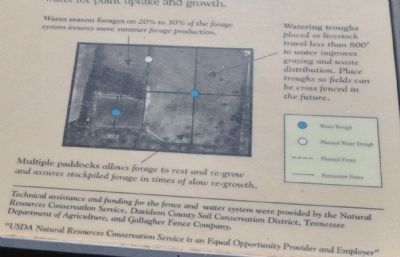
3. Land Conservation at The Hermitage Marker
Warm seasons forage on 20% to 30% of the forage system insures more summer forage production.
Watering troughs placed so livestock travel less than 800’ to water improves grazing and waste distribution. Placed troughs so fields can be cross-fenced in the future.
Multiple paddocks allow forage to rest, re-grow, and assure stockpile forage in times of slow re-growth.
Technical assistance and funding for the fence and water system were provided by the Natural Resources Conservation System, Davidson county Soil conservation District, Tennessee Department of Agriculture, and Gallagher Fence Company.
“USDA Natural Resources Conservation Service is an Equal Opportunity Provider and Employer.”

Photographed by J. Makali Bruton, June 14, 2015
4. Wide view of Land Conservation at The Hermitage Marker
Credits. This page was last revised on February 7, 2023. It was originally submitted on February 10, 2012, by Sandra Hughes Tidwell of Killen, Alabama, USA. This page has been viewed 641 times since then and 18 times this year. Last updated on March 13, 2015, by J. Makali Bruton of Washington, District of Columbia. Photos: 1, 2, 3. submitted on February 10, 2012, by Sandra Hughes Tidwell of Killen, Alabama, USA. 4. submitted on July 12, 2015, by J. Makali Bruton of Washington, District of Columbia. • Bill Pfingsten was the editor who published this page.
