Panama City in Bay County, Florida — The American South (South Atlantic)
The St. Andrew Bay Saltworks
Photographed by Craig Swain, May 29, 2008
1. The St. Andrew Bay Saltworks Marker
Inscription.
The St. Andrew Bay Saltworks. . Between 1861 and 1865, the St. Andrew Bay Saltworks, one of the largest producers of salt in the South, contributed to the Confederate cause by providing salt, fish, and cattle for southern troops and citizens. A necessary preservative in those times, salt sold for as much as $50 per bushel, and was produced in wood-fired saltworks on the perimeter of the West Bay, East Bay and North Bay and Lake Powell (a.k.a. Lake Ocala). An estimated 2,500 men, primarily from Florida, Georgia, and Alabama, were exempted from combat duty in order to labor in the saltworks. The salt was transported to Eufaula, Alabama, then to Montgomery, for distribution throughout the Confederate states. Because of the importance of St. Andrew Bay Saltworks to the Confederacy, acting Master W. R. Browne, commander of the U.S. Restless, was instructed to commence a series of assaults beginning in August 1862. In December 1863, additional Union attacks occurred, which Confederate home guards could not resist. The attacks resulted in the destruction of more than 290 salt works, valued by Master Browne at more than $3,000,000. The St. Andrew Bay Saltwork employees promptly rebuilt them, and they remained in operation through February 1865.,
A Florida Heritage Site.
Between 1861 and 1865, the St. Andrew Bay Saltworks, one of the largest producers of salt in the South, contributed to the Confederate cause by providing salt, fish, and cattle for southern troops and citizens. A necessary preservative in those times, salt sold for as much as $50 per bushel, and was produced in wood-fired saltworks on the perimeter of the West Bay, East Bay and North Bay and Lake Powell (a.k.a. Lake Ocala). An estimated 2,500 men, primarily from Florida, Georgia, and Alabama, were exempted from combat duty in order to labor in the saltworks. The salt was transported to Eufaula, Alabama, then to Montgomery, for distribution throughout the Confederate states. Because of the importance of St. Andrew Bay Saltworks to the Confederacy, acting Master W. R. Browne, commander of the U.S. Restless, was instructed to commence a series of assaults beginning in August 1862. In December 1863, additional Union attacks occurred, which Confederate home guards could not resist. The attacks resulted in the destruction of more than 290 salt works, valued by Master Browne at more than $3,000,000. The St. Andrew Bay Saltwork
Click or scan to see this page online
employees promptly rebuilt them, and they remained in operation through February 1865.
A Florida Heritage Site
Erected 2003 by the Sons of Confederate Veterans, Camp 1319 and the Florida Department of State. (Marker Number F-477.)
Location. 30° 9.82′ N, 85° 40.965′ W. Marker is in Panama City, Florida, in Bay County. It is at the intersection of West Beach Drive (Business U.S. 98) and East Caroline Boulevard, on the right when traveling south on West Beach Drive. Located in James R. Asbell Park near Lake Caroline. Touch for map. Marker is in this post office area: Panama City FL 32401, United States of America. Touch for directions.
Regionally, this marker is on the Florida Panhandle. It is also in the American South, specifically in the Deep South, and on the Gulf Coast. Globally, it is in the North Atlantic Region, North America, a Gulf of Mexico state, the Western Hemisphere,
Photographed by Craig Swain, May 29, 2008
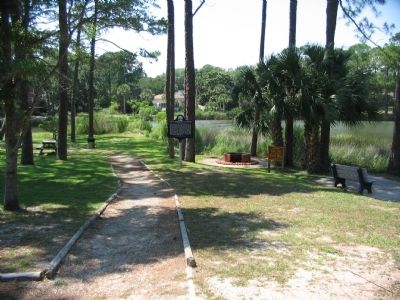
2. James R. Asbell Park
the Western World, and the Anglosphere. Historically, it finds itself in what was once New Spain, the territory of the Mississippian Culture, one of the Confederate States of America, and the Antebellum South.
Other markers no longer nearby. St. Andrews Bay Skirmish (was approx. ¼ mile away but has been replaced with another marker now near it); St. Andrew Skirmish (was approx. 0.3 miles away but has been confirmed missing).
Also see . . . Florida's Role in the Civil War. Alluded to in the marker text, Florida's major contribution to the Confederacy was supplies such as salt and
Photographed by Craig Swain, May 29, 2008
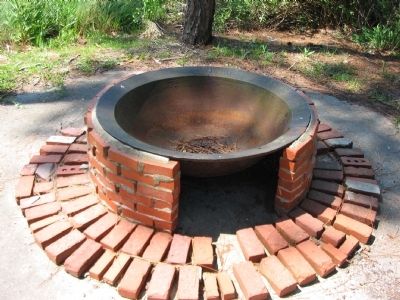
3. Salt Kettle
An original salt kettle used to produce salt from seawater. Fires were stoked under the kettle, and as the water boiled off, salt was left behind.
foodstuffs. (Submitted on June 5, 2008, by Craig Swain of Leesburg, Virginia.)
Credits. This page was last revised on May 16, 2025. It was originally submitted on June 5, 2008, by Craig Swain of Leesburg, Virginia. This page has been viewed 6,692 times since then and 213 times this year. Photos:1, 2, 3. submitted on June 5, 2008, by Craig Swain of Leesburg, Virginia.
Editor’s want-list for this marker. Photo of marker in moved location close to US-98. • Can you help?