Mosheim in Greene County, Tennessee — The American South (East South Central)
Pottertown Bridge Burners
Unionists Pay the Ultimate Price
Photographed by Don Morfe, July 30, 2013
1. Pottertown Bridge Burners Marker
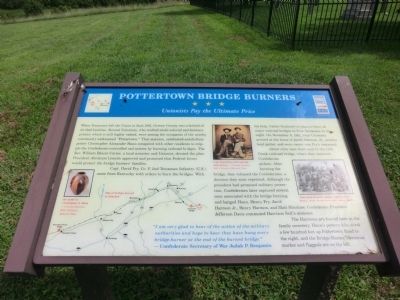
Capt. David Fry, Co. F, 2nd Tennessee Infantry (U.S.) came from Kentucky with orders to burn the bridges. With his help, Carter finalized the plan to burn all major railroad bridges in East Tennessee in one night. On November 8, 1861, local Unionists arrived at the home of Jacob Harmon, Jr, another local potter, and were sworn into Fry’s command.
About sixty men then went to the Lick Creek railroad bridge, where they captured Confederate pickets. After burning the bridge, they released the
this page online
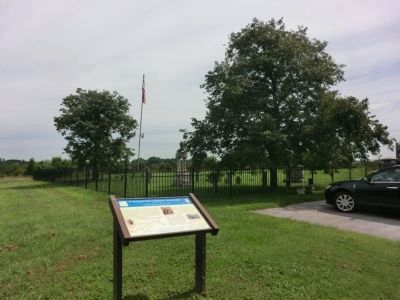
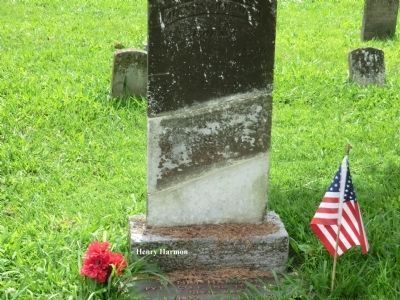
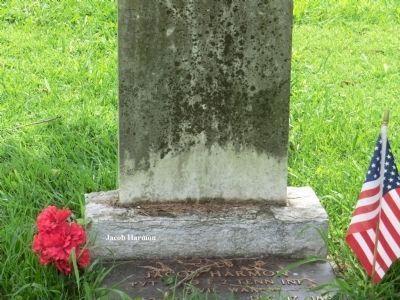
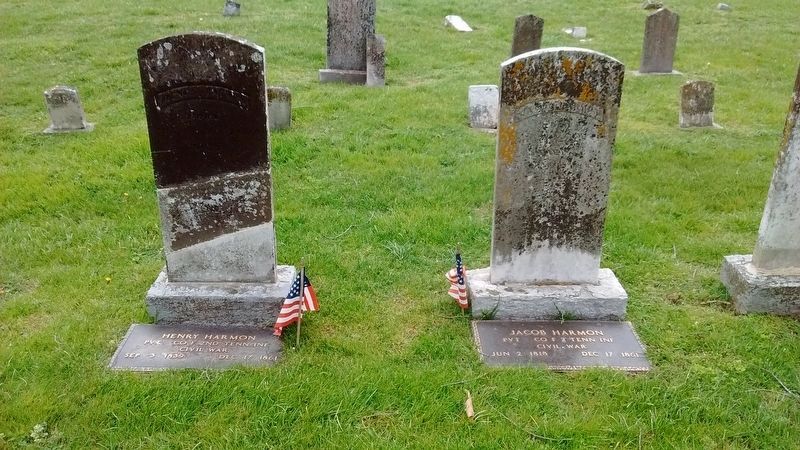
The Harmons are buried here in the family cemetery. Haun’s pottery kiln stood a few hundred feet up Pottertown Road to the right, and the Bridge-Burner Memorial marker and flagpole are on the left.
“I am very glad to hear of the action of the military authorities and hope to hear they have hung every bridge-burner at the end of the burned bridge.” —Confederated Secretary of War Judah P. Benjamin
(captions)
Jar made by Christopher A. Haun —Courtesy Donahue Bible Collection, Mohawk, Tenn.
Capt. David Fry (left) and Sgt. John McCoy —Courtesy Donahue Bible Collection, Mohawk, Tenn.
“Execution of Jacob Harmon and His Son, Henry,” from Parson Brownlow’s Book (1862)
Erected by Tennessee Civil War Trails.
Topics and series. This historical marker is listed
Photographed by Don Morfe, July 30, 2013
2. Pottertown Bridge Burners Marker
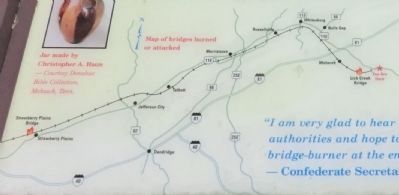
Close up of the map in the lower left side of the marker
Location. 36° 12.033′ N, 83° 0.826′ W. Marker is in Mosheim, Tennessee, in Greene County. It can be reached from the intersection of Pottertown Road and Gravel Woods Road, on the left when traveling east. Touch for map. Marker is at or near this postal address: 1270 Pottertown Road, Midway TN 37809, United States of America. Touch for directions.

Regionally, this marker is in East Tennessee. It is also in the American South, specifically in the Upper South, in Appalachia, and specifically in Southern Appalachia. Globally, it is in North America, the Western Hemisphere, the Western World, and the Anglosphere. Historically, it finds itself in what was once the original Cherokee Nation, the territory of the Mississippian Culture, one of the Confederate States of America, the State of Franklin, and the Antebellum South.
Other nearby markers. At least 8 other markers are within 6 miles of this marker, measured as the crow flies: Bridge Burners Monument (about 300 feet
Photographed by Don Morfe, July 30, 2013
3. Pottertown Bridge Burners Marker
Distant photo showing the Harmon Family Cemetery in the background
Another marker is no longer nearby. Battles of Blue Springs (was approx. 4½ miles away but has been permanently removed).
Also see . . . Rivers and Rails-Remembering the Pottertown Bridge Burners (video). (Submitted on November 20, 2016, by Tom Bosse of Jefferson City, Tennessee.)
Photographed by Tom Bosse, April 1, 2017
4. Pottertown Bridge Burners Marker
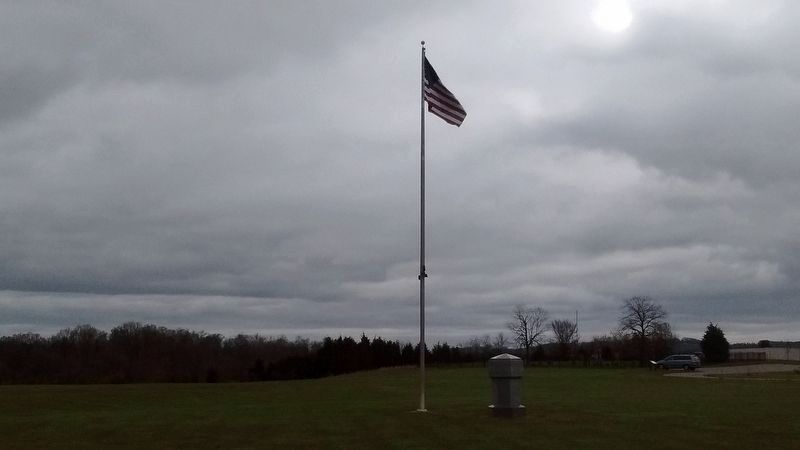
Bridge Burners Monument in Foreground.
Photographed by Don Morfe, July 30, 2013
5. Pottertown Bridge Burners Marker
Grave marker of Henry Harmon, buried in the Harmon Family Cemetery. He is mentioned in the text of the marker
Photographed by Don Morfe, July 30, 2013
6. Pottertown Bridge Burners Marker
Grave marker of Jacob Harmon buried in the Harmon Family Cemetery. He is mentioned in the text of the marker
Photographed by Tom Bosse, April 1, 2017
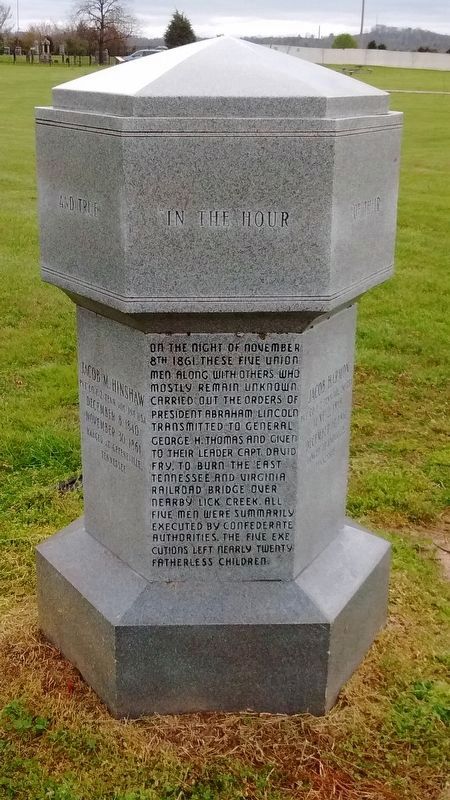
7. Pottertown Bridge Burners Monument
"In the hour of their country's peril, they were loyal and true."
On the night of November 8th 1861, these five Union men along with others, who mostly remain unknown, carried out the orders of President Abraham Lincoln transmitted to general George H. Thomas and given to their leader Capt. David Fry, to burn the East Tennessee and Virginia Railroad bridge over nearby Lick Creek. All five men were summarily executed by Confederate authorities. The five executions left nearly twenty fatherless children.
Photographed by Tom Bosse, April 1, 2017
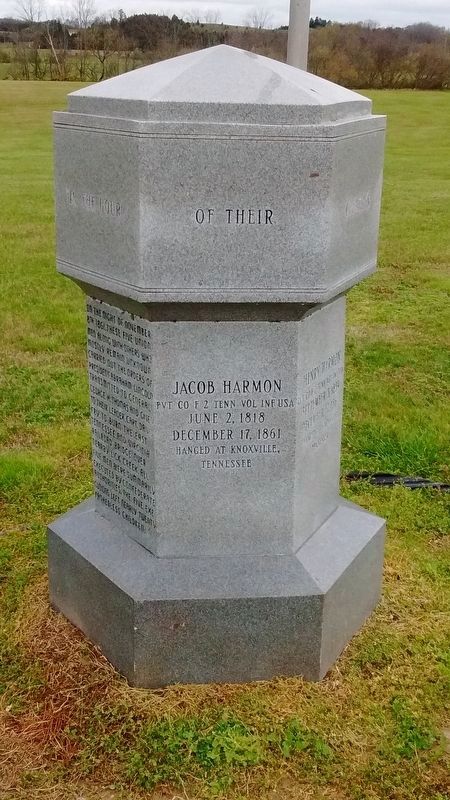
8. Pottertown Bridge Burners Monument
"In the hour of their country's peril, they were loyal and true."
Jacob Harmon
Pvt Co F 2 Tenn Vol Inf USA
June 2, 1818
December 17, 1861
Hanged at Knoxville, Tennessee
Photographed by Tom Bosse, April 1, 2017
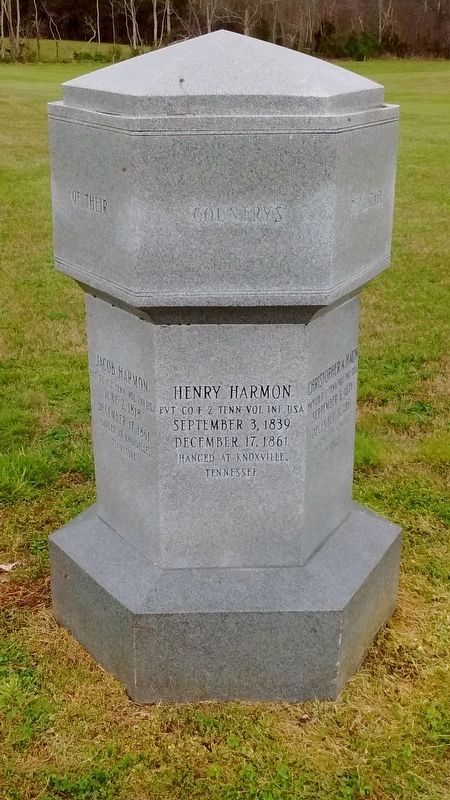
9. Pottertown Bridge Burners Monument
"In the hour of their country's peril, they were loyal and true."
Henry Harmon
Pvt Co F 2 Tenn Vol Inf USA
September 3, 1839
December 17, 1861
Hanged at Knoxville, Tennessee
Photographed by Tom Bosse, April 1, 2017
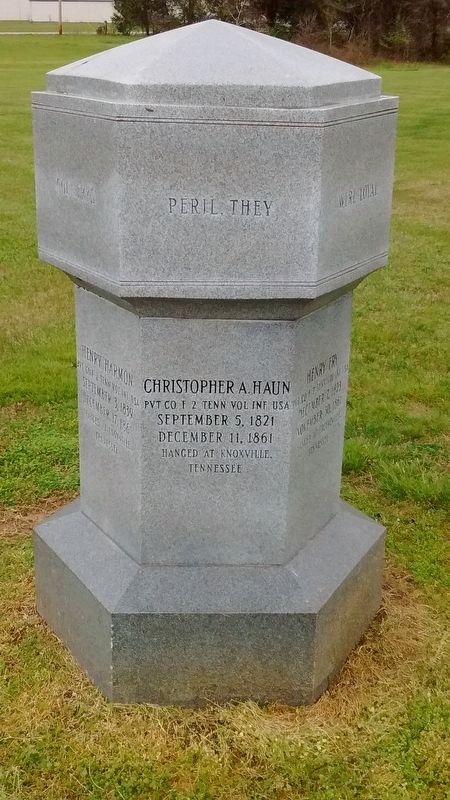
10. Pottertown Bridge Burners Monument
"In the hour of their country's peril, they were loyal and true."
Christopher A. Haun
Pvt Co F 2 Tenn Vol Inf USA
September 5, 1821
December 11, 1861
Hanged at Knoxville, Tennessee
Photographed by Tom Bosse, April 1, 2017
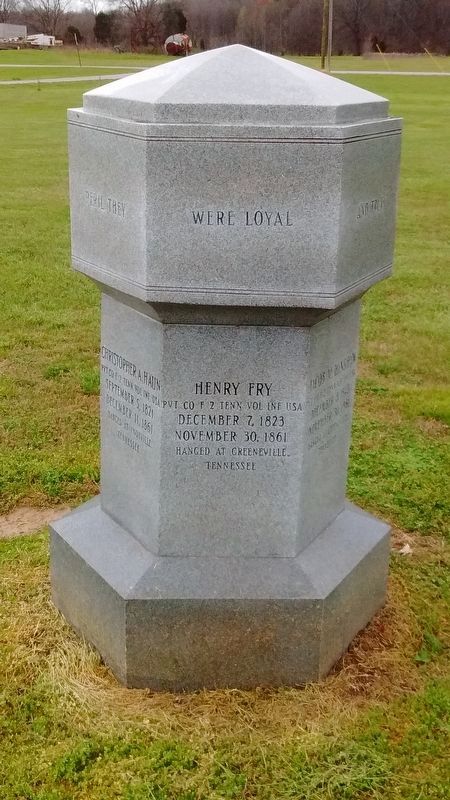
11. Pottertown Bridge Burners Monument
"In the hour of their country's peril, they were loyal and true."
Henry Fry
Pvt Co F 2 Tenn Vol Inf USA
December 7, 1823
November 30, 1861
Hanged at Greeneville, Tennessee
Photographed by Tom Bosse, April 1, 2017
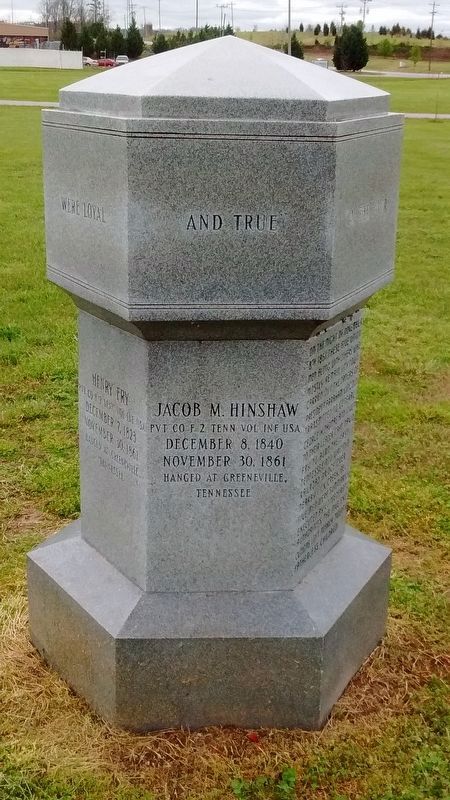
12. Pottertown Bridge Burners Monument
"In the hour of their country's peril, they were loyal and true."
Jacob M. Hinshaw
Pvt Co F 2 Tenn Vol Inf USA
December 8, 1840
November 30, 1861
Hanged at Greeneville, Tennessee
Photographed by Tom Bosse, April 1, 2017
13. Graves of Henry Harmon and Jacob Harmon
Credits. This page was last revised on July 19, 2017. It was originally submitted on October 21, 2013, by Don Morfe of Baltimore, Maryland. This page has been viewed 3,549 times since then and 265 times this year. Last updated on March 17, 2015, by J. Makali Bruton of Washington, District of Columbia. Photos: 1, 2, 3. submitted on October 21, 2013, by Don Morfe of Baltimore, Maryland. 4. submitted on April 1, 2017, by Tom Bosse of Jefferson City, Tennessee. 5, 6. submitted on October 21, 2013, by Don Morfe of Baltimore, Maryland. 7, 8, 9. submitted on July 9, 2017, by Tom Bosse of Jefferson City, Tennessee. 10, 11, 12. submitted on July 13, 2017, by Tom Bosse of Jefferson City, Tennessee. 13. submitted on July 18, 2017, by Tom Bosse of Jefferson City, Tennessee. • Bill Pfingsten was the editor who published this page.
