Washington Square West in Philadelphia in Philadelphia County, Pennsylvania — The American Northeast (Mid-Atlantic)
McClellan House
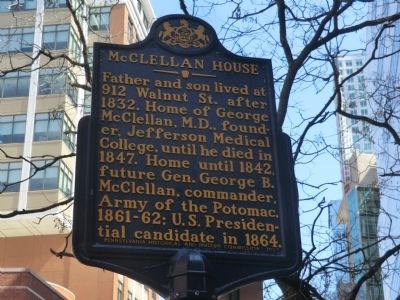
Photographed by Don Morfe, March 23, 2015
1. McClellan House Marker
Erected 1997 by Pennsylvania Historical & Museum Commission.
Topics and series. This historical marker is listed in these topic lists: Government & Politics • War, US Civil. In addition, it is included in the Pennsylvania Historical and Museum Commission (PHMC) series list. A significant historical year for this entry is 1832.
Location. 39° 56.89′ N, 75° 9.391′ W. Marker is in Philadelphia, Pennsylvania, in Philadelphia County. It is in Washington Square West. It is on Walnut Street. The marker is in front of a Wawa Store. Touch for map. Marker is at or near this postal address: 912 Walnut Street, Philadelphia PA 19107, United States of America. Touch for directions.

Regionally, this marker is in Southeast Pennsylvania. It is also in the American Northeast and in the Mid-Atlantic. Globally, it is in North America, the Western Hemisphere,
this page online
Other nearby markers. At least 8 other markers are within walking distance of this marker: Wills Eye Hospital (within shouting distance of this marker); Walnut Street Theatre (within shouting distance of this marker); a different marker also named Walnut Street Theatre (about 300 feet away, measured in a direct line); a different marker also named The Walnut Street Theatre (about 300 feet away); a different marker also named Walnut Street Theatre (about 300 feet away); "Ars Medendi" is an artwork by Jim Sanborn (about 300 feet away); Jefferson Hospital Curtis Clinic (about 400 feet away); Samuel D. Gross (about 500 feet away). Touch for a list and map of all markers in Philadelphia.
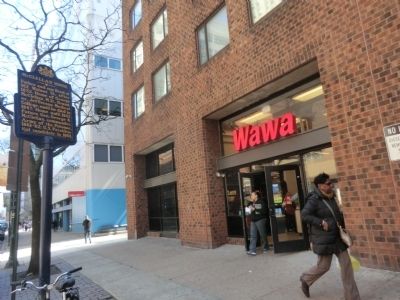
Photographed by Don Morfe, March 23, 2015
2. McClellan House Marker
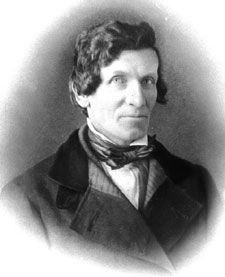
Photographed by Wikipedia
3. George McClellan, MD
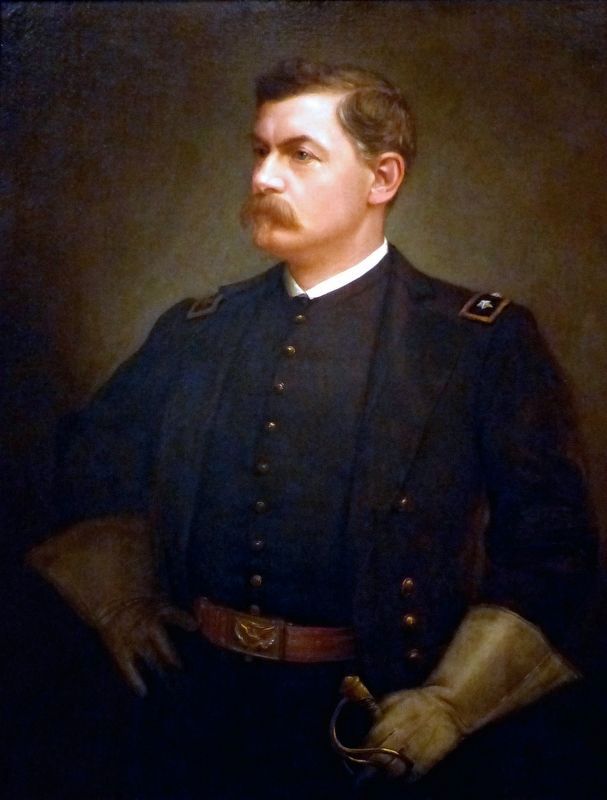
Photographed by Julian Scott, 1888
4. George B. McClellan
This 1888 portrait of George B. McClellan by Julian Scott hangs in the National Portrait Gallery in Washington DC.
“After the Union army's defeat at the First Battle of Manassas on July 21, 1861, President Lincoln appointed thirty-four-year-old General George B. McClellan to command federal operations in Virginia. Within weeks, "little Mac" transformed the remnants of a demoralized volunteer army into a disciplined fighting machine and christened it the Army of the Potomac. But achieving victory required engaging the enemy in battle, and in this McClellan procrastinated, much to Lincoln's exasperation. When he did lead his troops into battle, he was slow to advance and quick to retreat. Finally, after McClellan failed to pursue Robert E. Lee's army following the Union's victory at the Battle of Antietam in September 1862, Lincoln relieved him of his command. McClellan emerged briefly in national politics in 1864 as the Democratic Party's unsuccessful presidential candidate.” — National Portrait Gallery
“After the Union army's defeat at the First Battle of Manassas on July 21, 1861, President Lincoln appointed thirty-four-year-old General George B. McClellan to command federal operations in Virginia. Within weeks, "little Mac" transformed the remnants of a demoralized volunteer army into a disciplined fighting machine and christened it the Army of the Potomac. But achieving victory required engaging the enemy in battle, and in this McClellan procrastinated, much to Lincoln's exasperation. When he did lead his troops into battle, he was slow to advance and quick to retreat. Finally, after McClellan failed to pursue Robert E. Lee's army following the Union's victory at the Battle of Antietam in September 1862, Lincoln relieved him of his command. McClellan emerged briefly in national politics in 1864 as the Democratic Party's unsuccessful presidential candidate.” — National Portrait Gallery
Credits. This page was last revised on February 2, 2023. It was originally submitted on March 27, 2015, by Don Morfe of Baltimore, Maryland. This page has been viewed 2,027 times since then and 91 times this year. Photos: 1, 2. submitted on March 27, 2015, by Don Morfe of Baltimore, Maryland. 3, 4. submitted on January 25, 2019, by Allen C. Browne of Silver Spring, Maryland. • Bill Pfingsten was the editor who published this page.
