Lachine in Montréal, Québec — Central Canada (French-Canadian)
Lachine: Gateway to the Northwest
Lachine: porte des «Pays-d’en-Haut»
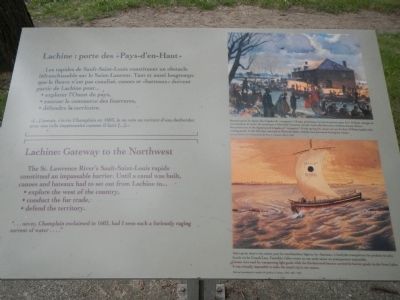
Photographed by Barry Swackhamer, August 5, 2014
1. Lachine: Gateway to the Northwest Marker
Captions (English / French): (top right) Reconstruction of the departure of brigades of “voyageurs:. Every spring the canoes set out for Fort Williams loaded with trading goods. In the fall, they returned to Montréal laden with the furs harvested during the winter. Spring Brigades Leave Montréal for the West. / Reconstitution du départ de «voyageurs». Chaque printemps , les canots partent pour Fort Williams, chargés de marchandises de traite. Ils reviennent à Montréal l’automne suivant, lestés des fourrures récoltées durant l’hiver.; (bottom right) Canoes were used for transporting light goods while the flat-bottomed bateaux carried the heavier goods via the Great Lakes. It was virtually impossible to make the round trip in one season. / Alors qu’on réserve les canots pour les marchandises légères, les «batteaux» à fond plat transportent les produits le plus lourds via les Grand Lacs. Toutefois l’aller-retour en une seule saison est pratiquement impossible. Bateau descendant les rapides de Lachine. P. Kane, 1843
The St. Lawrence River’s Sault-Saint-Louis rapids constitued (sic) an impassable barrier. Until a canal was built, canoes and bateaux had to set out from Lachine to…
• explore the west of the country,
• conduct the fur trade
• defend the territory.
“… never, Champlain exclaimed in 1603, had I seem such a furiously raging torrent of water… “
French:
Les rapides of Sault-Saint-Louis constituent un obstacle infranchissable sur le Saint-Laurent. Tant et aussi longtemps que le fleuve n’est pas canalisé, canots et «batteaux» doivent partier de Lachine pour…
• explore l’Ouest du pays,
• exercer le commerce des fourrures,
• défendre le territoire. «(…) jamais, s’écrie Champlain en 1603, je ne veis un torrent d’eau desborder avec une telle impétuosité comme il fait (…).»
Erected by Parks Canada / Parcs Canada.
Topics. This historical marker is listed in these topic lists: Industry & Commerce • Waterways & Vessels. A significant historical year for this entry is 1603.
Location. 45° 25.902′ N, 73° 40.526′ W. Marker is in Montréal, Québec. It is in Lachine. It is on Boulevard
this page online

Regionally, this marker is in Central Canada. Globally, it is in North America, the Western Hemisphere, and the Western World. Historically, it finds itself in what was once a British colony, the Viceroyalty of New France, the Haudenosaunee (Iroquois) Confederacy, and Rupert’s Land.
Other nearby markers. At least 8 other markers are within walking distance of this marker: The Hudson's Bay Company in Lachine (here, next to this marker); Lachine Massacre (here, next to this marker); Frances Anne Hopkins (a few steps from this marker); Robert Cavelier de la Salle (approx. 0.4 kilometers away); The Lachine Canal (approx. 0.4 kilometers away); A Wonderful New Addition (approx. half a kilometer away); An Upstream Battle (approx. half a kilometer away); Full Steam Ahead (approx. half a kilometer away). Touch for a list and map of all markers in Montréal.
More about this marker. This monument is opposite the Fur Trade
Photographed by Barry Swackhamer, August 5, 2014
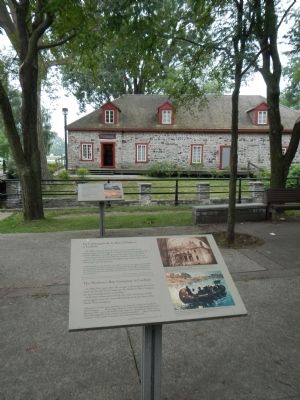
2. Lachine: Gateway to the Northwest Marker
This marker is in the middle ground, closer to the building.
Photographed by Barry Swackhamer, August 5, 2014
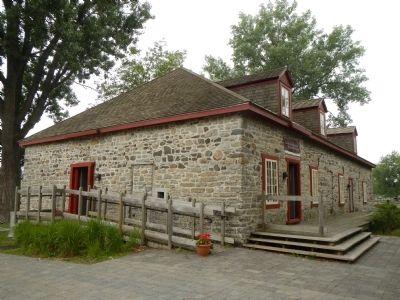
3. The Fur Trade at Lachine Visitors Centre
Photographed by Barry Swackhamer, August 5, 2014
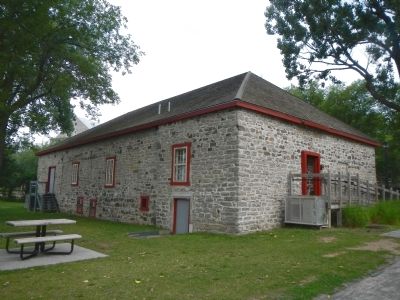
4. The Fur Trade at Lachine Visitors Centre
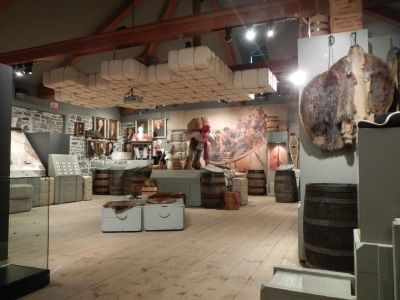
Photographed by Barry Swackhamer, August 5, 2014
5. The Fur Trade at Lachine museum
Credits. This page was last revised on February 9, 2023. It was originally submitted on April 2, 2015, by Barry Swackhamer of Brentwood, California. This page has been viewed 655 times since then and 34 times this year. Photos: 1, 2, 3, 4, 5. submitted on April 2, 2015, by Barry Swackhamer of Brentwood, California. • Andrew Ruppenstein was the editor who published this page.
