Near Picacho in Pinal County, Arizona — The American Mountains (Southwest)
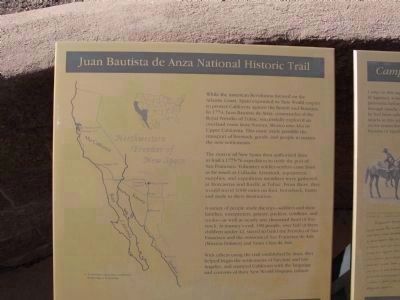
Juan Bautista de Anza National Historic Trail
⎯⎯⎯
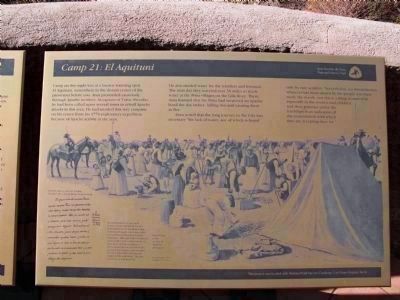
Camp 21: El Aquituni
Photographed by Richard Denney, November 22, 2010
1. Juan Bautista de Anza National Historic Trail Marker
Click to enlarge photo to see "You are here" which shows the location of these two markers.
National Historic Trail
The viceroy of New Spain then authorized Anza to lead a 1775-76 expedition to settle the port of San Francisco. Volunteer soldier-settlers came from as far south as Culiacán. Livestock, equipment, supplies, and expedition members were gathered at Horcasitas and finally at Tubac. From there, they would travel 1000 miles on foot, horseback, burro and mule to their destination.
A variety of people made the trip—soldiers and their families, interpreters, priests, packers, cowboys, and cooks—as well as nearly one thousand head of livestock. At journey’s end, 198 people, over half of them children under 12, stayed to build the Presidio of San Francisco and the
this page online
With others using the trail established by Anza, they helped begin the settlements of San José and Los Angeles, and stamped California with the language and customs of their New World Hispanic customs.
Anza noted that the long journey to the Gila was necessary "for lack of water, any of which is found only by rare accident. Nevertheless, no dissatisfaction whatever
Photographed by Richard Denney, November 22, 2010
2. Camp 21 - El Aquituni Marker
Click on photo to read the October 29th entry in Anza's journal - Camp below Picacho Peak - in Spanish and the English translation.
Erected by The Juan Bautista de Anza Historic National Trail Association and National Parks.
Topics and series. This historical marker is listed in these topic lists: Exploration • Hispanic Americans • Indigenous Peoples and Communities. In addition, it is included in the Juan Bautista de Anza National Historic Trail series list. A significant historical year for this entry is 1774.
Location. 32° 38.847′ N, 111° 25.754′ W. Marker is near Picacho, Arizona, in Pinal County. It is on Picacho Peak Road. Marker is located in the Picacho Peak State Park, off I-10, north of Tucson. Touch for map. Marker is in this post office area: Picacho AZ 85141, United States of America. Touch for directions.

Regionally, this marker is in Arizona’s Sonoran Desert, in the Phoenix Metropolitan Area, in the San Carlos Apache Nation, and specifically in the Tohono O’odham Nation. It is also in
Photographed by Richard Denney
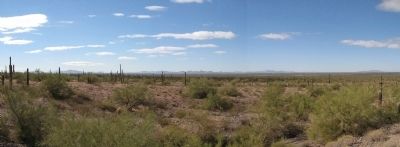
3. Panorama referenced on marker, where Camp 21 was located.
Other nearby markers. At least 4 other markers are within 13 miles of this marker, measured as the crow flies: Memorial to the 1st California Cavalry Volunteers (approx. 1.7 miles away); Mormon Battalion Trail (approx. 1.7 miles away); Red Rock Post Office (approx. 7.3 miles away); Stage Station and Homestead (approx. 12.2 miles away).
Another marker is no longer nearby. Battle at Picacho (was approx. 1.7 miles away but has been confirmed missing).
Also see . . . A KTEH TV Production of the DeAnza Trail on YouTube. In this video the viewer learns the history and purpose of the DeAnza Expedition, the heritage of descendants of expedition members, and current sites along the trail. (Submitted on December 12, 2010.)
Credits. This page was last revised on January 26, 2026. It was originally submitted on December 12, 2010, by Richard Denney of Austin, Texas. This page has been viewed 2,115 times since then and 49 times this year. Last updated on May 5, 2015, by J. Makali Bruton of Washington, District of Columbia. Photos: 1, 2, 3. submitted on December 12, 2010, by Richard Denney of Austin, Texas. • Andrew Ruppenstein was the editor who published this page.
