Waynesboro in Wayne County, Tennessee — The American South (East South Central)
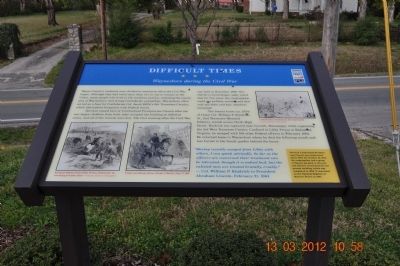
Difficult Times
Waynesboro during the Civil War
Photographed by Sandra Hughes, March 13, 2012
1. Difficult Times Marker
Services ceased here at Cumberland Presbyterian Church after the war began. Soldiers from both sides occupied the building at different times, and all of the records were lost. The first meeting after the Civil War was held in November 1866. The church’s record keeper sadly noted that for five years the congregation could not publicly worship and that only one elder and four members remained.
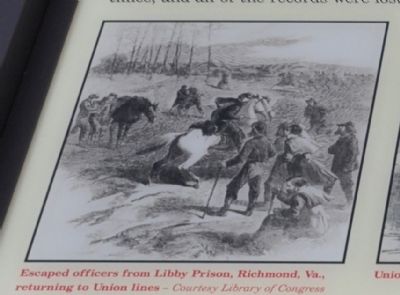
The former home (ca. 1854) of Union Col. William P. Kindrick, Jr., 2nd Tennessee Mounted Infantry, stands across North High Street. Kindrick was captured near Corinth, Mississippi while organizing the 3rd West Tennessee Cavalry. Confined in Libby Prison in Richmond, Virginia, he escaped with 108 other Federal officers in
this page online
“Having recently escaped from Libby with others, I can speak advisedly. So far as the officers are concerned their treatment can be tolerated, though it is indeed bad, but the enlisted men are treated brutally, cruelly.”
Col. William P. Kindrick to President Abraham Lincoln, February 2, 1864
Sidebar:
The First Cumberland Presbyterian Church was constructed about 1840. On October 10, 1854, the congregation and a group of Masons paraded to this site and laid the cornerstone for the present building, which was completed in 1855. It was listed on the National Register of Historic Places in 1987.
Erected 2012 by Tennessee Civil War Trails.
Topics and series. This historical marker is listed in this topic list: War, US Civil. In addition, it is included in the Tennessee Civil War Trails series list. A significant historical month for this entry is February 1864.
Location. 35° 19.262′ N, 87° 45.792′ W. Marker is in Waynesboro, Tennessee, in Wayne County. It is at the intersection of North High Street and Water
Photographed by Sandra Hughes, March 13, 2012
2. Escaped officers from Libby Prison, Richmond, Va
returning to Union lines -Courtesy of Library of Congress

Regionally, this marker is in Middle Tennessee and in the Highland Rim. It is also in the American South and specifically in the Upper South. Globally, it is in North America, the Western Hemisphere, the Western World, and the Anglosphere. Historically, it finds itself in what was once the territory of the Mississippian Culture, one of the Confederate States of America, and the Antebellum South.
Other nearby markers. At least 8 other markers are within 5 miles of this marker, measured as the crow flies: Waynesboro Cumberland Presbyterian Church (here, next to this marker); Mark Collie (about 400 feet away, measured in a direct line); Wayne County Revolutionary War Veterans (about 400 feet away); Waynesboro Operation Enduring Freedom & Operation Iraqi Freedom Monument (about 400 feet away); Wayne County World War II Memorial (about 500 feet away); Sons of Confederate Veterans (about 500 feet away); Incident at Waynesboro
Photographed by Sandra Hughes, March 13, 2012
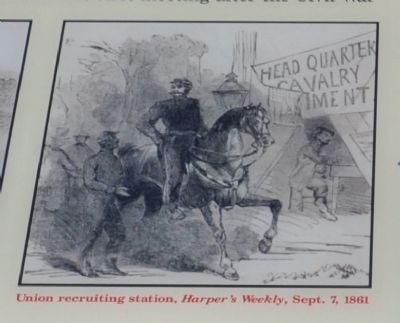
3. Union recruiting station Harper's Weekly, Sept 7, 1861
Photographed by Sandra Hughes, March 13, 2012
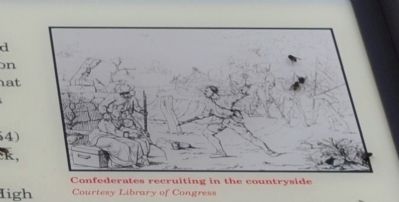
4. Confederate recruiting in the countryside
Courtesy Library of Congress
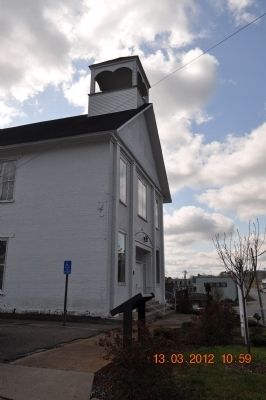
Photographed by Sandra Hughes, March 13, 2012
5. Difficult Times Marker and the First Cumberland Presbyterian Church
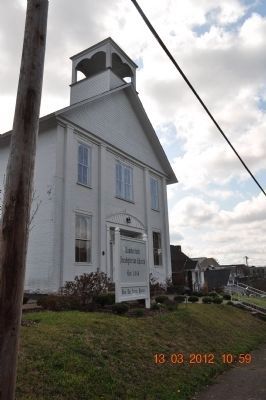
Photographed by Sandra Hughes, March 13, 2012
6. The First Cumberland Presbyterian Church
The church was constructed about 1840. On October 10, 1854, the congregation and a group of Masons paraded to this site and laid the cornerstone for the present building, which was completed in 1855. It was listed on the National Register of Historic Places in 1987.
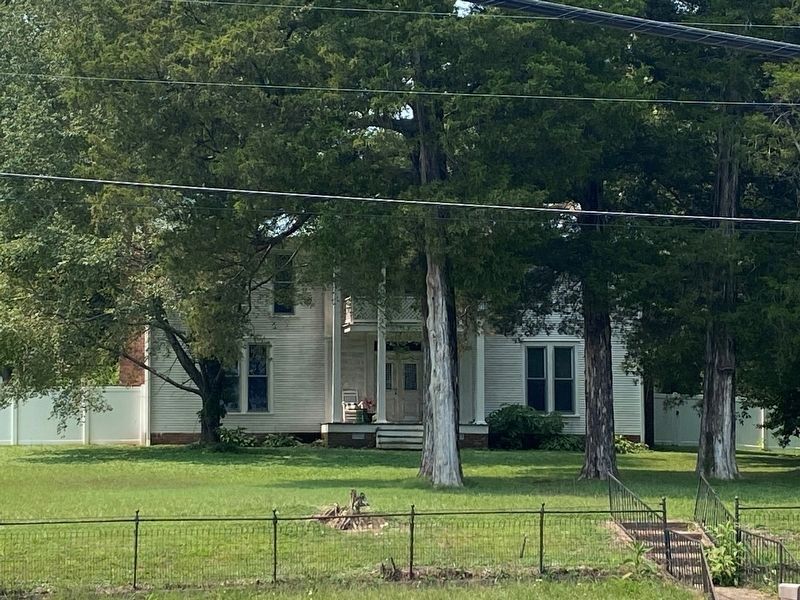
Photographed by Darren Jefferson Clay, August 21, 2021
7. Colonel Kindrick's Homeplace
Credits. This page was last revised on October 1, 2021. It was originally submitted on March 15, 2012, by Sandra Hughes Tidwell of Killen, Alabama, USA. This page has been viewed 1,184 times since then and 59 times this year. Last updated on May 12, 2015, by J. Makali Bruton of Washington, District of Columbia. Photos: 1, 2, 3, 4, 5, 6. submitted on March 15, 2012, by Sandra Hughes Tidwell of Killen, Alabama, USA. 7. submitted on September 30, 2021, by Darren Jefferson Clay of Duluth, Georgia. • Bill Pfingsten was the editor who published this page.
