Downtown in Tucson in Pima County, Arizona — The American Mountains (Southwest)
Plaza de la Mesilla
Photographed by Bill Kirchner, January 10, 2010
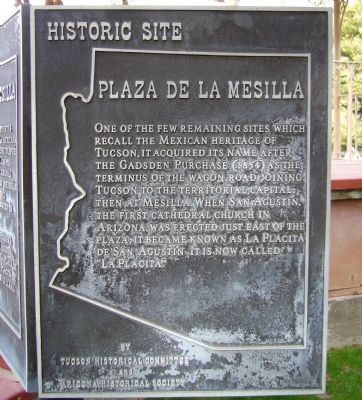
1. Plaza de la Mesilla Marker

One of the few remaining sites which recall the Mexican heritage of Tucson, it acquired its name after the Gadsden Purchase (1854) as the terminus of the wagon road joining Tucson to the territorial capital, then at Mesilla. When San Agustin, the first cathedral church in Arizona, was erected just east of the plaza, it became known as La Placita de San Agustin. It is now called "La Placita."
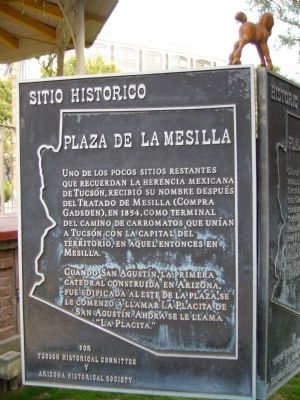
Spanish Translation:
Cuando San Agustín, la primera catedral construida en Arizona, fue edificada al este de la plaza, se le comenzó a llamar La Placita de San Agustín. Ahora se le llama “La Placita”.
Erected by Tucson Historical Committee and Arizona Historical Society.
Topics and series. This historical marker is listed in this topic list: Hispanic Americans. In addition, it is included in the Arizona, The Presidio Trail
this page online
Location. 32° 13.258′ N, 110° 58.396′ W. Marker is in Tucson, Arizona, in Pima County. It is in Downtown. It can be reached from West Broadway Boulevard. Marker is located at north end of La Placita in front of the gazebo. La Placita is just south of Broadway Blvd. Touch for map. Marker is at or near this postal address: 123 W Broadway Blvd, Tucson AZ 85701, United States of America. Touch for directions.

Regionally, this marker is in Arizona’s Sky Islands, in the Sonoran Desert, and in the Phoenix Metropolitan Area. It is also in the American Borderlands and in the Southwest. Globally, it is in North America, the Western Hemisphere, the Western World, and the Anglosphere. Historically, it finds itself in what was once New Spain and also the Gadsden Purchase.
Other nearby markers. At least 8 other markers are within walking distance of this marker: Meyer Street (within shouting distance of this marker); Convent Street (within shouting distance of this marker); August 20th Park (within shouting distance of this marker); La Catedral de San Agustin (within shouting
Photographed by Bill Kirchner, January 10, 2010
2. Plaza de la Mesilla Marker
Spanish translation of marker text.
Regarding Plaza de la Mesilla. This site is #7 on the Presidio Walking Tour:
“This is a replica of the original 1880’s bandstand in the plaza and is the site where the stagecoach would gallop into town from Mesilla, New Mexico, or San Diego along the old El Camino Real (the royal road). Often Apache arrows would be embedded in the stagecoach from encounters along the trail. La Placita is a collection of shops and offices built in the 1970s on the site of an old Tucson neighborhood as part of urban renewal."
Photographed by Bill Kirchner, January 10, 2010
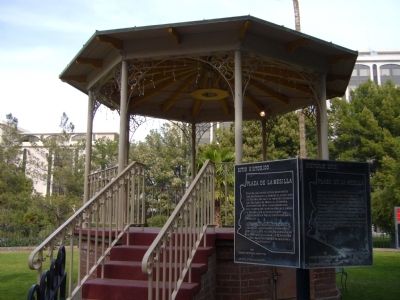
3. Plaza de la Mesilla Marker & Gazebo
This gazebo is a replica of the original 1880's bandstand. This was a stage-stop along the old Camino Real (the Royal Road).
Credits. This page was last revised on August 1, 2025. It was originally submitted on January 14, 2010, by Bill Kirchner of Tucson, Arizona. This page has been viewed 3,143 times since then and 130 times this year. Last updated on May 13, 2015, by J. Makali Bruton of Washington, District of Columbia. Photos: 1, 2, 3. submitted on January 14, 2010, by Bill Kirchner of Tucson, Arizona. • Bill Pfingsten was the editor who published this page.
