Sheffield in Colbert County, Alabama — The American South (East South Central)
President Franklin Delano Roosevelt
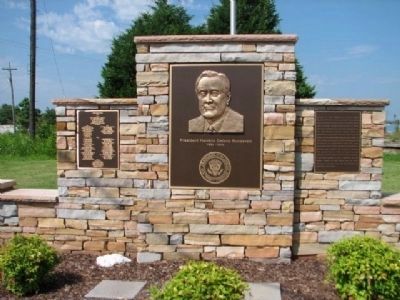
Photographed by Sandra Hughes, June 17, 2009
1. President Franklin Delano Roosevelt Marker
Topics and series. This historical marker is listed in these topic lists: Government & Politics • Industry & Commerce • Waterways & Vessels. In addition, it is included in the Former U.S. Presidents: #32 Franklin D. Roosevelt
this page online
Location. 34° 45.52′ N, 87° 41.934′ W. Marker is in Sheffield, Alabama, in Colbert County. It is at the intersection of South Montgomery Avenue and West 1st Street, on the right when traveling south on South Montgomery Avenue. North of the railroad crossing. Touch for map. Marker is in this post office area: Sheffield AL 35660, United States of America. Touch for directions.

Regionally, this marker is in North Alabama and in the Shoals. It is also in the American South, specifically in the Deep South, in Appalachia, and specifically in Southern Appalachia. Globally, it is in North America, a Gulf of Mexico state, the Western Hemisphere, the Western World, and the Anglosphere. Historically, it finds itself in what was once the territory of the Mississippian Culture, one of the Confederate States of America, and the Antebellum South.
Other nearby markers. At least 8 other markers are within walking distance of this marker: Percy Sledge / Producer Quin Ivy (about 500 feet away, measured in a direct line); In Memory of Our Comrades of Sheffield (about 700 feet away);
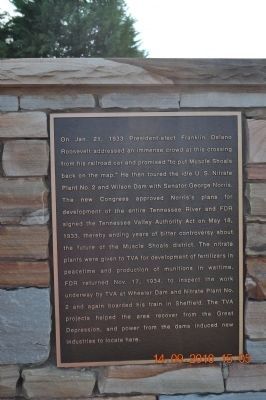
Photographed by Sandra Hughes, June 17, 2009
2. President Franklin Delano Roosevelt Marker
Also see . . . Why the Tennessee Valley Authority was the New Deal’s Most Ambitious—and Controversial—Program. History website entry (Submitted on September 26, 2026, by Larry Gertner of New York, New York.)
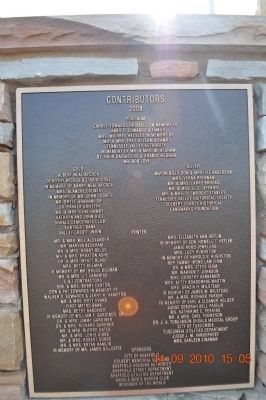
Photographed by Sandra Hughes, June 17, 2009
3. Contributors Marker
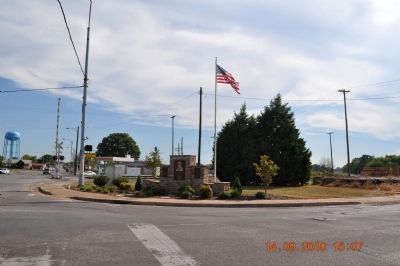
Photographed by Sandra Hughes, September 14, 2010
4. President Franklin Delano Roosevelt Marker
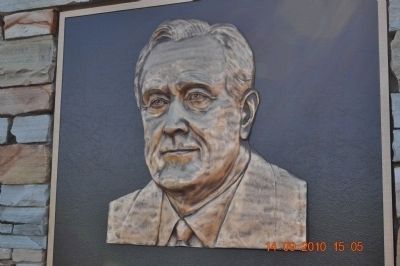
Photographed by Sandra Hughes, September 14, 2010
5. President Franklin Delano Roosevelt
Photographed by Allen C. Browne, February 16, 2015
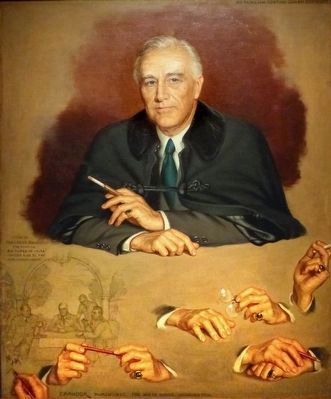
6. Franklin D. Roosevelt
This 1945 Portrait of Franklin D. Roosevelt by Douglas Chandor hangs in the National Portrait Gallery in Washington, DC.
“When Franklin Roosevelt began serving in New York's state legislature in 1911, some observers declared him ill-suited to the rough realities of politics. But Roosevelt thrived on those realities; some two decades later, he was advancing from the New York governorship to the presidency.
Taking office against the bleak backdrop of the Great Depression, Roosevelt responded quickly to this economic disaster with a host of regulatory and welfare measures that redefined the government's role in American life. Among conservatives, the new federal involvement in matters traditionally left to the private sector was a betrayal of America's ideals. But in other quarters, Roosevelt's activism inspired an unwavering popularity that led to his election to an unprecedented four terms.
When Roosevelt sat for this portrait in 1945, his presidential concerns had long since shifted to guiding the nation through World War II. This likeness is a study for a larger painting a sketch of which appears at the lower left commemorating Roosevelt's meeting with wartime Allied leaders, Winston Churchill and Joseph Stalin at Yalta.” — National Portrait Gallery
“When Franklin Roosevelt began serving in New York's state legislature in 1911, some observers declared him ill-suited to the rough realities of politics. But Roosevelt thrived on those realities; some two decades later, he was advancing from the New York governorship to the presidency.
Taking office against the bleak backdrop of the Great Depression, Roosevelt responded quickly to this economic disaster with a host of regulatory and welfare measures that redefined the government's role in American life. Among conservatives, the new federal involvement in matters traditionally left to the private sector was a betrayal of America's ideals. But in other quarters, Roosevelt's activism inspired an unwavering popularity that led to his election to an unprecedented four terms.
When Roosevelt sat for this portrait in 1945, his presidential concerns had long since shifted to guiding the nation through World War II. This likeness is a study for a larger painting a sketch of which appears at the lower left commemorating Roosevelt's meeting with wartime Allied leaders, Winston Churchill and Joseph Stalin at Yalta.” — National Portrait Gallery
Credits. This page was last revised on September 27, 2026. It was originally submitted on September 12, 2010, by Sandra Hughes Tidwell of Killen, Alabama, USA. This page has been viewed 2,567 times since then and 93 times this year. Last updated on May 18, 2015, by J. Makali Bruton of Washington, District of Columbia. Photos: 1, 2, 3. submitted on September 12, 2010, by Sandra Hughes Tidwell of Killen, Alabama, USA. 4, 5. submitted on September 14, 2010, by Sandra Hughes Tidwell of Killen, Alabama, USA. 6. submitted on November 2, 2015, by Allen C. Browne of Silver Spring, Maryland. • Bernard Fisher was the editor who published this page.
