Cahaba in Dallas County, Alabama — The American South (East South Central)
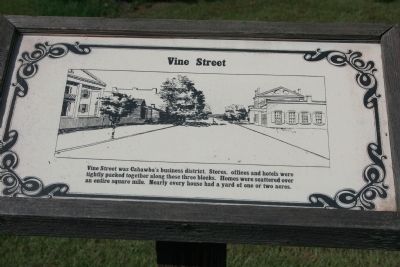
Vine Street
Photographed by Tim Carr, August 15, 2009
1. Vine Street Marker
Erected by Alabama Historical Commission.
Topics and series. This historical marker is listed in these topic lists: Industry & Commerce • Roads & Vehicles • Settlements & Settlers. In addition, it is included in the Alabama Historical Commission series list.
Location. Marker has been permanently removed. It was located near 32° 19.038′ N, 87° 5.796′ W. Marker was in Cahaba, Alabama, in Dallas County. It was at the intersection of Vine Street and Capitol Avenue, on the right when traveling north on Vine Street. Touch for map. Marker was in this post office area: Orrville AL 36767, United States of America.
We have been informed that this marker is no longer there and will not be replaced. This page is an archival view of what was.
Regionally, this marker was in the American South, specifically in the Deep South, and in the Black

this page online
Other nearby markers. At least 8 other markers are within walking distance of this location: The Mound at Old Cahawba Archaeological Park (here, next to this marker); Cahaba First State Capital (a few steps from this marker); a different marker also named Welcome to Downtown Cahawba (a few steps from this marker); Railroad Depot and Commissary (within shouting distance of this marker); Alabama's First Statehouse (within shouting distance of this marker); Cahawba - circa 1500 (within shouting distance of this marker); Captive Boys in Blue (within shouting distance of this marker); Footprint of a Church (about 300 feet away). Touch for a list and map of all markers in Cahaba.
Other markers no longer nearby. Welcome to Downtown Cahawba (was a few steps from this marker but has been replaced with another marker now near it);
Photographed by Tim Carr, August 15, 2009
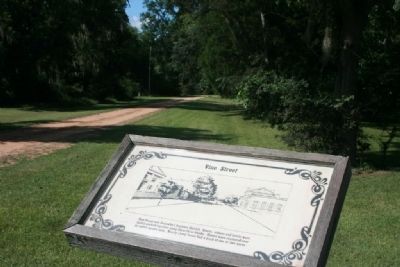
2. Vine Street and Marker
Also see . . . Old Cahawba, "Alabama's most famous Ghost Town". (Submitted on October 14, 2009, by Timothy Carr of Birmingham, Alabama.)
Photographed by Tim Carr, August 15, 2009
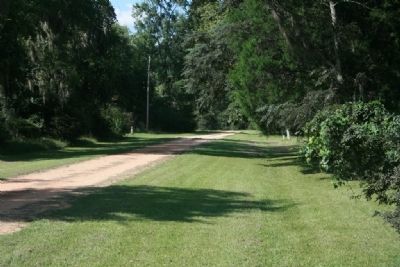
3. Vine Street
Photographed by Tim Carr, August 15, 2009
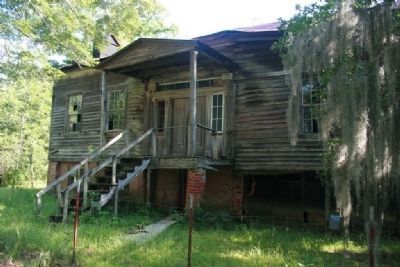
4. The Last Remaining Original Home In Cahaba
Fambro/ Arthur Home was built in the early 1840s by W.W. Fambro but parts of this home could date back to the Capitol Era (1819-1826). Fambro sold the house in 1855 to a D. S. Troy. When D. S. Troy's wife died in 1856 he then sold the house to a John D. Williams in 1857. J. D. Williams lived in the house up till 1866 after his wife died he sold the home to a T. J. Portis. T. J. Portis then sold the home to a William Bell. Ezekiel Arthur who was born into slavery bought the house in 1894 from Mary Bell for $2,000. The Arthur family continued to live in the house until the late 1990's.
Currently the Alabama Historical Commission is working on stabilizing the structure from collapsing. This is one of only two antebellum structures still standing in the town of Cahaba, Alabama.
Located on the corner of 1st North Street and Oak Street in what was downtown Cahaba.
Credits. This page was last revised on April 21, 2024. It was originally submitted on October 14, 2009, by Timothy Carr of Birmingham, Alabama. This page has been viewed 2,401 times since then and 20 times this year. Last updated on May 20, 2015, by J. Makali Bruton of Washington, District of Columbia. Photos: 1, 2, 3, 4. submitted on October 14, 2009, by Timothy Carr of Birmingham, Alabama. • Bernard Fisher was the editor who published this page.
