Brutus in Cayuga County, New York — The American Northeast (Mid-Atlantic)
The Boom Years
The Canalway Trail
Photographed by Anton Schwarzmueller, May 16, 2015
1. The Boom Years Marker
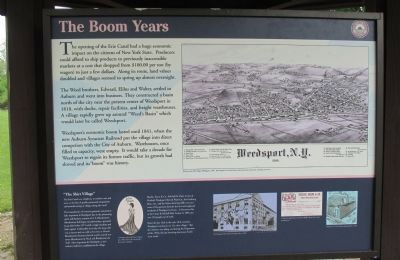
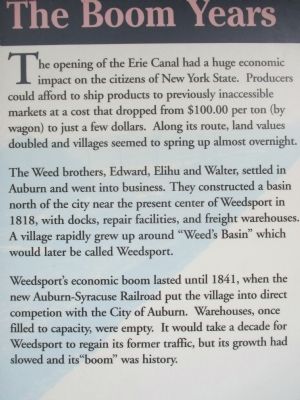
The Weed brothers, Edward, Elihu and Walter, settled in Auburn and went into business. They constructed a basin north of the city near the present center of Weedsport in 1818, with docks, repair facilities, and freight warehouses. A village rapidly grew up around "Weed's Basin" which would later be called Weedsport.
Weedsport's economic boom lasted until 1841, when the new Auburn-Syracuse Railroad put the village into direct competition with the City of Auburn. Warehouses, once filled to capacity, were empty. It would take a decade for Weedsport to regain its former traffic, but its growth had slowed and its "boom" was history.
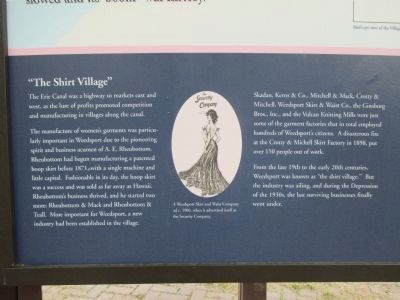
"The Shirt Village". The Erie Canal was a highway to markets east and west, as the lure of profits promoted competition and manufacturing in villages along the canal.
The
this page online
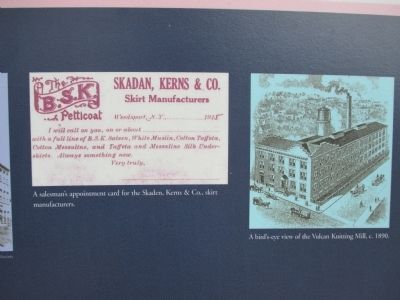
Skadan, Kerns & Co., Mitchell & Mack, Crotty & Mitchell, Weedsport Skirt & Waist Co., the Ginsburg Bros., Inc., and the Vulcan Knitting Mills were just some of the garment factories that in total employed hundreds of Weedsport's citizens. A disasterous fire at the Crotty & Mitchell Skirt Factory in 1898, put over 150 people out of work.
From the late 19th to the early 20th centuries, Weedsport was known as "the shirt village." But the industry was ailing, and during the Depression of the 1930s, the last surviving businesses finally went under.
Erected by New York State Canals.
Topics and series. This historical
Photographed by Anton Schwarzmueller, May 16, 2015
2. Left Text
Location. 43° 2.584′ N, 76° 34.563′ W. Marker is in Brutus, New York, in Cayuga County. It can be reached from the intersection of New York State Route 31 and West Brutus Street. Marker is at a parking area on the south side of NY Route 31, across from West Brutus Street. The marker is on a tri-panel kiosk; it is the panel facing east. Touch for map. Marker is in this post office area: Weedsport NY 13166, United States of America. Touch for directions.

Regionally, this marker is in Upstate New York, specifically in Central New York, and in the Syracuse Metropolitan Area. It is also in the American Northeast and in the Mid-Atlantic. Globally, it is in North America, the Western Hemisphere, the Western World, and the Anglosphere. Historically, it finds itself in what was once the Haudenosaunee (Iroquois) Confederacy, New Netherland, and one of the original Thirteen Colonies.
Other nearby markers. At least 8 other markers are within
Photographed by Anton Schwarzmueller, May 16, 2015
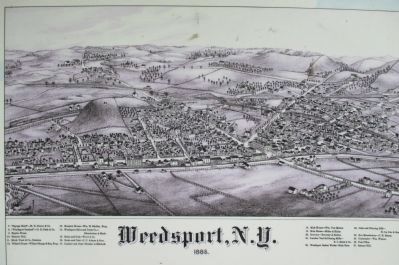
3. Main Image - Weedsport, N.Y., 1885
"Bird's-eye view of the Village of Weedsport, c.1885. the Enlarged Erie Canal is shown in the lower section og the print, stretching east to west."
Photographed by Anton Schwarzmueller, May 16, 2015
4. Bottom Text
"A Weedsport Skirt and Waist Company as c. 1906, when it advertised itself as the Security Company."
[bottom center photo not shown]"The Weedsport Skirt & Waist Company Plant, c.1910."
[bottom center photo not shown]"The Weedsport Skirt & Waist Company Plant, c.1910."
Photographed by Anton Schwarzmueller, May 16, 2015
5. Bottom Right Images
"A salesman's appointment card for the Skaden, Kerns & Co., shirt manufacturers."
"A bird's-eye view of the Vulcan Knitting Mill, c. 1890."
"A bird's-eye view of the Vulcan Knitting Mill, c. 1890."
Photographed by Anton Schwarzmueller, May 16, 2015
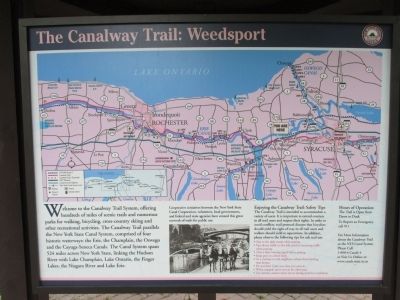
6. The Canalway Trail Information Panel
This panel faces towards NY Route 31 on the tri-panel kiosk.
Photographed by Anton Schwarzmueller, May 16, 2015
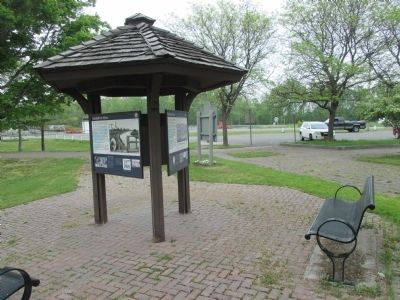
7. The Boom Years Marker - Right Panel
Parking lot off NY Route 31 in background.
Credits. This page was last revised on June 16, 2016. It was originally submitted on May 24, 2015, by Anton Schwarzmueller of Wilson, New York. This page has been viewed 1,222 times since then and 57 times this year. Photos: 1, 2, 3, 4, 5, 6, 7. submitted on May 24, 2015, by Anton Schwarzmueller of Wilson, New York.
