Hudson Bay in Vancouver in Clark County, Washington — The American West (Northwest)
Early Aviation History in Vancouver
Pearson Field
Photographed by Kevin W., June 12, 2008
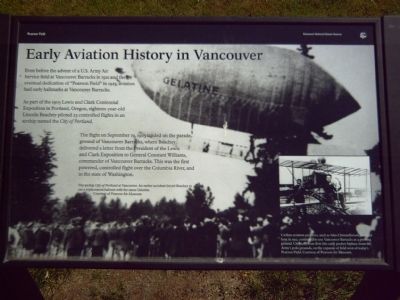
1. Early Aviation History in Vancouver Marker
Even before the advent of a U.S. Army Air Service field at Vancouver Barracks in 1921 and the eventual dedication of “Pearson Field” in 1925, aviation had early hallmarks at Vancouver Barracks.
As part of the 1905 Lewis and Clark Centennial Exposition in Portland, Oregon, eighteen-year-old Lincoln Beachey piloted 23 controlled flights in an airship named the City of Portland.
The flight on September 19, 1905 landed on the parade ground of Vancouver Barracks, where Beachey delivered a letter from the President of the Lewis and Clark Exposition to General Constant Williams, commander of Vancouver Barracks. This was the first powered, controlled flight over the Columbia River, and in the state of Washington.
Erected by Vancouver National Historic Reserve.
Topics. This historical marker is listed in these topic lists: Air & Space • Notable Events. A significant historical date for this entry is September 19, 1905.
Location. 45° 37.457′ N, 122° 39.411′ W. Marker is in Vancouver, Washington, in Clark County. It is in Hudson Bay. It is on E. 5th Street, on the right when traveling east. Marker is near the Pearson Air Museum. Touch for map.
this page online

Regionally, this marker is in Greater Portland Area and in Southwest Washington State. It is also on the American Pacific Coast, in the Pacific Northwest, and in the Lewis & Clark Corridor. Globally, it is in North America, the Pacific Rim, the Western Hemisphere, the Western World, and the Anglosphere.
Other nearby markers. At least 8 other markers are within walking distance of this marker: Carlton Foster Bond (here, next to this marker); Pearson Airfield (a few steps from this marker); The Soviet Transpolar Flight of 1937 (a few steps from this marker); The Chkalov Transpolar Flight (within shouting distance of this marker); Howard C. French / Alexander Pearson (within shouting distance of this marker); The 321st Observation Squadron (1923-1941) (within shouting distance of this marker); First Japanese on the North American Continent (about 800 feet away, measured in a direct line); Whose Anchor? (about 800 feet away). Touch for a list and map of all markers in Vancouver.
More about this marker.
Photographed by Kevin W., June 12, 2008
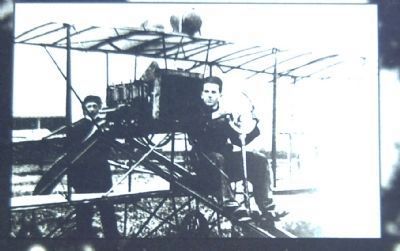
2. Closeup of picture in lower right of marker
"Civilian aviation pioneers such as Silas Christofferson pictured here in 1912, continued to use Vancouver Barracks as a proving ground. Christofferson flew this early pusher biplane from the Army’s polo grounds, on the expanse of field west of today’s Pearson Field."
The picture provided for the marker courtesy of Pearson Air Museum.
The picture provided for the marker courtesy of Pearson Air Museum.
Photographed by Kevin W., June 12, 2008
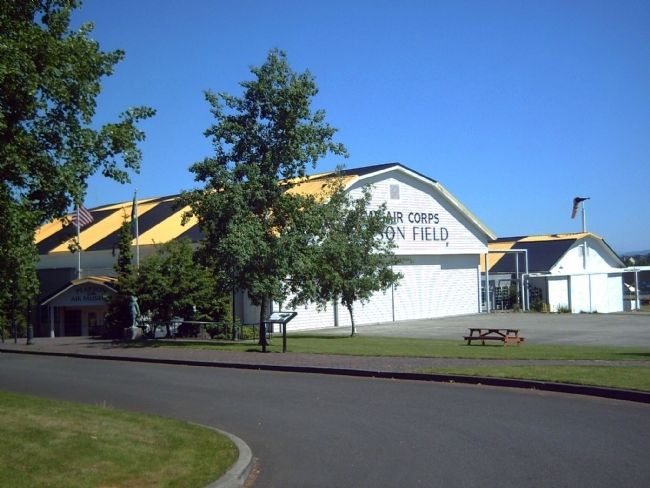
3. Early Aviation History in Vancouver Marker
Credits. This page was last revised on May 31, 2024. It was originally submitted on June 20, 2008, by Kevin W. of Stafford, Virginia. This page has been viewed 2,021 times since then and 107 times this year. Last updated on June 2, 2015, by Scot Harkins of Greenbank, Washington. Photos: 1, 2, 3. submitted on June 20, 2008, by Kevin W. of Stafford, Virginia. • Bill Pfingsten was the editor who published this page.
