Near Oakville in Lawrence County, Alabama — The American South (East South Central)
Oakville Indian Mound
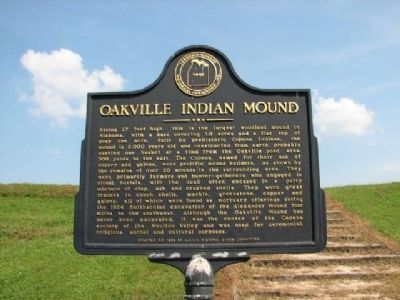
Photographed by Sandra Hughes, August 8, 2009
1. Oakville Indian Mound Marker
Erected by Lawrence County Historical Commission Inc.
Topics. This historical marker is listed in
this page online
Location. 34° 26.529′ N, 87° 10.717′ W. Marker is near Oakville, Alabama, in Lawrence County. It is on County Road 187. Located inside Oakville Indian Mound Park at foot of Indian Mound near steps. Touch for map. Marker is at or near this postal address: 1219 Co Rd 187, Danville AL 35619, United States of America. Touch for directions.

Regionally, this marker is in North Alabama. It is also in the American South, specifically in the Deep South, in Appalachia, and specifically in Southern Appalachia. Globally, it is in North America, a Gulf of Mexico state, the Western Hemisphere, the Western World, and the Anglosphere. Historically, it finds itself in what was once the territory of the Mississippian Culture, one of the Confederate States of America, and the Antebellum South.
Other nearby markers. At least 8 other markers are within walking distance of this marker: Creek Indian Removal (a few steps from this marker); Cherokee Indian Removal (a few steps from this marker); Streight's Raid (about 300 feet away, measured in
Photographed by Sandra Hughes, August 8, 2009
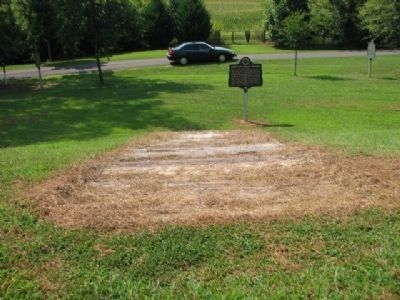
2. Oakville Indian Mound, Cherokee Indian Removal, Creek Indian Removal
Oakville Indian Mound (middle) Creek Indian Removal (left) Cherokee Indian Removal (right)
Also see . . . Oakville, Alabama - Wikipedia. (Submitted on March 5, 2010, by Sandra Hughes Tidwell of Killen, Alabama, USA.)
Photographed by Mark Hilton, August 27, 2021
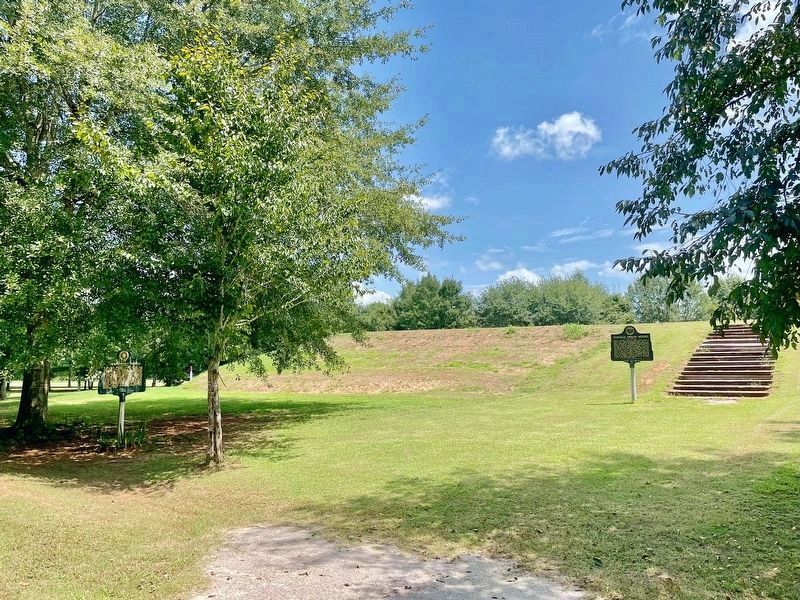
3. Oakville Indian Mound Marker on right by stairs up the mound.
Credits. This page was last revised on March 19, 2025. It was originally submitted on March 4, 2010, by Sandra Hughes Tidwell of Killen, Alabama, USA. This page has been viewed 2,607 times since then and 61 times this year. Last updated on June 12, 2015, by J. Makali Bruton of Washington, District of Columbia. Photos: 1. submitted on March 4, 2010, by Sandra Hughes Tidwell of Killen, Alabama, USA. 2. submitted on September 21, 2010, by Sandra Hughes Tidwell of Killen, Alabama, USA. 3. submitted on August 27, 2021, by Mark Hilton of Montgomery, Alabama. • Bill Pfingsten was the editor who published this page.
