Fountain Inn in Greenville County, South Carolina — The American South (South Atlantic)
Old Fountain Inn
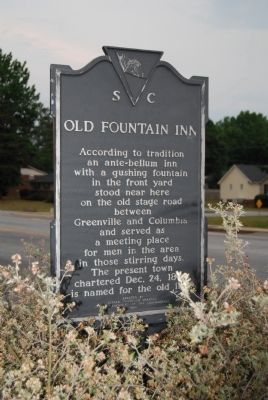
Photographed by Brian Scott, June 20, 2008
1. Old Fountain Inn Marker
Erected 1960 by Oliver Thompson Chapter 1850, United Daughters of the Confederacy, Fountain Inn, SC. (Marker Number 23-6.)
Topics and series. This historical marker is listed in these topic lists: Industry & Commerce • Roads & Vehicles • Settlements & Settlers. In addition, it is included in the United Daughters of the Confederacy series list. A significant historical date for this entry is December 24, 1767.
Location. 34° 42.082′ N, 82° 12.973′ W. Marker is in Fountain Inn, South Carolina, in Greenville County. It is at the intersection of North Main Street (State Highway 14) and Howard Drive on North Main Street. Marker is located near the city limits of Fountain Inn. Touch for map. Marker is in this post office area: Fountain Inn SC 29644, United States of America. Touch for directions.

Regionally, this marker is in Upstate and in the Greater Greenville-Spartanburg Area. It is also in the American South, specifically in the Deep South, in Appalachia, and specifically in Southern Appalachia. Globally, it is in North America, the Western Hemisphere, the Western World, and the Anglosphere. Historically, it finds itself in what was once the original Cherokee Nation, the territory of the Mississippian Culture, one of the original Thirteen Colonies, one of the Confederate States of America, and the Antebellum South.
Other nearby markers. At least 10 other markers are within one mile of this marker, measured as the crow flies: Cannon Memorial Park Veterans Monument (approx. 0.3 miles away); Fountain Inn High School (approx.
this page online
Also see . . . Fountain Inn, South Carolina. Fountain Inn is a city in Greenville and Laurens counties in the U.S. state of South Carolina. (Submitted on February 11, 2009, by Brian Scott of Anderson, South Carolina.)
Additional commentary.
1. A Brief History of Fountain Inn
Until the late 1700's, Cherokee Indians were the principal inhabitants of the northwest area of what is now South Carolina. Greenville, Anderson, and other counties were set aside for them, while Laurens, Richland and Spartanburg counties became the territories of the white man.
After the War for Independence, the
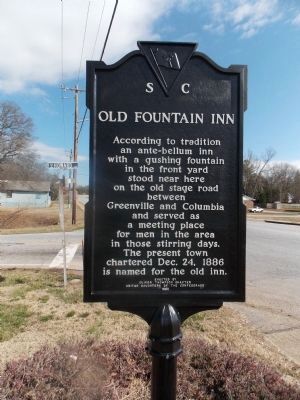
Photographed by Stanley and Terrie Howard, March 6, 2013
2. Old Fountain Inn Marker
Fountain Inn was known as a horse and mule trading center in the early 1800's and a popular stagecoach stop.
The inn that originally greeted weary travelers on this route dates to 1830. It was a large house with a bubbling fountain spring that gushed 2 feet high. Tradition tells us that horses would break into a trot as they approached the fountain for a cool drink after a long trip.
The inn and fountain were located one mile north of the present city hall. Today a roadside historical marker sits near Howard Road and North Main Street where the original site was.
The recorded birth of the town took place on Christmas Eve, 1886. Fountain Inn is the only town known by that name in the United States. (Source: Fountain Inn Chamber of Commerce.)
— Submitted July 16, 2008, by Brian Scott of Anderson, South Carolina.
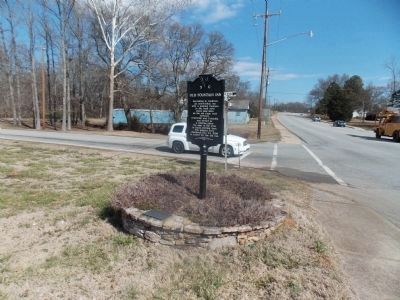
Photographed by Stanley and Terrie Howard, March 6, 2013
3. Old Fountain Inn Marker
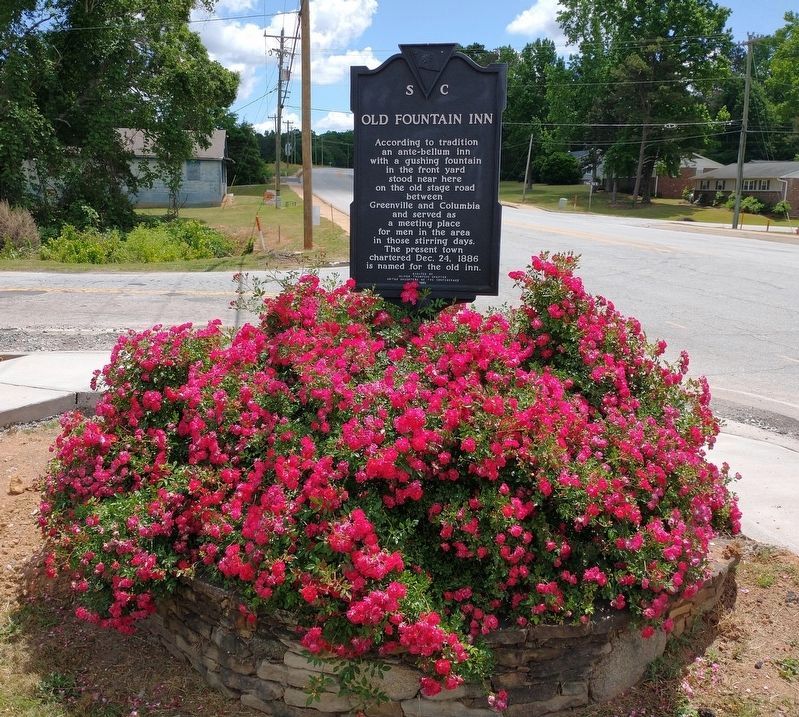
Photographed by Tom Bosse, May 14, 2022
4. Old Fountain Inn Marker
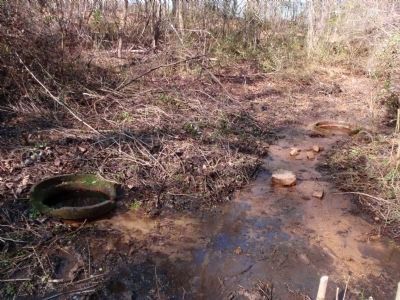
Photographed by Mickey Ocean, January 22, 2009
5. The site of the old fountain
This is the site of the old fountain. It no longer gushes two feet in the air, but there are two artesian wells and several springs which still flow at the site. The Inn was located across Howard Drive from the fountain site. All that remains of it today is a pile of stones from the crumbled chimney.
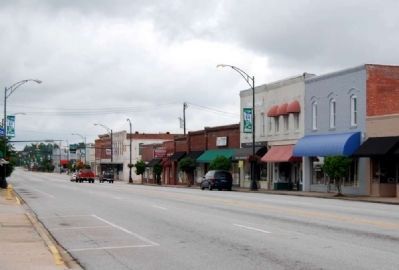
Photographed by Brian Scott, May 17, 2009
6. Fountain Inn Downtown
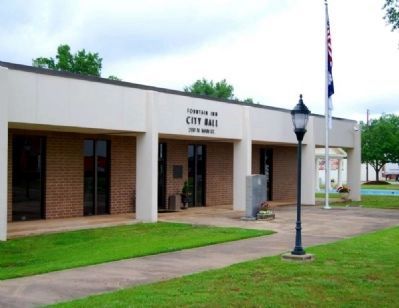
Photographed by Brian Scott, May 17, 2009
7. Fountain Inn City Hall
Credits. This page was last revised on May 19, 2026. It was originally submitted on June 20, 2008, by Brian Scott of Anderson, South Carolina. This page has been viewed 6,353 times since then and 366 times this year. Photos: 1. submitted on June 20, 2008, by Brian Scott of Anderson, South Carolina. 2, 3. submitted on March 10, 2013, by Stanley and Terrie Howard of Greer, South Carolina. 4. submitted on May 21, 2022, by Tom Bosse of Jefferson City, Tennessee. 5. submitted on January 22, 2009, by Mickey Ocean of Greenville County, South Carolina. 6, 7. submitted on September 13, 2009, by Brian Scott of Anderson, South Carolina. • Christopher Busta-Peck was the editor who published this page.
