Gümüssuyu in Istanbul in Beyoglu, Turkiye — West Asia or Southeast Europe
Maksem Taksim
Taksim Maksem
Photographed by Barry Swackhamer, May 6, 2015
1. Maksem Taksim Marker
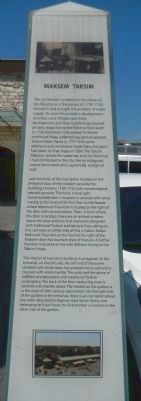
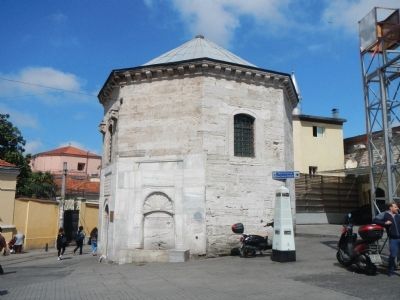
The settlement increased on the shores of the Bosphorus in the period of (1703-1730) Ahmed III and brought the problem of water supply. To solve this problem, development activities were initiated but these development activities could not go beyond an early stage due to the Patrona Halil revolt. In 1730, Mahmud I who passed to throne continued these undertakings and completed Taksim Water Plants in 1731. With some additions and corrections made then, the plant had taken its final shape in 1839. The Taksim Maksem, where this waterway built by Mahmud I had distributed to the city, has an octagonal, coarse stone body and a pyramidal, octagonal roof.
Last two lines of the inscription located on the entrance door of the maksem provide the building's historic 1145/1732 with numerological (ebced) account. The front, where light round-arched door is located, is covered with white marble to the level of the first floor as the facade where Mahmud I Fountain is located at the right of the door with no inscription.Then, in front where the door is located, there are an arched window above the door and two bird mansions
this page online
The interior of two-story building is octagonal. At the entrance, on the left side, the left end of the scene climbed with three steps, has entered into a wall and is covered with white marble. The walls and the dome of maksem are decorated with traditional Turkish embroidery. The back of the flow measuring crate is covered with marble plates. The marble on the gutters is in the style of 18th-century decorations, On the right side of the gutters to the entrance, there is an inscription about the water allocated to Algerian Gazi Hasan Pasha; one belonging to Yusuf Pasha the Grand Vizier is located on the other side of the gutters.
Turkish:
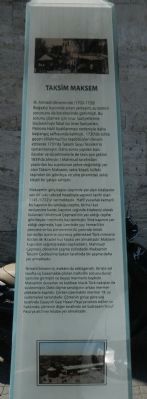
III. Ahmed döneminde (1703-1730) Boğaziçi kıyısında artan yerleşim, su t sorununu da beraberinde getirmişti. Bu sorunu çözmek için imar faaliyetlerine başlanılmıştı fakat bu imar faaliyetleri, Patrona Halil Ayaklanması
Photographed by Barry Swackhamer, May 6, 2015
2. Taksim Maksem Marker
Maksemin giriş kapısı üzerinde yer alan kitabenin son iki satırı ebced hesabıyla yapının tarihi olan 1145 /1732'yi vermektedir. Hafif yuvarlak kemerli bu kapının bulunduğu cephe, birinci kat seviyesine kadar, kapının sağında ki gibi beyaz mermerle kaplanmıştır. Yine kapının yer aldığı cephede, kapı u konsollar üzerine oturmuş geleneksel Türk mimarisi hatları ile iki adet kuş kapısının sağında kalan cephedeki I. Mahmud Çeşmesi, dönemin çeşme Taksim Caddesi'ne bakan tarafında
Photographed by Barry Swackhamer, May 6, 2015
3. Maksem Taksim Marker (Arabic)
İki katlı binanın iç mekânı da sekizgendir. Girişte sol tarafta üç basamakla çıkılan mahallin sol ucu duvar içerisine girmiştir ve beyaz mermerle kaplıdır. Maksemin duvarları ve kubbesi klasik Türk nakışları ile süslenmiştir. Debi ölçme sandığının arkası mermer plakalarla kaplıdır. Çörten üzerindeki mermer 18. yy süslemeleri tarzındadır. Çörtenin girişe göre sağ tarafında Cezayirli Gazi Hasan Paşa'ya tahsis edilen su hakkında; çörtenin diğer tarafında ise Sadrazam Yusuf Paşa'ya ait birer kitabe yer almaktadır.
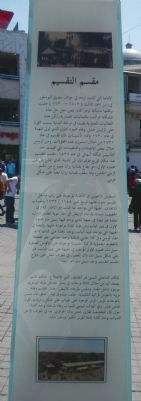
Arabic: To read the Arabic text, click on the Arabic image to enlarge it.
Erected by Istanbul Büyüksehir Belediyesi (Istanbul Metropolitan Municipality).
Topics. This historical marker is listed in these topic lists: Charity & Public Work • Waterways & Vessels. A significant historical year for this entry is 1730.
Location. 41° 2.18′ N, 28° 59.063′ E. Marker is in Istanbul, in Beyoglu. It is in Gümüssuyu. It
Photographed by Barry Swackhamer, May 9, 2015
4. Maksem Taksim Marker

Regionally, this marker is in Turkish East Thrace. Globally, it is in West Asia, Mesopotamia, Europe, the Balkans, and in a coastal Mediterranean country. Historically, it finds itself in what was once the Byzantine Empire, the Ottoman Empire, the Roman Empire, and on the Silk Road.
Other nearby markers. At least 8 other markers are within 3 kilometers of this marker, measured as the crow flies: Galatasarayi Hamami (approx. half a kilometer away); The Tunnel (approx. 1.4 kilometers away); Galata Tower (approx. 1.5 kilometers away); The History of the Egyptian Bazaar (approx. 2.4 kilometers away); Sirkeci Terminal (approx. 2.4 kilometers away); Rustem Pasha Mosque (approx. 2.5 kilometers away); The Building of Ministry of Post and Telegraph (Grand Post Office) (approx. 2.6 kilometers away); Mimar Sinan (approx. 2.7 kilometers away). Touch for a list and map of all markers in Istanbul.
Credits. This page was last revised on February 13, 2023. It was originally submitted on June 30, 2015, by Barry Swackhamer of Brentwood, California. This page has been viewed 948 times since then and 64 times this year. Photos: 1, 2, 3, 4. submitted on June 30, 2015, by Barry Swackhamer of Brentwood, California. • Andrew Ruppenstein was the editor who published this page.
