Hermitage in Davidson County, Tennessee — The American South (East South Central)
The Field Quarter Spring
Nourishing Body and Spirit
Photographed by J. Makali Bruton, June 14, 2015
1. The Field Quarter Spring Marker
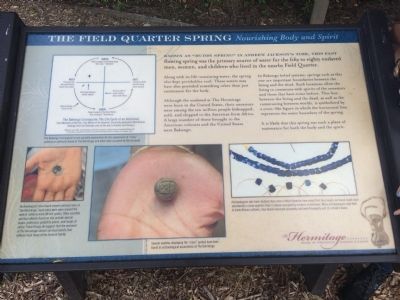
Along with its life-sustaining water, the spring also kept perishables cool. These waters may have also provided for something other than just sustenance for the body.
Although the enslaved at The Hermitage were born in the United States, their ancestors were among the ten million people kidnapped, sold, and shipped to the Americas from Africa. A large number of those brought to the American colonies and the United States were Bakongo.
In Bakongo belief systems, springs such as this one are important boundaries between the living and the dead. Such locations allow the living to commune with spirits of the ancestors and those that have come before. This line between the living and the dead, as well as the communing between worlds, is symbolized by a cross-like figure in which the horizontal line represents the water boundary of the spring.
It is likely that this spring was such a place of sustenance for both
this page online
Captions:
The Bakongo Cosmogram is one possible explanation for the appearance of “cross” symbols on artifacts found at The Hermitage and other sites occupied by the enslaved.
Several marbles displaying the “cross” symbol have been found in archaeological excavations at The Hermitage.
Archaeologists who have studied slave sites in North America have noted that blue beads are found much more abundantly in slave quarters than in places occupied by masters or overseers. Many archaeologists note that in some African cultures, blue beads represent prosperity and were frequently part of a bride's dowry.
Erected by The Hermitage Foundation.
Topics. This historical marker is listed in these topic
Photographed by J. Makali Bruton, June 14, 2015
2. Wide view of The Field Quarter Spring Marker
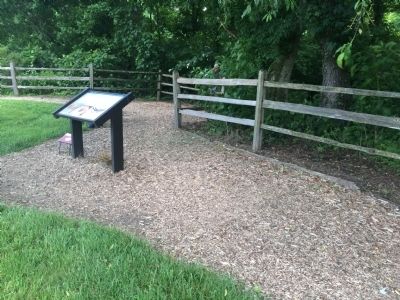
Location. 36° 13.162′ N, 86° 36.719′ W. Marker is in Hermitage, Tennessee, in Davidson County. It is on Field Quarter Trail, on the right when traveling north. The marker can be seen along the Field Quarter Trail at The Hermitage. Touch for map. Marker is in this post office area: Hermitage TN 37076, United States of America. Touch for directions.

Regionally, this marker is in Middle Tennessee and in Greater Nashville. It is also in the American South and specifically in the Upper South. Globally, it is in North America, the Western Hemisphere, the Western World, and the Anglosphere. Historically, it finds itself in what was once the territory of the Mississippian Culture, one of the Confederate States of America, and the Antebellum South.
Other nearby markers. At least 8 other markers are within walking distance of this marker: Land Conservation at The Hermitage (within shouting distance of this marker); "Have the Negro Houses Placed Where the Old Ones Stands" (about 300 feet

Photographed by J. Makali Bruton, June 14, 2015
3. The Field Quarter Spring
The spring is still flowing in the present day.
Credits. This page was last revised on February 7, 2023. It was originally submitted on July 12, 2015, by J. Makali Bruton of Washington, District of Columbia. This page has been viewed 514 times since then and 17 times this year. Photos: 1, 2, 3. submitted on July 12, 2015, by J. Makali Bruton of Washington, District of Columbia. • Andrew Ruppenstein was the editor who published this page.
