
Near Henrico in Henrico County, Virginia — The American South (Mid-Atlantic)
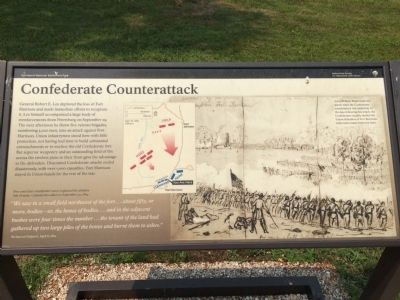
Confederate Counterattack
Photographed by Shawn Oliver, July 1, 2015
1. Confederate Counterattack Marker
Five years later a battlefield visitor explained the fate of many Confederates killed on September 30, 1864:
"We saw in a small field northwest of the fort...about 50, or more, bodies—or, the bones of bodies...and in the adjacent bushes were four times the number...the tenant of the land has gathered up two large piles of the bones and burnt them to ashes."
Richmond Dispatch, April 8, 1869
(caption)
Artist
this page online
Erected by Richmond National Battlefield Park.
Topics. This historical marker is listed in these topic lists: Forts and Castles • War, US Civil. A significant historical month for this entry is April 1837.
Location. 37° 25.653′ N, 77° 22.377′ W. Marker is near Henrico, Virginia, in Henrico County. It can be reached from Battlefield Park Road 0.2 miles Picnic Road, on the left when traveling south. Marker is located at the Fort Harrison unit of Richmond National Battlefield Park and can be reached by hiking the 1/5-mile trail at the fort. Touch for map. Marker is at or near this postal address: 8621 Battlefield Park Road, Henrico VA 23231, United States of America. Touch for directions.

Regionally, this marker is in Virginia’s Piedmont, in Central Virginia, and in the Richmond Metropolitan Area. It is also in the American South, specifically in the Upper South, and on the Eastern Seaboard. Globally, it is
Photographed by Shawn Oliver, July 1, 2015
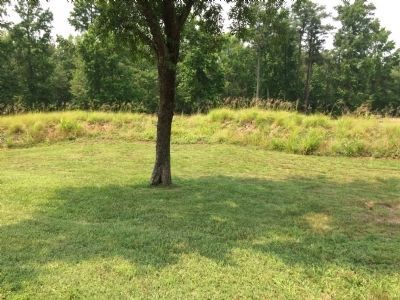
2. Low breastworks in front of the Confederate Counterattack marker
Other nearby markers. At least 8 other markers are within walking distance of this marker: Fort Harrison Trail (within shouting distance of this marker); A Unique Photograph (within shouting distance of this marker); First Park Headquarters (within shouting distance of this marker); a different marker also named First Park Headquarters (within shouting distance of this marker); Freedom Fighters (within shouting distance of this marker); Counterattack (within shouting distance of this marker); a different marker also named Surprise Attack (about 300 feet away); a different marker also named Fort Harrison (about 400 feet away). Touch for a list and map of all markers in Henrico.
Other markers no longer nearby. Fort Harrison Trail (was within shouting distance of this marker but has been replaced with another marker now near it); Fort Harrison (was within shouting distance of this marker but has been replaced with another marker now near it); Surprise Attack (was about 300 feet away, measured in a direct line but has been replaced with another marker now near it).
More about this marker. This marker replaced an older one at this location titled "Counterattack" (see nearby markers)
Also see . . . Fort Harrison. Richmond National Battlefield Park (Submitted on July 15, 2015.)
Credits. This page was last revised on June 16, 2016. It was originally submitted on July 14, 2015, by Shane Oliver of Richmond, Virginia. This page has been viewed 685 times since then and 25 times this year. Photos: 1, 2. submitted on July 14, 2015, by Shane Oliver of Richmond, Virginia. • Bernard Fisher was the editor who published this page.
