Huntsville in Madison County, Alabama — The American South (East South Central)
Late Indian Wars
1866–1890
Photographed by Sandra Hughes, September 13, 2013
1. Late Indian Wars Marker
Inscription.
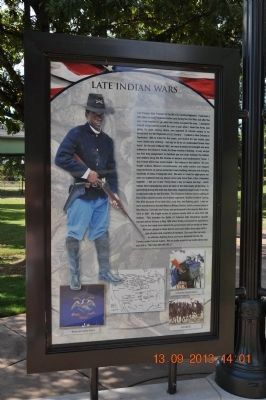
I am Trooper Able Freeman of the 9th Cavalry Regiment. I had been a field slave in south Alabama before and during the Civil War; but after the war, I had nowhere to go when the Union occupied the area. I wandered around living hand-to-mouth for over a year when I heard the Army was going “to raise, among others, one regiment of colored cavalry to be designated the 9th Regiment of U.S. Cavalry”. I walked to New Orleans in September 1866 to enlist for five years, and received $13 per month, plus room, board and clothing – not bad at all for an uneducated former farm hand! By the end of March 1867, we were at nearly full strength and were ordered to San Antonio, Texas, for three months of training. In July, we got our first duty assignment: to maintain law and order between the Indians and settlers along the Rio Grande in western and southwestern Texas. I don’t know which was more trouble- the Indians or the settlers! We also fought outlaws, Mexican revolutionaries, and cattle rustlers and mapped large territories as well as protected crews building railroads and stringing hundreds of miles of telegraph wire. We were in Texas for eight years but were so scattered that we almost never saw more than a few companies together. I tell you it was “forty miles a day on beans and hay” which means hard campaigning since we were in the fields nearly all the time. A good thing during this time was that Army chaplains taught many of us how to read and write for the first time. The Cheyenne Indians took to calling all four of the colored cavalry and infantry regiments “Buffalo Soldiers” during this time because of our dark skin, curly hair, and fighting spirit. Later we were transferred to the New Mexico Military District, which covered parts of New Mexico, Colorado and Texas, and
Click or scan to see this page online
participated in the Apache Wars from 1875 to 1881. We fought scores of actions usually with no more than 100 Indians. This included the Battle of Tularosa with Chiricahua Apache warriors led by Victorio in May 1880 which finally convinced the Apaches to live on the hated reservations the government had set aside for them. We have camped in three feet of snow and ridden three days with a pint of water and a handful of hardtack. But even then we were an effective fighting force, and never defeated like the 7th Cavalry under Colonel Custer. We are justly proud of our motto, which was and still is, “WE CAN AND WE WILL!”
1866–1890
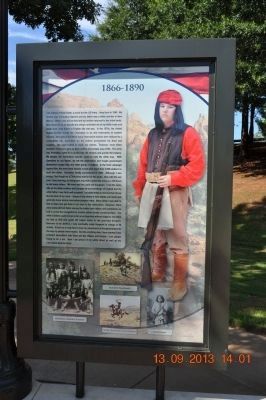
I am Johnny Yellow Hawk, a scout for the US Army. I was born in 1869. My mother was Chiricahua Apache and my father was a white rancher in New Mexico. When I was six he died and my mother returned to her tribal lands. She raised me as an Apache but always reminded me of my white roots and made sure I was fluent in English like she was. In the 1870s, the United States forcibly moved the Chiricahua to an arid reservation in eastern Arizona. Throughout the West, many reservation Indians were
Photographed by Sandra Hughes, September 13, 2013
2. Late Indian Wars Marker
reduced to a subsistence life, dependent on the federal government for food and supplies. We used tickets to claim our rations. However, most tribes resisted, refusing to give up their culture and unique way of life. The army was invariable called in to protect the US citizens and punish the Indians. My people, the Chiricahua Apache, came to hate the white man. With Geronimo as our leader, we left the reservation and fought government domination longer than any other group of Indians. In the final campaign against him, the army used Apache scouts plus more than 5,000 soldiers to hunt him down. Geronimo finally surrendered in 1886. Although I was young, I had fought as a Chiricahua warrior for two years. Now with the war over, I was starving, so biting back my pride I joined the army as a US Scout as did many others. We were well fed, paid and equipped. I had the same rifle as the white soldiers and because of my knowledge of English and my white father I was fairly well accepted. I scouted areas in Arizona that I knew like the back of my hand. I always knew where to find shelter and water and generally knew where reservation-jumpers
Photographed by Sandra Hughes, September 13, 2013
3. Late Indian Wars Marker
were. Many times I was able to talk to them and get them to go back to the reservation. However, there were some pitched fights among the buttes and valleys and sometimes we had to chase the renegades for months before finally cornering them. The white soldier could not go as far as us Apaches without supplies and often we had to find and guide US wagon trains to the worn-out troops. Because of my abilities, I was eventually made Sergeant in charge of 20 scouts. It took me a long time to lose my resentment of the government for the way my people were treated. But like anything else, I have learned from constant association that there are few villains and heroes – just people trying to do a job. Now I am proud of my white blood as well as my Chiricahua Apache blood.
Erected 2013.
Topics and series. This memorial is listed in this topic list: Wars, US Indian. In addition, it is included in the Buffalo Soldiers series list.
Location. 34° 44.106′ N, 86° 35.315′ W. Memorial is in Huntsville, Alabama, in Madison County. It can be reached from the intersection of Monroe Street
Photographed by Sandra Hughes, September 13, 2013
4. Patriots Walkway
Northwest and Washington Street Northwest, on the left when traveling east. Located along Patriots Walkway in Veterans Park. Touch for map. Memorial is at or near this postal address: 200 Monroe St NW, Huntsville AL 35801, United States of America. Touch for directions.
Regionally, this memorial is in North Alabama. It is also in the American South, specifically in the Deep South, in Appalachia, and specifically in Southern Appalachia. Globally, it is in North America, a Gulf of Mexico state, the Western Hemisphere, the Western World, and the Anglosphere. Historically, it finds itself in what was once the original Cherokee Nation, the territory of the Mississippian Culture, one of the Confederate States of America, and the Antebellum South.
Credits. This page was last revised on June 16, 2016. It was originally submitted on January 26, 2014, by Sandra Hughes Tidwell of Killen, Alabama, USA. This page has been viewed 1,153 times since then and 25 times this year. Last updated on July 15, 2015, by J. Makali Bruton of Washington, District of Columbia. Photos:1, 2, 3, 4. submitted on January 26, 2014, by Sandra Hughes Tidwell of Killen, Alabama, USA. • Bill Pfingsten was the editor who published this page.