Highlands/Perkins in Baton Rouge in East Baton Rouge Parish, Louisiana — The American South (West South Central)
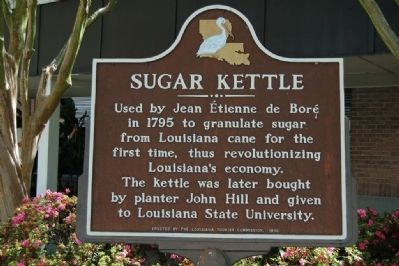
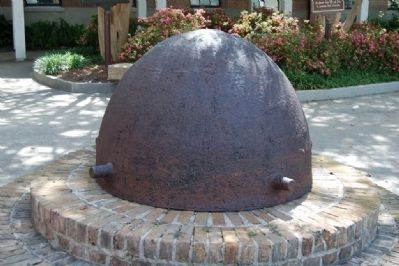
Sugar Kettle
Photographed by Cajun Scrambler, June 17, 2005
1. Sugar Kettle Marker
Erected 1970 by Louisiana Tourist Commission.
Topics. This historical marker is listed in these topic lists: Agriculture • Education • Industry & Commerce. A significant historical year for this entry is 1795.
Location. 30° 24.628′ N, 91° 10.936′ W. Marker is in Baton Rouge, Louisiana, in East Baton Rouge Parish. It is in Highlands/Perkins. It is on Stadium Drive west of South Campus Drive, on the right when traveling west. Touch for map. Marker is in this post office area: Baton Rouge LA 70803, United States of America. Touch for directions.

Regionally, this marker is in Louisiana’s Florida Parishes. It is also in the American South, specifically in the Deep South, and in the Great River Road Region. Globally, it is in North America, a Gulf of Mexico state, the Western Hemisphere, the Western World, and the Anglosphere. Historically, it finds itself in what was once
this page online
Other nearby markers. At least 8 other markers are within walking distance of this marker: Texas Bowl (within shouting distance of this marker); ReliaQuest Bowl (within shouting distance of this marker); Distinguished Cadets (within shouting distance of this marker); Citrus Bowl (within shouting distance of this marker); a different marker also named Distinguished Cadets (within shouting distance of this marker); a different marker also named Distinguished Cadets (within shouting distance of this marker); a different marker also named Distinguished Cadets (within shouting distance of this marker); Civil War Cannons (within shouting distance of this marker). Touch for a list and map of all markers in Baton Rouge.
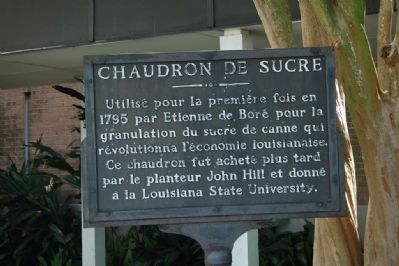
More about this marker. Also includes a marker in French next to this marker.
Photographed by Cajun Scrambler, June 17, 2005
2. Sugar Kettle French Marker
Utilisé pour la première fois en 1795 par Etienne de Boré pour la granulation du sucre de canne qui révolutionna l’économie louisianaise. Ce chaudron fut acheté plus tard par la planteur John Hill et donné à la Louisiana State University.
Photographed by Cajun Scrambler, June 17, 2005
3. Sugar Kettle
Photographed by Cajun Scrambler, June 17, 2005
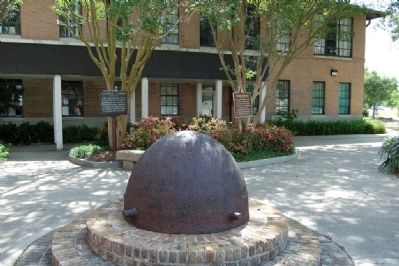
4. Sugar Kettle and Marker
Credits. This page was last revised on February 12, 2023. It was originally submitted on July 18, 2015. This page has been viewed 842 times since then and 30 times this year. Photos: 1, 2, 3, 4. submitted on July 18, 2015. • Bernard Fisher was the editor who published this page.
