
Johnstone in Renfrewshire, Scotland, United Kingdom — Northwestern Europe (the British Isles)
William Wallace Birthplace Memorial
Elderslie, Scotland
Photographed by Brandon Fletcher, May 31, 2013
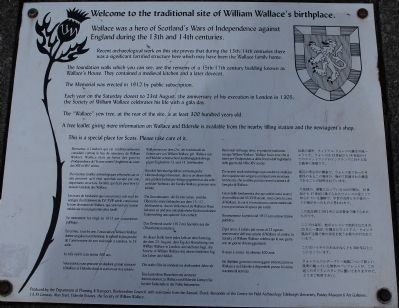
1. William Wallace Birthplace Marker
Wallace was a hero of Scotland's Wars of Independence against England during the 13th and 14th centuries.
Recent archaeological work on this site proves that during the 13th/14th centuries there was a significant fortified structure here which may have been the Wallace family home.
The foundation walls which you can see, are the remains of a 15th/17th century building known as Wallace's House. They contained the medieval kitchen and a later dovecot.
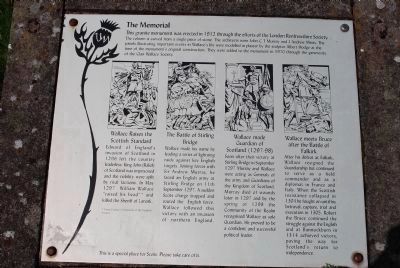
The Memorial was erected in 1912 by public subscription.
Each year on the Saturday closest to 23rd August, the anniversary of his execution in London in 1305, the Society of William Wallace celebrates his life with a gala day.
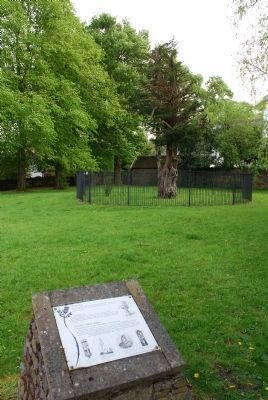
The "Wallace" yew tree, at the rear of the site, is at least 300 hundred years old.
A free leaflet giving information on Wallace and Elderslie is available from the nearby filling station and the newsagent's shop.
This is a special place for Scots. Please take care of it.
(French, German, Italian, and Japanese transcriptions omitted. Please click on picture enlarge.)
Erected 1912
this page online
Topics. This historical marker and memorial is listed in this topic list: Wars, Non-US.
Location. 55° 50.135′ N, 4° 29.32′ W. Marker is in Johnstone, Scotland, in Renfrewshire. It is at the intersection of Main Road and Castle Street, on the right when traveling east on Main Road. Touch for map. Marker is in this post office area: Johnstone, Scotland PA5 9EN, United Kingdom. Touch for directions.

Regionally, this marker and memorial is in Scotland’s Glasgow & Clyde Valley. Globally, it is on the Atlantic Ocean, in the North Atlantic Region, in Europe, on the Celtic Fringe, in Atlantic Europe, on one of the British Isles, in the Western World, and in the Anglosphere.
Other nearby markers. At least 5 other markers are within 13 kilometers of this marker, measured as the crow flies: The Memorial (a few steps from this marker); The Yew Tree, The Wallace Oak, and The Cult of William Wallace (a few steps from this marker); Welcome to the traditional site of William Wallace's birthplace (within shouting distance of this marker); Alt Clut (approx.
Photographed by Brandon Fletcher, May 31, 2013
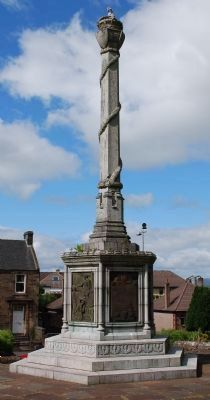
2. William Wallace Birthplace Monument
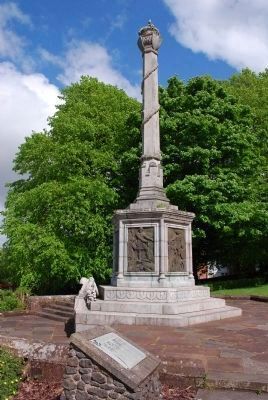
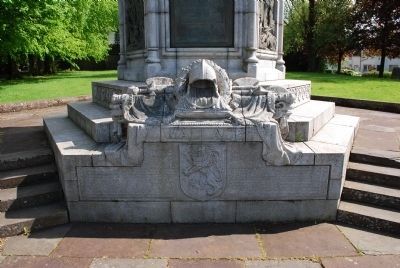
Regarding William Wallace Birthplace Memorial. The Wallace monument was unveiled on 28th September 1912 by Sir Thomas Glen Coats. It was designed by Mr.J.C.Murray of Westminister. It is 37 feet high and the base is 20 feet above street level.
Every August the Wallace Day parade takes place, with a march from Johnstone town centre to the Monument at Elderslie, where a service takes place.
William Wallace was born in Elderslie about 1270. The legend of the Wallace Oak says Wallace avoided capture by hiding more than 100 of his men in the giant tree. The tree began to deteriorate in health due to age and souvenir hunters, removing part of the bark. A cutting from the 300-year-old Wallace Yew is to be planted outside the new £400 million Scottish Parliament building in Edinburgh. The owner of the sapling wished to remain anonymous. - Wikimapia
Also see . . .
1. William Wallace Biography. (Submitted on July 24, 2015, by Brandon Fletcher of Chattanooga, Tennessee.)
2. The Society of William Wallace. (Submitted on July 24, 2015, by Brandon Fletcher of Chattanooga, Tennessee.)
3. Wikimapia- William Wallace, Elderslie.
Photographed by Brandon Fletcher, May 31, 2013
3. William Wallace Birthplace Monument
Photographed by Brandon Fletcher, May 31, 2013
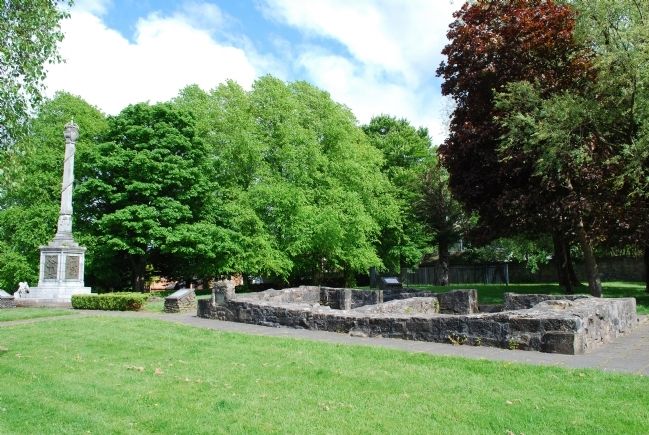
4. William Wallace Birthplace
Left: Wallace Birthplace Marker
Right: Foundation of the house that Wallace was born
Back: Wallace Yew Tree
Photographed by Brandon Fletcher, May 31, 2013
5. The Memorial Marker with details about bronze plaques on Monument
This marker correlates with the plaques attached to the memorial. Information for each plaque is included and located below each plaque pictured.
Photographed by Brandon Fletcher, May 31, 2013
6. Wallace Yew Tree, Oak, and Cult Marker
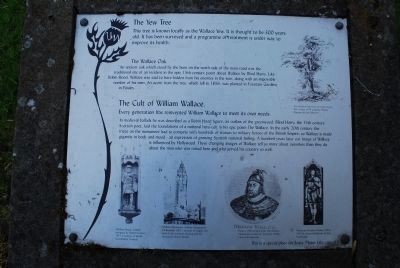
The Yew Tree
This tree is known locally as the Wallace Yew. It is thought to be 300 years old. It has been surveyed and a programme of treatment is under way to improve its health.
The Wallace Oak
An ancient oak which stood by the burn on the north side of the main road was the traditional site of an incident in the epic 15th century about Wallace by Blind Harry. Like Robin Hood, Wallace was said to have hidden from his enemies in the tree, along with an impossible number of his men. An acorn from the tree, which fell in 1856, was planted in Fountain Gardens in Paisley.
The Cult of William Wallace
Every generation has reinvented William Wallace to meet its own needs.
In medieval ballads he was described as a Robin Hood figure, an outlaw of the greenwood. Blind Harry, the 15th century Scottish poet, laid the foundations of a national hero-cult in his epic poem The Wallace. In the early 20th century the frieze on the monument had to compete with hundreds of statues to military heroes of the British Empire, so Wallace is made gigantic in body and mood- an expression of growing Scottish national feeling. A hundred years later our image of Wallace influenced by Hollywood. These changing images of Wallace tell us more about ourselves than they do about the man who was raised here and who served his country so well.
Photographed by Brandon Fletcher, May 31, 2013
7. Wallace Yew Tree
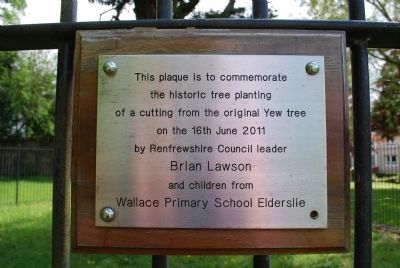
This plaque is to commemorate the historic tree planting of a cutting from the original Yew tree on the 16th of June 2011 by Renfrewshire Council leader
Brian Lawson and children from Wallace Primary School Elderslie
Photographed by Brandon Fletcher, May 31, 2013
8. William Wallace Birthplace Marker
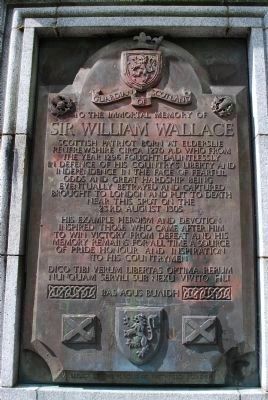
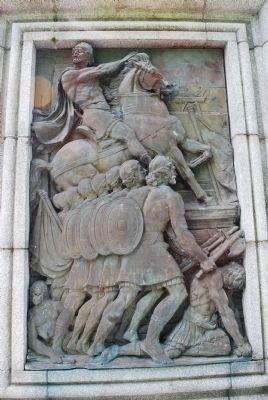
This plaque is a replica of the marker that sits at the site of Wallace's execution in Smithfield, London
Photographed by Brandon Fletcher, May 31, 2013
9. The Battle of Stirling Bridge
Wallace made his name by leading a series of lightning raids against key English targets. Joining forces with Sir Andrew Murray, he faced an English army at Stirling Bridge on 11th of September 1297. A sudden Scots charge trapped and routed the English force. Wallace followed this victory with an invasion of northern England.
Photographed by Brandon Fletcher, May 31, 2013
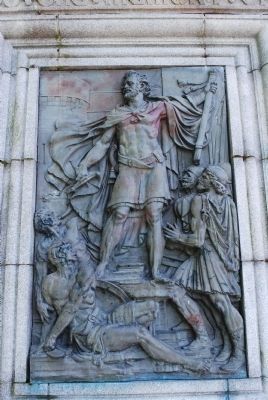
10. Wallace Raises the Scottish Standard
Edward of England's invasion of Scotland in 1296 left the country leaderless. King John (Baliol) of Scotland was imprisoned and the nobility were split by rival factions. In May 1297 William wallace "raised his head"* and killed the Sheriff of Lanark.
*From Fordun's Chronicle of the Scottish Nation
Photographed by Brandon Fletcher, May 31, 2013
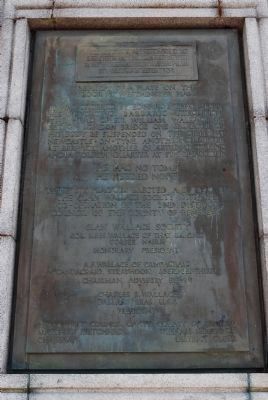
11. William Wallace Birthplace Marker
Replica of a plate on the floor at Westminster Hall
It was ordered by Edward that after his revolting, barbaric execution, the head of Sir William Wallace be set on London Bridge one quarter of his body be suspended on the Gibbett at Newcastle-on-Tyne. another quarter at Berwick, another quarter at Stirling, and a fourth quarter at St. Johnstoun
"He had no tomb
He needed none"
These six plaques erected A.D. 1970 by the Clan Wallace Society with the co-operation of the 2nd District Council of the county of Renfrew
Clan Wallace Society
Col. R.F.H. Wallace of that H.K, C.M.G
Corsee, Nairn
Honorary President
A.F. Wallace of Candacraig
Candacraig, Strathdon, Aberdeenshire
Chairman, Advisory Board
Charles B. Wallace
Dalas, Texas, U.S.A.
President
2nd District Council of the county of Renfrew
Matthew Pritchard Chairman
William Kilpatrick District Clerk
Photographed by Brandon Fletcher, May 31, 2013
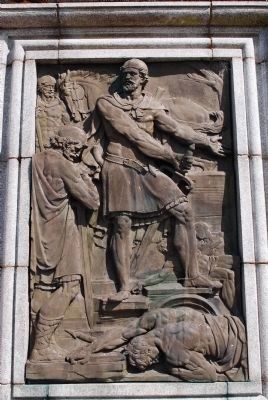
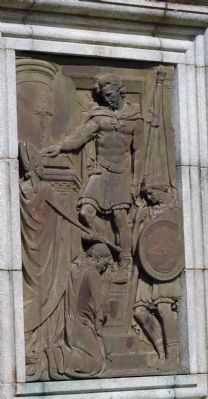
12. Wallace meets Bruce after the Battle of Falkirk
After his defeat at Falkirk, Wallace resigned the Guardianship but continued to serve as a field commander and as a diplomat in France and Italy. When the Scottish resistance collapsed in 1304 he fought on until his betrayal, capture, trial and execution in 1305. Robert the Bruce continued the struggle against the English and at Bannockburn in 1314 achieved victory, paving the way for Scotland's return to independence.
Photographed by Brandon Fletcher, May 31, 2013
13. Wallace made Guardian of Scotland (1297-98)
Soon after their victory at Stirling Bridge in September 1297 Murray and Wallace were acting as Generals of the Kingdom of Scotland. Murray died of wounds later in 1297 and by the spring of 1298 the Community of the Realm recognised Wallace as sole Guardian. He proved to be a confident and successful political leader.
Photographed by Brandon Fletcher, May 31, 2013
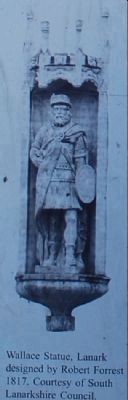
14. William Wallace Birthplace
Wallace Statue, Lanark designed by Robert Forrest 1817. Courtesy of South Lanarkshire Council.
Photographed by Brandon Fletcher, May 31, 2013
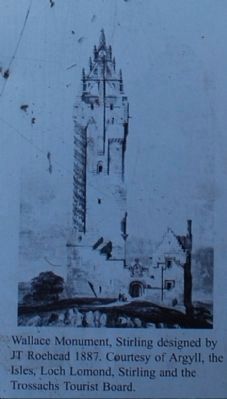
15. William Wallace Birthplace
Wallace Monument, Stirling designed by JT Roehead 1887. Courtesy of Argyll, the Isles, Loch Lomond, Stirling and the Trossachs Tourist Board.
Photographed by Brandon Fletcher, May 31, 2013
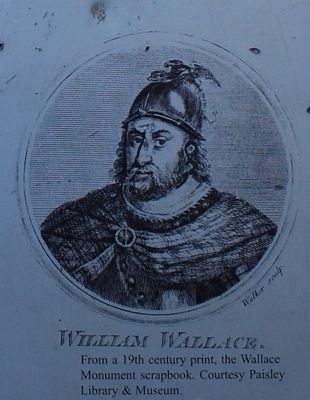
16. William Wallace
Willam Wallace
from a 19th century print, the Wallace Monument scrapbook. Courtesy Paisley Library & Museum.
Photographed by Brandon Fletcher, May 31, 2013
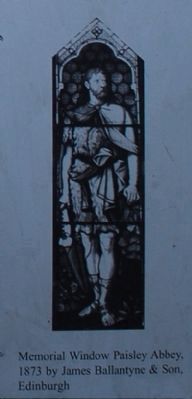
17. Paisley Abbey Window
Memorial Window Paisley Abbey, 1873 by James Ballantyne & Son, Edinburgh
Photographed by Brandon Fletcher, May 31, 2013
18. William Wallace Birthplace Marker
Front details of the marker
Photographed by Brandon Fletcher, May 31, 2013
19. Wallace Yew Tree, Oak, and Cult Marker
Credits. This page was last revised on January 27, 2022. It was originally submitted on July 19, 2015, by Brandon Fletcher of Chattanooga, Tennessee. This page has been viewed 1,016 times since then and 56 times this year. Photos: 1, 2, 3, 4, 5, 6, 7, 8, 9, 10, 11, 12, 13, 14, 15, 16, 17, 18, 19. submitted on July 19, 2015, by Brandon Fletcher of Chattanooga, Tennessee. • Andrew Ruppenstein was the editor who published this page.
