Cobh in County Cork, Munster, Ireland — Irish South-West ((Éire) North Atlantic Ocean)
S.S. Lusitania
Photographed by Brandon Fletcher, June 11, 2015
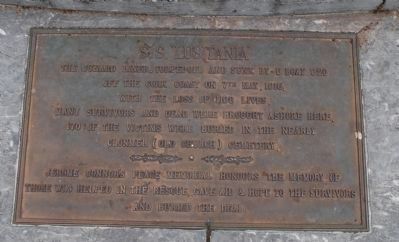
1. Lusitania Peace Memorial Marker
Located on the steps leading up to the Lusitania Peace Memorial
The Cunard Liner, torpedoed and sunk by U Boat U20 off the Cork Coast on 7th May, 1915, With the loss of 1198 lives. Many survivors and dead were brought ashore here. 170 of the victims were buried in the nearby Clonmel (Old Church) Cemetery.
Jerome Connor's Peace Memorial honours the memory of those who helped in the rescue, gave aid & hope to the survivors and buried the dead.
Topics and series. This memorial is listed in these topic lists: Disasters • War, World I • Waterways & Vessels. In addition, it is included in the Lost at Sea series list. A significant historical date for this entry is May 7, 1915.
Location. 51° 51.022′ N, 8° 17.707′ W. Memorial is in Cobh, Munster, in County Cork. It is on Strand Road. Touch for map. Touch for directions.

Regionally, it is on the Atlantic Ocean, in the North Atlantic Region, on the Atlantic Arc, in Europe, on the Island of Ireland, on the Celtic Fringe, in the European Union, in Atlantic Europe, on one of the British Isles, in the Western World, and in the Anglosphere.
Other nearby markers. At least 8 other markers are within walking distance of this marker:
this page online
Also see . . .
1. Topics in Chronicling America - Sinking of the Lusitania. The Library of Congress presents a curated set of links to contemporary newspaper articles related to the sinking of the Lusitania: Despite published newspaper articles warning against travel on Allied ships, the RMS Lusitania departed from New York on May 1, 1915, bound for Liverpool. As the ship sailed near Ireland on May 7, it was torpedoed by a German U-boat and sank, killing over 1,100 people on board. A later British investigation into the incident ruled that the Lusitania was attacked with the intent to kill civilians, as the ship did not carry explosives. Read more about it!
Photographed by Brandon Fletcher, June 11, 2015
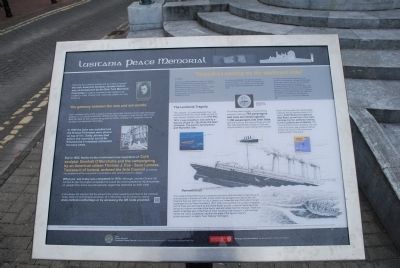
2. New Lusitania Peace Memorial Marker
Interpretation of the memorial and history in the sinking of the Lusitania.
2. The Lusitania Resource. (Submitted on August 7, 2015.)
Photographed by Brandon Fletcher, June 11, 2015
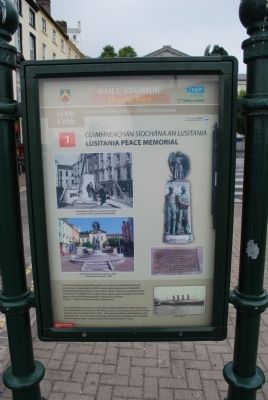
3. Lusitania Peace Memorial Marker
Another marker with information about the memorial
Photographed by Brandon Fletcher, June 11, 2015
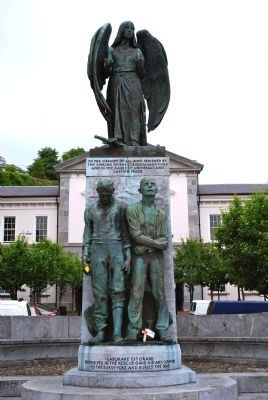
4. Lusitania Peace Memorial Marker
Top Reads:
To the memory of all who perished by
the sinking of the Lusitania May 7 1915
and in the cause of universal and lasting peace
Bottom Reads:
Laborare est orare
They helped in the rescue- gave aid and comfort to the survivors and buried the dead
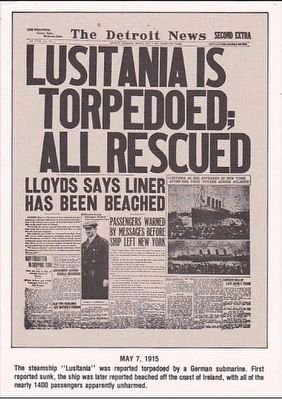
Photographed by Detroit Free Press, May 7, 1915
5. Lusitania is Torpedoed; All Rescued Headline
Sometimes the newspapers got ahead of themselves.
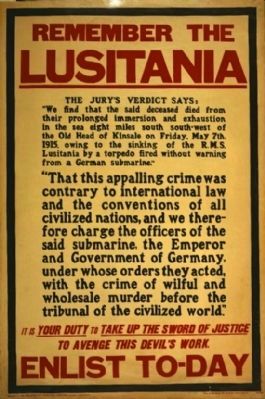
Photographed by David Allen & Sons, Ltd., 1915
6. Remember the Lusitania…
Recruiting poster published by the Parliamentary Recruiting Committee. Image courtesy of the Library of Congress. (Click to enlarge.)
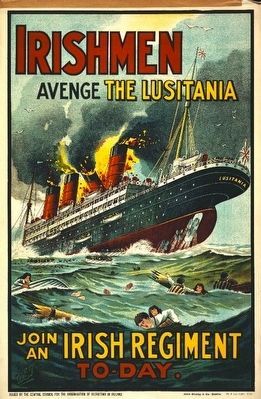
Central Council for the Organisation of Recruiting in Ireland, 1915
7. Irishmen - Avenge the Lusitania. Join an Irish Regiment To-day
Image courtesy of the Library of Congress.
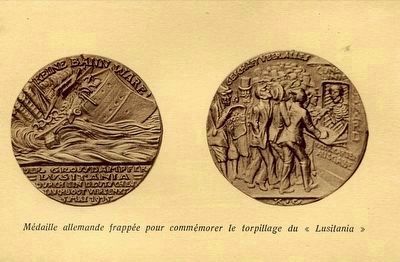
8. Germans S.S. Lusitania Medallion (Click on image to enlarge.)
The Germans, too, remembered the Lusitania, albeit for different reasons. This postcard presents pictures of the medallion struck by the Germans to commemorate the sinking. On the one side (left), is the legend, "The Grand Steamship Lusitania, sunk by a German U-Boat, 7th of May, 1915". The other side presents a satirical view of rich passengers lining up to buy tickets at the Cunard Line window (being manned by a skeleton), with the slogan above reading "Business Above All".
The sinking of the Lusitania was not completely without warning, as the German government had in April placed ads in American newspapers warning that travellers entering the war zone on ships flying the flags of Great Britain or her allies did so at their own risk. After the sinking, the Germans justified the sinking by noting that the ship had munitions as cargo, and that the ship in previous war-time trips carried troops and munitions to Britain. Subsequent investigations have also revealed that large amounts of munitions were indeed being transported.
The sinking of the Lusitania was not completely without warning, as the German government had in April placed ads in American newspapers warning that travellers entering the war zone on ships flying the flags of Great Britain or her allies did so at their own risk. After the sinking, the Germans justified the sinking by noting that the ship had munitions as cargo, and that the ship in previous war-time trips carried troops and munitions to Britain. Subsequent investigations have also revealed that large amounts of munitions were indeed being transported.
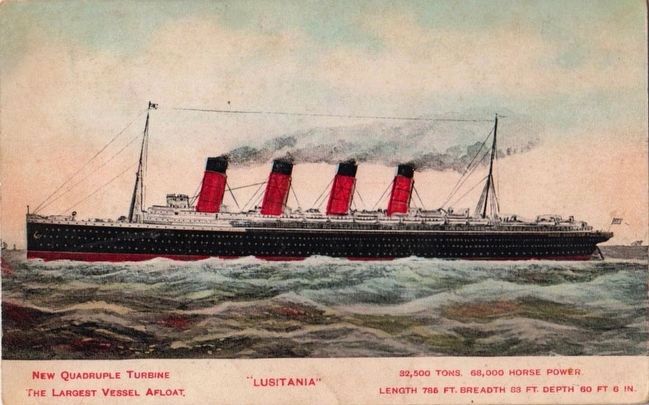
9. S.S. Lusitania
...Lusitania was carrying a great number of Americans and women and children as well as war materiel for the British Army. The sinking of the Lusitania and resulting deaths of civilians and neutral nationals aboard the ship is considered one of the first modern examples of “total war” and a turning point in World War I. The nature of the explosions that sank the ship and the politics surrounding her demise remain controversial topics. - The Lusitania Resource
Photographed by Ian Lefkowitz, May 15, 2026
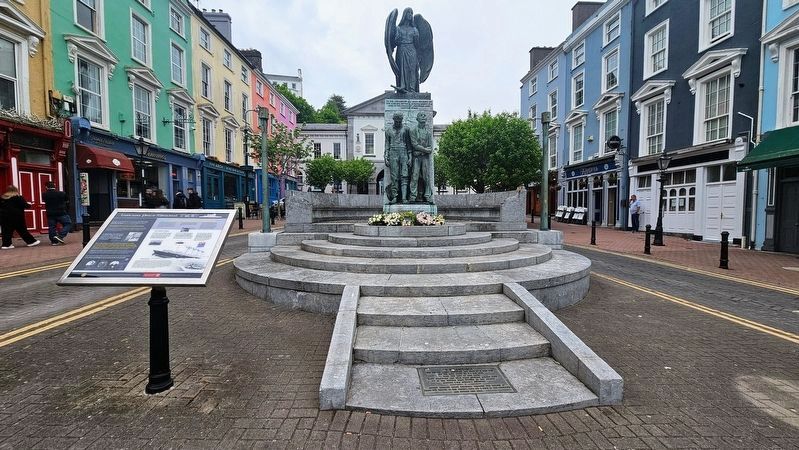
10. S.S. Lusitania Marker
The marker is located at the base of the Lusitania memorial.
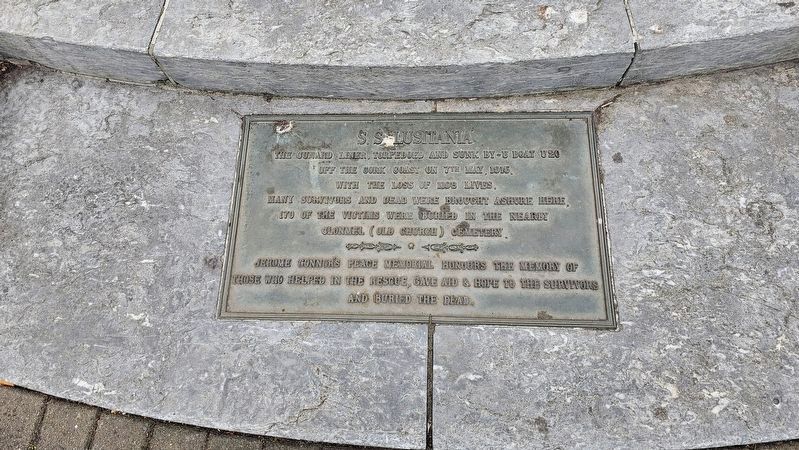
Photographed by Ian Lefkowitz, May 15, 2026
11. S.S. Lusitania Marker
The marker has been cleaned, but remains weathered.
Credits. This page was last revised on July 10, 2026. It was originally submitted on July 20, 2015, by Brandon Fletcher of Chattanooga, Tennessee. This page has been viewed 723 times since then and 42 times this year. Photos: 1, 2, 3, 4. submitted on July 20, 2015, by Brandon Fletcher of Chattanooga, Tennessee. 5. submitted on August 6, 2015. 6. submitted on July 24, 2015. 7. submitted on August 7, 2015. 8. submitted on August 6, 2015. 9. submitted on August 7, 2015. 10, 11. submitted on June 16, 2026, by Ian Lefkowitz of New York, New York. • Andrew Ruppenstein was the editor who published this page.
