
Rip Raps Island in Hampton, Virginia — The American South (Mid-Atlantic)
Fort Wool
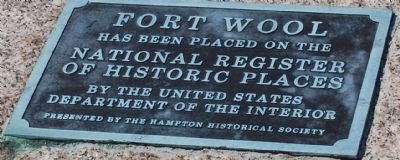
Photographed by Brandon Fletcher, June 22, 2010
1. Fort Wool Marker
National Register
of Historic Places
by the United States
Department of the Interior
Erected by Hampton Historical Society.
Topics. This historical marker is listed in these topic lists: Forts and Castles • War, US Civil.
Location. 36° 59.199′ N, 76° 18.093′ W. Marker is in Hampton, Virginia. It is on Rip Raps Island. It can be reached from Interstate 64. THIS HISTORICAL MARKER IS NO LONGER ACCESSIBLE. Boats are not allowed to dock on the island. Touch for map. Marker is in this post office area: Norfolk VA 23503, United States of America. Touch for directions.

Regionally, this marker is on Virginia’s Peninsula and in Coastal Virginia. It is also in the American South, specifically in the Upper South, in the Tidewater, and on the Eastern Seaboard. Globally, it is in the North Atlantic Region, North America, the Western Hemisphere, the Western World, and the Anglosphere. Historically, it finds itself in what was once the territory of the Mississippian Culture, one of the original Thirteen Colonies, one of the Confederate
this page online
Other nearby markers. At least 8 other markers are within one mile of this marker, measured as the crow flies: A different marker also named Fort Wool (within shouting distance of this marker); The Sculpture (approx. one mile away); The Cultural Connections (approx. one mile away); Fort Monroe History (approx. 1.1 miles away); The Movement of a Legacy (approx. 1.1 miles away); a different marker also named First Africans in Virginia (approx. 1.1 miles away); Battery Irwin (approx. 1.1 miles away); Old Point Comfort Light (approx. 1.1 miles away). Touch for a list and map of all markers in Hampton.
Other markers no longer nearby. Fort Monroe Concrete Seawall Eastern Terminus (was approx. one mile away but has been confirmed missing); Fort Monroe Seawall History (was approx. one mile away but has been confirmed missing); Engineer Wharf (was approx. 1.1 miles away but has been confirmed missing); a different marker also named Fort Monroe Seawall History (was approx. 1.1 miles away but has been confirmed missing); First Africans in Virginia (was approx. 1.1 miles away but has been
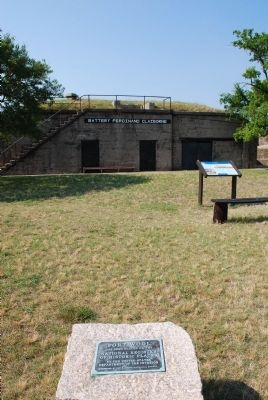
Photographed by Brandon Fletcher, June 22, 2010
2. Fort Wool Marker
More about this marker. Fort Wool is on an uninhabited island. It can be seen from the Chesapeake Bay shore of Fort Monroe or from the Hampton Roads Bridge Tunnel (I-64). The island has been converted into a bird sanctuary and boats are prohibited from landing there.
Also see . . .
1. Fort Wool. This Hampton Parks page has some information on Fort Wool and states “The City of Hampton operated the historic fort as a park and historic attraction for years. However, it is now closed to tours and boaters.” (Submitted on May 16, 2023.)
2. Habitat Work at Fort Wool Completed. This link includes photographs of the conversion of Fort Wool to a bird habitat. Excerpts:
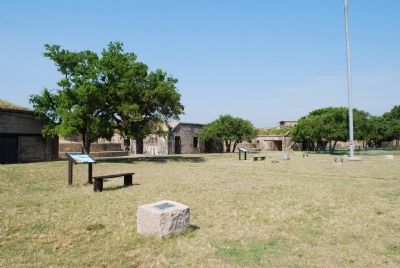
Over the last two months, DGIF and its contractors have converted Fort Wool on Rip Raps Island from a grassy, vegetated area to an open sandy nesting area for the seabird colony displaced from the Hampton Roads Bridge-Tunnel South Island. DGIF collaborated with U.S. Department of Agriculture-Wildlife Services to effect mammalian predator control, and our contractors removed all vegetation in the target nesting(Submitted on May 16, 2023.)area.Photographed by Brandon Fletcher, June 22, 20103. Fort Wool Marker
Barriers were set up at doorways and other openings to prevent chicks from entering into spaces that adult birds could not follow. Best practices defined by the Department of Historic Resources were followed; staff also created a steel plate box to protect an historic grave marker on the island.
Additional commentary.
1. Fort Wool is now closed.
Fort Wool closed to the public late in 2019 and was been converted to a bird sanctuary/bird colony to house gulls displaced by bridge construction.
Tour boats no longer go there, and private boats are not allowed to dock.
— Submitted May 12, 2023, by Evan Dwyer of Richmond, Virginia.
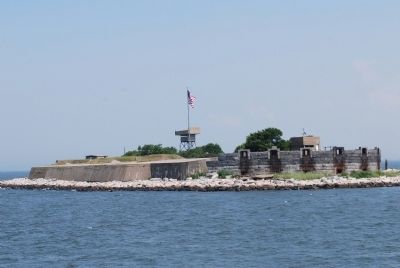
Photographed by Brandon Fletcher, June 22, 2010
4. Fort Wool Marker
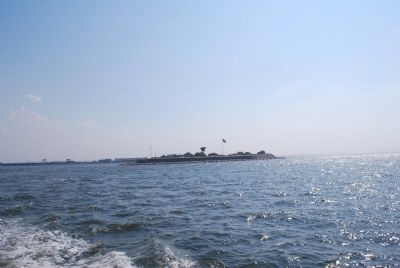
Photographed by Brandon Fletcher, June 22, 2010
5. Fort Wool Marker
Credits. This page was last revised on May 16, 2023. It was originally submitted on July 23, 2015, by Brandon Fletcher of Chattanooga, Tennessee. This page has been viewed 892 times since then and 41 times this year. Photos: 1, 2, 3, 4, 5. submitted on July 23, 2015, by Brandon Fletcher of Chattanooga, Tennessee. • Bernard Fisher was the editor who published this page.
