Fredericksburg, Virginia — The American South (Mid-Atlantic)
The Original Wall
The Battle of Fredericksburg
| — | Fredericksburg and Spotsylvania National Military Park | — |
Photographed by Craig Swain, May 25, 2008
1. The Original Wall Marker
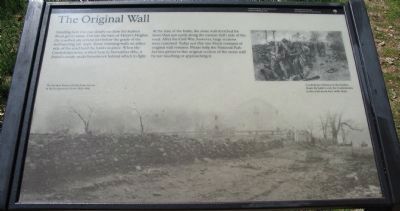
Standing here you can clearly see how the Sunken Road got its name. Cut into the base of Marye's Heights, the roadbed sits several feet below the grade of the surrounding hill slope. Stone retaining walls on either side of the road hold the banks in place. When the Confederate army arrived here in November 1862, it found a ready-made breastwork behind which to fight.
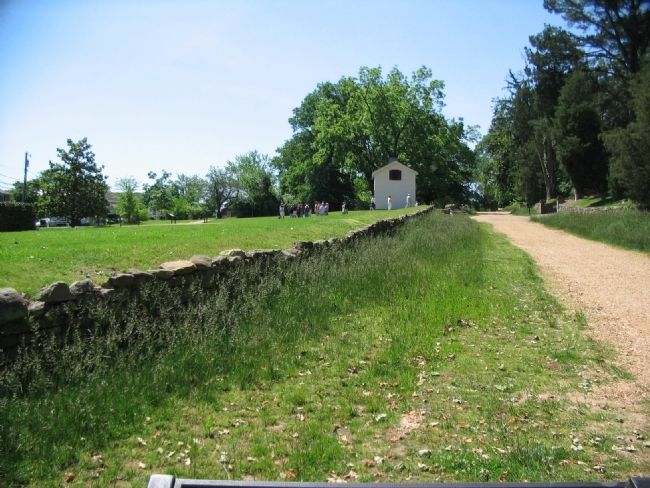
At the time of the battle, the stone wall stretched for more than 500 yards along the eastern (left) side of the road. After the Civil War, however, large sections were removed. Today just this one-block remnant of original wall remains. Please help the National Park Service preserve this original section of the stone wall by not touching or approaching it.
Erected by National Park Service, U.S. Department of the Interior.
Topics. This historical marker is listed in this topic list: War, US Civil. A significant historical month for this entry is November 1862.
Location. 38° 17.793′ N, 77° 28.115′ W. Marker is in Fredericksburg, Virginia. It is at the intersection of Sunken Road and Hanover Street, on the left when traveling north on Sunken Road. Located on the
this page online

Regionally, this marker is in the Washington Metropolitan Area and in Northern Virginia. It is also in the American South and specifically in the Upper South. Globally, it is in North America, the Western Hemisphere, the Western World, and the Anglosphere. Historically, it finds itself in what was once the territory of the Mississippian Culture, one of the original Thirteen Colonies, one of the Confederate States of America, and the Antebellum South.
Other nearby markers. At least 8 other markers are within walking distance of this marker: Brompton (a few steps from this marker); The Ebert House and Store (a few steps from this marker); Kirkland Monument (within shouting distance of this marker); Sunken Road (within shouting distance of this marker); a different marker also named The "Angel of Marye's Heights" (within shouting distance of this marker); Seeking Cover
Photographed by Craig Swain, May 25, 2008
2. Three Wayside along the Sunken Road
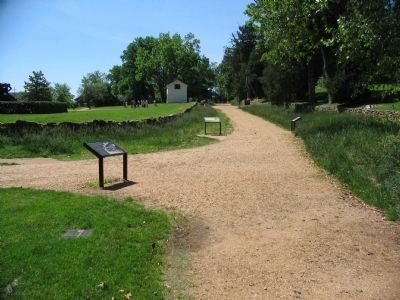
From left to right, the Ebert House and Store, The Original Wall, and Brompton.
Other markers no longer nearby. Fredericksburg Campaign (was a few steps from this marker but has been permanently removed); a different marker also named Fredericksburg Campaign (was a few steps from this marker but has been confirmed missing); Angel of Marye's Heights (was within shouting distance of this marker but has been replaced with another marker now near it).
More about this marker. The background of the marker is a photo of The Sunken Road with the Innis House in the background, about 1865-1866. On the upper right is a drawing of Confederate riflemen in the Sunken Road. By battle's end, the Confederates in the road stood four ranks deep.
Also see . . . Sunken Road Tour. Virtual tour of the Sunken Road. (Submitted on June 29, 2008, by Craig Swain of Leesburg, Virginia.)
Photographed by Craig Swain, May 25, 2008
3. Original Section of the Wall
Looking over the marker, the section of wall to the left is mentioned in the text.
Photographed by J. Makali Bruton, July 23, 2016
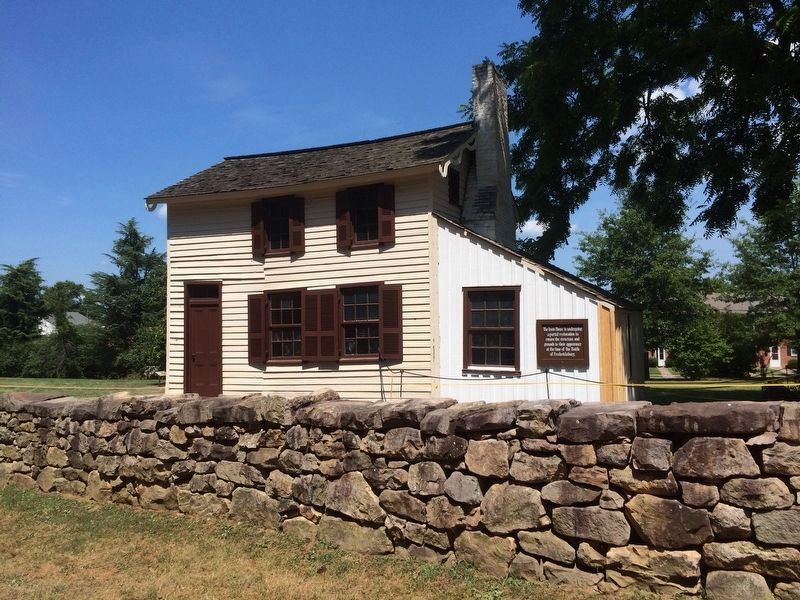
4. The Innis House at the far east end of the Original Wall
Credits. This page was last revised on June 29, 2023. It was originally submitted on June 29, 2008, by Craig Swain of Leesburg, Virginia. This page has been viewed 3,078 times since then and 69 times this year. Photos: 1, 2, 3. submitted on June 29, 2008, by Craig Swain of Leesburg, Virginia. 4. submitted on July 24, 2016, by J. Makali Bruton of Washington, District of Columbia.
