
Beallsville in Dickerson in Montgomery County, Maryland — The American Northeast (Mid-Atlantic)
Equestrian Heritage
Photographed by Allen C. Browne, July 26, 2015
1. Equestrian Heritage Marker
Importance of Horses
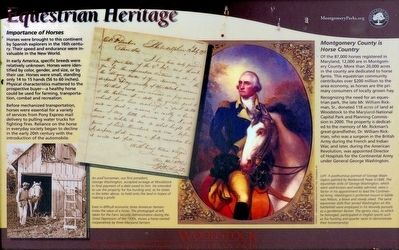
Horses were brought to this continent by Spanish explorers in the 16th century. Their speed and endurance were invaluable in the New World. In early America. specific breeds were relatively unknown. Horses were identified by color, gender, and size, or by their use. Horses were small, standing only 14 to 15 hands (56 to 60 inches). Physical characteristics mattered to the prospective buyer—a healthy horse could be used for farming. transportation. combat and recreation. Before mechanized transportation, horses were essential for a variety of services from Pony Express mail delivery to pulling water trucks for fighting fires. Reliance on the horse in everyday society began to decline in the early 20th century with the introduction of the automobile.
Montgomery County is Horse Country
Of the 87,000 horses registered in Maryland, 12,000 are in Montgomery County. More than 20,000 acres in the county are dedicated to horse farms. This equestrian community contributes over $200 million to the area economy, as horses are the primary consumers of locally grown hay. Recognizing the need for an equestrian
this page online
Erected by Montgomery Parks.
Topics and series. This historical marker is listed in these topic lists: Agriculture • Animals • Sports. In addition, it is included in the Maryland, Montgomery Parks series list. A significant historical year for this entry is 2000.
Location. 39° 11.458′ N, 77° 25.192′ W. Marker is in Dickerson, Maryland, in Montgomery County. It is in Beallsville. It can be reached from Darnestown Road (Maryland Route 28) 1.1 miles north of Beallsville Road ( Route 109), on the right when traveling north. Marker is in the Woodstock Equestrian Park at 20207 Darnestown Road (MD 28). Touch for map. Marker is at or near this postal address: 20207 Darnestown Rd, Bealsville MD 20839, United States
Photographed by Allen C. Browne, July 26, 2015
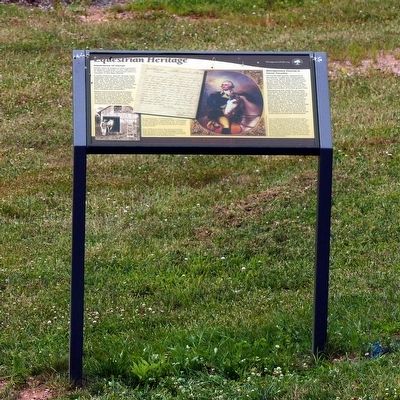
2. Equestrian Heritage Marker

Regionally, this marker is in the Washington Metropolitan Area. It is also in the American Mid-Atlantic. Globally, it is in North America, the Western Hemisphere, the Western World, and the Anglosphere. Historically, it finds itself in what was once one of the original Thirteen Colonies and also the Antebellum South.
Other nearby markers. At least 8 other markers are within walking distance of this marker: Brewer Farmstead (within shouting distance of this marker); African American Soldiers from Montgomery County (about 400 feet away, measured in a direct line); Washington's Farm (approx. 0.7 miles away); In Loving Memory (approx. 0.8 miles away); The Country Store (approx. 0.9 miles away); The Darby Store (approx. 0.9 miles away); The Darby Family (approx. 0.9 miles away); Beallsville (approx. 0.9 miles away). Touch for a list and map of all markers in Dickerson.
Photographed by Allen C. Browne, July 26, 2015
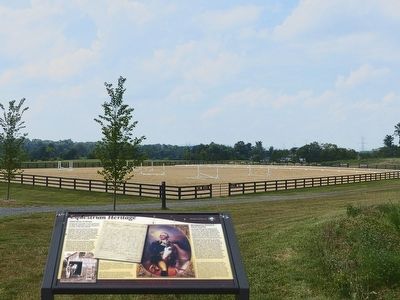
3. Equestrian Heritage Marker
Photographed by Allen C. Browne, July 26, 2015
4. George Washington
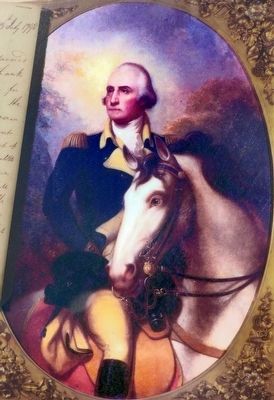
A posthumous portrait of George Washington painted by Rembrandt Peale in 1848. The equestrian skills of George Washington, which were well-known and widely admired, were a factor in his appointment to lead the Continental Army. Washington's preferred mount in battle was Nelson, a brave and steady steed. The same equestrian skills that served Washington on the battlefield were employed in his leisurely pursuits as a gentleman farmer. The gentry class, to which he belonged, participated in English sports such as fox hunting and quarter races to demonstrate their horsemanship.Close-up of photo on marker
Photographed by Allen C. Browne, July 26, 2015
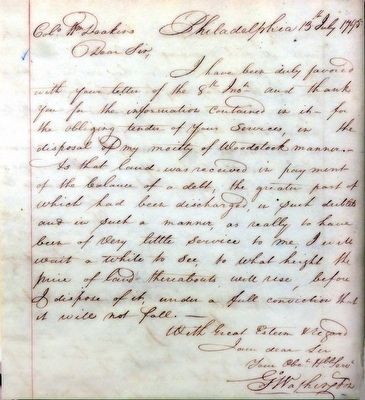
5. A Letter from George Washington
An avid horseman, our first president, George Washington, accepted acreage at Woodstock in final payment of a debt owed to him. He intended to use the property for fox hunting and, as he states in the letter above, to hold onto the land in hopes of making a profit. Close-up of photo on marker
Photographed by Allen C. Browne, July 26, 2015
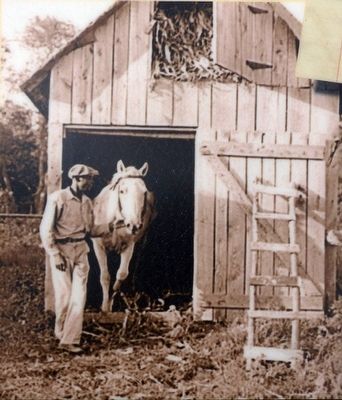
6. A Horse Shared
Even in difficult economic times American farmers knew the value of a horse. This photograph taken for the Farm Security Administration during the Great Depression of the 1930s, shows a horse owned cooperatively by three Maryland farmers. Close-up of photo on marker
Credits. This page was last revised on February 21, 2023. It was originally submitted on July 29, 2015, by Allen C. Browne of Silver Spring, Maryland. This page has been viewed 738 times since then and 34 times this year. Photos: 1, 2, 3, 4, 5, 6. submitted on July 29, 2015, by Allen C. Browne of Silver Spring, Maryland. • Bill Pfingsten was the editor who published this page.
