Dalton in Whitfield County, Georgia — The American South (South Atlantic)
The Battle of Mill Creek Gap
May 7-12, 1864 — The Opening Phase of the Atlanta Campaign
Photographed by Brandon Fletcher, March 31, 2014
1. The Battle of Mill Creek Gap Marker
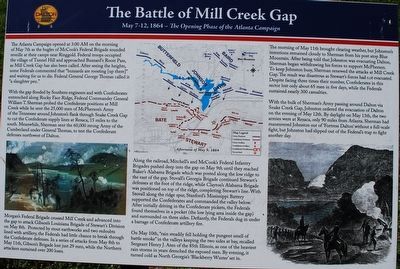
With the gap flooded by Southern engineers and with Confederates entrenched along Rocky Face Ridge, Federal Commander General William T. Sherman probed the Confederate positions at Mill Creek while he sent the 25,000 men of McPherson's Army of the Tennessee around Johnston's flank through Snake Creek Gap to cut the Confederate supply lines at Resaca, 15 miles to the south. Meanwhile, Sherman sent 60,000 strong Army of the Cumberland under General Thomas, to test the Confederate defenses northwest of Dalton.
Morgan's Federal Brigade crossed Mill Creek and advanced into the gap to attack Gibson's Louisiana Brigade of Stewart's Division on May 8th. Protected by stout
this page online
Along the railroad, Mitchell's and McCook's Federal Infantry Brigades pushed deep into the gap on May 9th until they reached Baker's Alabama Brigade which was posted along the low ridge to the east of the gap. Stovall's Georgia Brigade continued Stewart's defenses at the foot of the ridge, while Clayton's Alabama Brigade was positioned on top of the ridge, completing Stewart's line. With Stovall along the ridge spur, Standford's Mississippi Battery supported the Confederates and commanded the valley below. After initially driving in the Confederate pickets, the Federals found themselves in a pocket (the low lying area inside the gap) and surrounded on three sides. Defiantly, the Federals dug in under a barrage of Confederate artillery fire.
On May 10th, "rain steadily fell holding the pungent smell of battle smoke" in the valleys keeping the two sides at bay, recalled Sergeant
Photographed by Brandon Fletcher, March 31, 2014
2. The Battle of Mill Creek Gap Marker
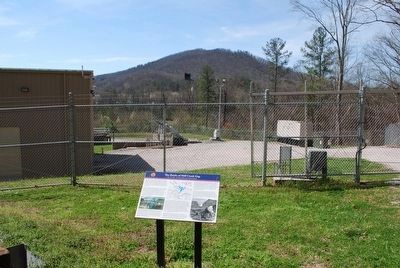
Dalton utility site can be seen in the background. Buzzard's Roost in the distance.
The morning of May 11th brought clearing weather, but Johnston's intentions remained cloudy to Sherman from his post atop Blue Mountain. After being told that Johnston was evacuating Dalton, Sherman began withdrawing his forces to support McPherson. To keep Johnston busy, Sherman renewed the attacks at Mill Creek Gap. The result was disastrous as Stewart's forces had not evacuated. Despite facing three times their number, Confederates in this sector lost only about 65 men in five days, while the Federals sustained nearly 300 casualties.
With the bulk of Sherman's Army passing around Dalton via Snake Creek Gap, Johnston ordered the evacuation of Dalton on the evening of May 12th. By daylight on May 13th, the two armies were at Resaca, only 90 miles from Atlanta. Sherman had maneuvered Johnston out of 'Fortress Dalton' without a full-scale fight, but Johnston had slipped out of the Federal's trap to fight another day.
Erected by 150th Dalton, Gateway
Photographed by Brandon Fletcher, March 31, 2014
3. The Battle of Mill Creek Gap Marker
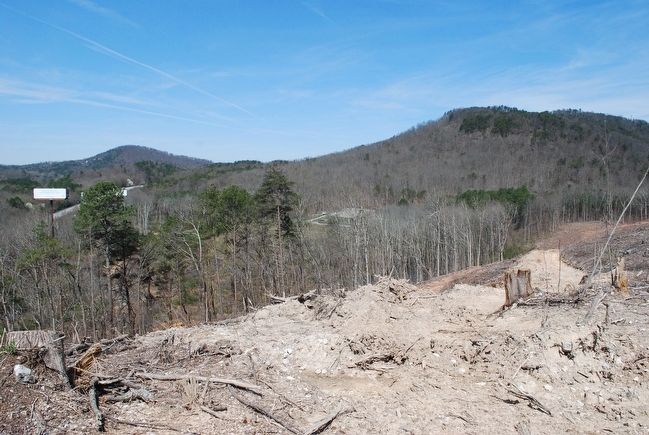
Center of photo in the distance, the Dalton Utility are where the marker is located can be seen, looking north.
Topics. This historical marker is listed in this topic list: War, US Civil. A significant historical date for this entry is May 7, 1864.
Location. 34° 48.283′ N, 85° 0.549′ W. Marker is in Dalton, Georgia, in Whitfield County. It can be reached from Larry McDonald Memorial Highway half a mile west of Crow Valley Road, on the left when traveling north. To reach the marker, turn off of Crow Valley Road at the following coordinates: 34.807158, -85.003927. Take the gravel road and turn left at the fork. Continue until you reach the Dalton utility building where there is a parking area. The marker sits near by. Touch for map. Marker is in this post office area: Dalton GA 30720, United States of America. Touch for directions.

Regionally, this marker is in Georgia’s Mountains. It is also in the American South, specifically in the Deep South, in Appalachia, and specifically in Southern Appalachia. Globally, it is in North America, the Western Hemisphere, the Western World, and the Anglosphere. Historically, it finds itself in what was once the original Cherokee Nation, the territory of the Mississippian Culture, one of the original Thirteen Colonies, one of the Confederate States of America, and the Antebellum South.
Other nearby markers. At least 8 other markers are within walking distance of this marker: Confederate Defense of Mill Creek Gap (approx. 0.3 miles away); George Disney's Grave (approx. 0.3 miles away); Atlanta Campaign (approx. 0.3 miles away); The Flooded Gap (approx. 0.3 miles away); Mill Creek Gap (approx. 0.3 miles away); Rocky Face Ridge Phase (approx. 0.3 miles away); a different marker also named Battle of Mill Creek Gap (approx. 0.3 miles away); a different marker also named Mill Creek Gap (approx. 0.8 miles away).
Related markers. Click here for a list of markers that are related to this marker. To better understand the relationship, study each marker in the order shown.
Credits. This page was last revised on June 30, 2025. It was originally submitted on July 31, 2015, by Brandon Fletcher of Chattanooga, Tennessee. This page has been viewed 2,847 times since then and 155 times this year. Photos: 1, 2, 3. submitted on July 31, 2015, by Brandon Fletcher of Chattanooga, Tennessee. • Bernard Fisher was the editor who published this page.
