Calhoun in Gordon County, Georgia — The American South (South Atlantic)
Sequoyah
Photographed by Brandon Fletcher, April 23, 2011
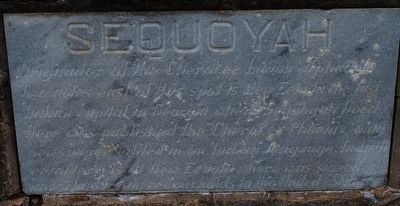
1. Sequoyah Marker
Originator of the Cherokee Indian alphabet. Two miles east of this spot is New Echota, the last Indian capital in Georgia, where Sequoyah lived. Here was published the "Cherokee Phoenix," only newspaper edited in an Indian language. Indian cemetery is at New Echota where was signed important treaty ceding lands to the United States.
Topics. This historical marker is listed in these topic lists: Communications • Indigenous Peoples and Communities.
Location. 34° 31.818′ N, 84° 56.207′ W. Marker is in Calhoun, Georgia, in Gordon County. It is at the intersection of North Wall Street (U.S. 41) and Joseph Vann Highway (Georgia Route 225), on the left when traveling south on North Wall Street. Touch for map. Marker is in this post office area: Calhoun GA 30701, United States of America. Touch for directions.

Regionally, this marker is in Georgia’s Mountains. It is also in the American South, specifically in the Deep South, in Appalachia, and specifically in Southern Appalachia. Globally, it is in North America, the Western Hemisphere, the Western World,
this page online
Other nearby markers. At least 8 other markers are within 2 miles of this marker, measured as the crow flies: Calhoun War Memorial (within shouting distance of this marker); New Echota Cemetery (approx. 1.6 miles away); Cherokee Indian Memorial (approx. 1.7 miles away); Trail of Tears (approx. 1.7 miles away); Historic Site in Journalism (approx. 1.7 miles away); New Echota (approx. 1.7 miles away); Hicks/McCoy House Sites (approx. 1.7 miles away); New Echota Ferry (approx. 1.8 miles away). Touch for a list and map of all markers in Calhoun.
Photographed by Brandon Fletcher, April 23, 2011
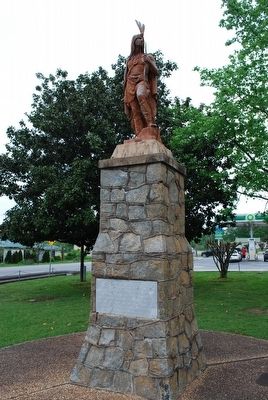
2. Sequoyah Marker
Photographed by Brandon Fletcher, April 23, 2011
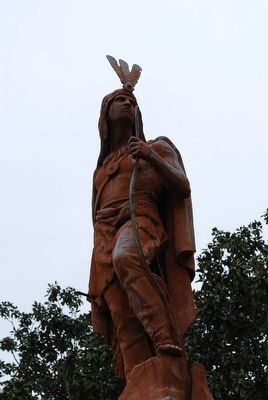
3. Sequoyah statue
Photographed by Allen C. Browne, February 16, 2015
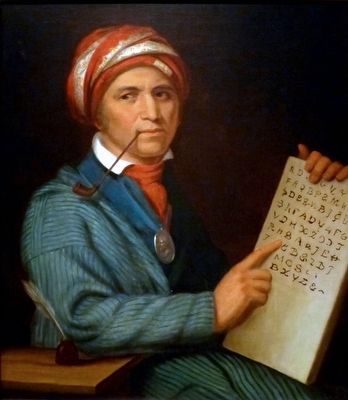
4. Sequoyah
This c. 1830 portrait of Sequoyah by Henry Inman after Charles Bird King hangs in the National Portrait Gallery in Washington, DC.
“Born Cherokee town of Tuskegee, eastern Tennessee, Sequoyah, the son of a Cherokee chief's daughter and a fur trader from Virginia, was a warrior and hunter and, some say, a silversmith. For twelve years he worked to devise a method of writing for the Cherokee language. His syllabary of eighty-five symbols representing vowel and consonant sounds was approved by the Cherokee chiefs in 1821. The simple utilitarian system made possible a rapid spread of literacy throughout the Cherokee nation. Medicine men set down ceremonies for healing, divination, war, and traditional ball games; missionaries translated hymns and the New Testament into the native language; and in 1828 the Cherokee Phoenix, a weekly bilingual newspaper, began publication at New Echota, Georgia.
The original portrait of Sequoyah, commissioned by Thomas McKenney and painted by Charles Bird King, was destroyed by the fire that swept through the Smithsonian Castle building in January 1865.” — National Portrait Gallery
“Born Cherokee town of Tuskegee, eastern Tennessee, Sequoyah, the son of a Cherokee chief's daughter and a fur trader from Virginia, was a warrior and hunter and, some say, a silversmith. For twelve years he worked to devise a method of writing for the Cherokee language. His syllabary of eighty-five symbols representing vowel and consonant sounds was approved by the Cherokee chiefs in 1821. The simple utilitarian system made possible a rapid spread of literacy throughout the Cherokee nation. Medicine men set down ceremonies for healing, divination, war, and traditional ball games; missionaries translated hymns and the New Testament into the native language; and in 1828 the Cherokee Phoenix, a weekly bilingual newspaper, began publication at New Echota, Georgia.
The original portrait of Sequoyah, commissioned by Thomas McKenney and painted by Charles Bird King, was destroyed by the fire that swept through the Smithsonian Castle building in January 1865.” — National Portrait Gallery
Credits. This page was last revised on November 25, 2020. It was originally submitted on August 11, 2015, by Brandon Fletcher of Chattanooga, Tennessee. This page has been viewed 1,060 times since then and 60 times this year. Photos: 1, 2, 3. submitted on August 11, 2015, by Brandon Fletcher of Chattanooga, Tennessee. 4. submitted on August 13, 2015, by Allen C. Browne of Silver Spring, Maryland. • Bernard Fisher was the editor who published this page.
