Woodley Park in Northwest Washington in Washington, District of Columbia — The American Northeast (Mid-Atlantic)
Woodley Estate
Photographed by Allen C. Browne, August 15, 2015
1. Woodley Estate Marker
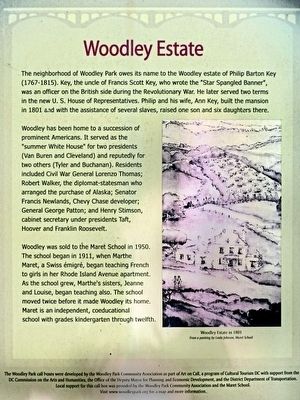
The neighborhood of Woodley Park owes its name to the Woodley estate of Philip Barto Key (1767-1815). Key, uncle of Francis Scott Key, who wrote “Star Spangled Banner”, was an officer on the British side during the Revolutionary War. He later served two terms in the new U.S. House of Representatives. Philip and his wife Ann Key, built the mansion in 1801 and with the assistance of several slaves, raised one son and and six daughters here.
Woodley has been home to a succession of prominent Americans. It served as the “summer White House” for two presidents (Van Buren and Cleveland) and reputedly for two others (Tyler and Buchanan). Residents included Civil War General Lorenzo Thomas; Robert Walker, the diplomat-statesman who arranged the purchase of Alaska; Senator Francis Newlands, Chevy Chase Developer; General George Patton; and Henry Stimson, cabinet secretary under presidents Taft, Hoover and Franklin Roosevelt.
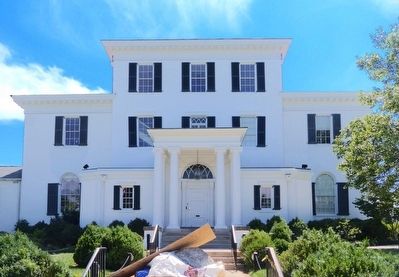
Woodley was sold to the Maret School in 1950. The School began in 1911, when Mathe Maret, a Swiss émigré, began teaching French to girls in her Rhode Island Avenue apartment.
this page online
Erected by Cultural Tourism DC.
Topics and series. This historical marker is listed in these topic lists: Arts, Letters, Music • Education • Settlements & Settlers • Women. In addition, it is included in the DC, Art on Call, the Former U.S. Presidents: #08 Martin Van Buren, the Former U.S. Presidents: #10 John Tyler, the Former U.S. Presidents: #15 James Buchanan, the Former U.S. Presidents: #22 and #24 Grover Cleveland, the Former U.S. Presidents: #27 William Howard Taft, the Former U.S. Presidents: #31 Herbert Hoover, and the Former U.S. Presidents: #32 Franklin D. Roosevelt series lists. A significant historical year for this entry is 1801.
Location. 38° 55.745′ N, 77° 3.624′ W. Marker is in Northwest Washington in Washington, District of Columbia. It is in Woodley Park. It is on Cathedral Avenue Northwest east of Woodley Road Northwest, on the right when traveling west. Touch for map. Marker is
Photographed by Allen C. Browne, August 15, 2015
2. Woodley Estate Marker

Regionally, this marker is in the Washington Metropolitan Area. It is also in the American Northeast, in the Upper South, in the Mid-Atlantic, in the Tidewater, and in the Chesapeake Bay Region. Globally, it is in North America, the Western Hemisphere, the Western World, and the Anglosphere.
Other nearby markers. At least 8 other markers are within walking distance of this marker: Mihran Mesrobian (about 700 feet away, measured in a direct line); Long & Winding Woodley Road (approx. ¼ mile away); Redwood (approx. ¼ mile away); A Long and Winding Road (approx. 0.3 miles away); Tregaron Conservancy (approx. 0.3 miles away); Causeway at Tregaron (approx. 0.3 miles away); Woodley Road Neighbors (approx. 0.3 miles away); Harry Wardman (approx. 0.3 miles away). Touch for a list and map of all markers in Northwest Washington.
Other markers no longer nearby. From Woodley to Woodley Park (was approx. 0.2 miles away but has been confirmed missing); Black and Gray Squirrels (was approx. 0.3
Photographed by Allen C. Browne, August 15, 2015
3. Woodley, now the Maret School
Additional commentary.
1. Responsible Verbiage in historical writing
I’d like to express concern about the language used in this article, specifically the assertion that Francis Scott Key built the Woodley Mansion and was “assisted by 6 slaves.” Referring to enslaved individuals as having “assisted” in building the estate is deeply misleading and erases the violent reality of forced labor. “Assistance” implies voluntary participation and free will, neither of which apply to slavery. Enslaved people were subjected to unimaginable coercion and exploitation, and it is crucial that historical narratives accurately reflect this truth.
Additionally, if the names of these enslaved individuals are known, they should be included in the article. Their contributions were not voluntary, but they were significant, and acknowledging them by name where possible is a small step toward restoring the humanity that slavery sought to deny. I urge you to revise this language and adopt a more accurate and respectful framing in telling this history.
Editor’s note: We appreciate your concern and we're pleased to publish it. Hmdb.org strives to faithfully transcribe the text on historical signs we find in the public way, and to subsequently publish thoughtful commentary that illuminates, refutes, corrects, admonishes, or in other ways comments on what is written on the sign.
— Submitted December 16, 2024, by Caroline of Washington DC.
Credits. This page was last revised on December 16, 2024. It was originally submitted on August 21, 2015, by Allen C. Browne of Silver Spring, Maryland. This page has been viewed 1,205 times since then and 98 times this year. Photos: 1, 2, 3. submitted on August 21, 2015, by Allen C. Browne of Silver Spring, Maryland. • Bill Pfingsten was the editor who published this page.
