Near Charlottesville in Albemarle County, Virginia — The American South (Mid-Atlantic)
Edgar Allan Poe
Photographed by J. J. Prats, June 15, 2008
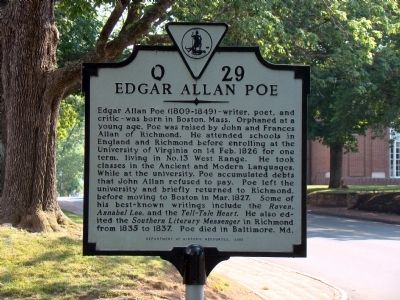
1. Edgar Allan Poe Marker
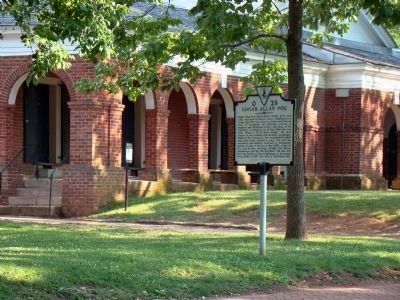
Edgar Allan Poe (1809-1849)—writer, poet, and critic—was born in Boston, Mass. Orphaned at a young age, Poe was raised by John and Frances Allan of Richmond. He attended schools in England and Richmond before enrolling at the University of Virginia on 14 Feb. 1826 for one term, living in No.13 West Range. He took classes in the Ancient and Modern Languages. While at the university, Poe accumulated debts that John Allan refused to pay. Poe left the university and briefly returned to Richmond, before moving to Boston in Mar. 1827. Some of his best-known writings include the Raven, Annabel Lee, and the Tell-Tale Heart. He also edited the Southern Literary Messenger in Richmond from 1835 to 1837. Poe died in Baltimore, Md.
Erected 2003 by Department of Historic Resources. (Marker Number Q-29.)
Topics and series. This historical marker is listed in these topic lists: Arts, Letters, Music • Communications. In addition, it is included in the Virginia Department of Historic Resources (DHR) series list. A significant historical date for this entry is February 14, 1826.
Location. 38° 2.133′ N, 78° 30.312′ W. Marker is near Charlottesville,
this page online

Regionally, this marker is in the Piedmont and in Central Virginia. It is also in the American South and specifically in the Upper South. Globally, it is in North America, the Western Hemisphere, the Western World, and the Anglosphere. Historically, it finds itself in what was once the territory of the Mississippian Culture, one of the original Thirteen Colonies, one of the Confederate States of America, and the Antebellum South.
Other nearby markers. At least 8 other markers are within walking distance of this marker: ACLU Case Brings Full Coeducation to UVA (within shouting distance of this marker); Honor Men Address (within shouting distance of this marker); James Monroe’s First Farm (within shouting distance of this marker); These Garden Walls (within shouting distance of this marker); Alderman Library (about 300 feet away, measured in a
Photographed by J. J. Prats, June 15, 2008
2. Edgar Allan Poe Marker
Also see . . .
1. Edgar Allan Poe. Wikipedia entry (Submitted on April 7, 2023, by Larry Gertner of New York, New York.)
2. Southern Literary Messenger. The Southern Literary Messenger began publication in 1834, and ceased publication in 1864. This University of Michigan Archive has page images of all issues. (Submitted on July 4, 2008.)
Photographed by J. J. Prats, June 15, 2008
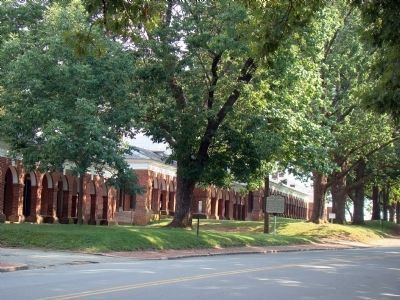
3. Marker at the West Range Student Rooms and Pavilions
There is a brass tablet over the door to No. 13 that reads “Edgar Allan Poe MDCCCXXVI Domus Parva Magni Poetae.” The latin translates to “the small house of a great poet.”
Photographed by J. J. Prats, June 15, 2008
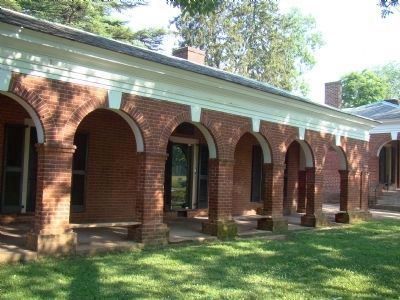
4. Edgar Allan Poe's Room
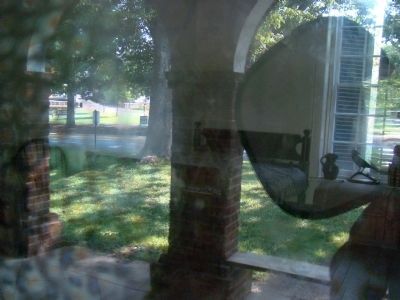
No. 13 West Range (door at center of photograph) now has plexiglas in place of the door so that the room, furnished the way it might have been when Poe was resident—except perhaps for the small statue of a raven on the windowsill—can be viewed at all times.
Photographed by J. J. Prats, June 15, 2008
5. View into Edgar Allen Poe's Room
Plexiglas makes taking photographs of the room difficult. Notice the raven.
Oil by Samuel Stillman Osgood, 1845
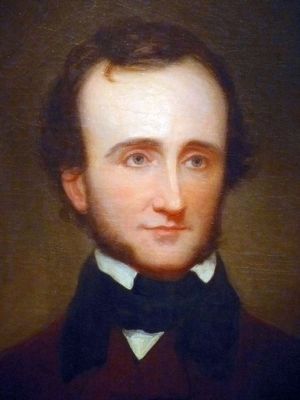
6. Edgar Allan Poe
This 1845 portrait of Edgar Allan Poe by Samuel Stillman Osgood hangs in the National Portrait Gallery in Washington, DC.
“Edgar Allan Poe is popularly known for his poem ‘The Raven’ (1844), and like the raven itself, Poe was a dark presence amid the optimism of early American culture. Not for him was the glorification of the individual or the celebration of nature as life-giving. Poe peeled back the underside of America to sketch a world in which nothing, especially human motivation, was transparent, predictable, or even knowable. In their dark, hallucinatory imagery, Poe's writings profoundly influenced such European poets as Baudelaire and Rimbaud. In America, his voice is still singular for the strength with which it spoke against the spirit of the Romantic age in which he lived. Poe's great subject was death, and he seemed to court it in his life as well as art, dying early after proving himself unable to function in the society he dissected so remorselessly.” — National Portrait Gallery
“Edgar Allan Poe is popularly known for his poem ‘The Raven’ (1844), and like the raven itself, Poe was a dark presence amid the optimism of early American culture. Not for him was the glorification of the individual or the celebration of nature as life-giving. Poe peeled back the underside of America to sketch a world in which nothing, especially human motivation, was transparent, predictable, or even knowable. In their dark, hallucinatory imagery, Poe's writings profoundly influenced such European poets as Baudelaire and Rimbaud. In America, his voice is still singular for the strength with which it spoke against the spirit of the Romantic age in which he lived. Poe's great subject was death, and he seemed to court it in his life as well as art, dying early after proving himself unable to function in the society he dissected so remorselessly.” — National Portrait Gallery
1899 Bronze bust by George Zolnay; photograph by Kathy Walker, April 12, 2008
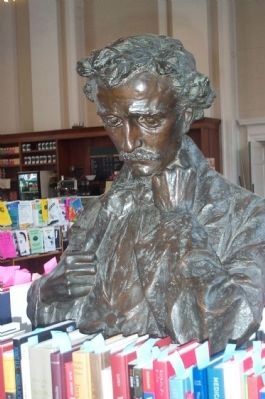
7. Edgar Allan Poe Marker
Bust of Edgar Allen Poe in the University of Virginia Library.
Credits. This page was last revised on April 7, 2023. It was originally submitted on July 3, 2008, by J. J. Prats of Powell, Ohio. This page has been viewed 4,482 times since then and 81 times this year. Photos: 1, 2, 3, 4, 5. submitted on July 3, 2008, by J. J. Prats of Powell, Ohio. 6. submitted on November 4, 2015, by Allen C. Browne of Silver Spring, Maryland. 7. submitted on July 16, 2008, by Kathy Walker of Stafford, Virginia.
