
Wheatland in Platte County, Wyoming — The American West (Mountains)
Open Spaces Sustained by Agriculture
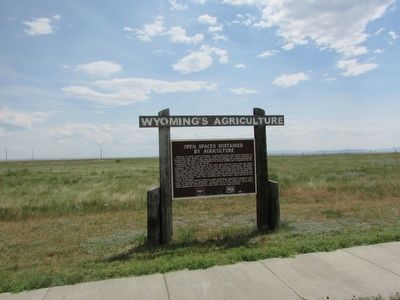
Wyoming’s Agriculture
Photographed by Bill Coughlin, August 2, 2015
1. Open Spaces Sustained by Agriculture Marker
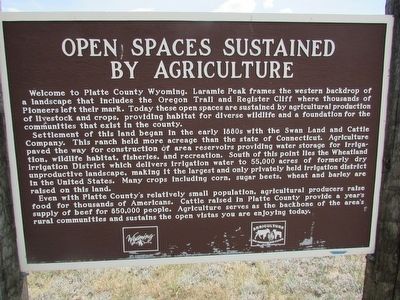
Welcome to Platte County Wyoming. Laramie Peak frames the western backdrop of a landscape that includes the Oregon Trail and Register Cliff where thousands of Pioneers left their mark. Today these open spaces are sustained by agricultural production of livestock and crops, providing habitat for diverse wildlife and a foundation for the communities that exist in the county.
Settlement of this land began in the early 1880s with the Swan Land and Cattle Company. This ranch held more acreage than the state of Connecticut. Agriculture paved the way for construction of the area reservoirs providing water storage for irrigation, wildlife habitat, fisheries, and recreation. South of this point lies the Wheatland Irrigation District which delivers irrigation water to 55,000 acres of formerly dry unproductive landscape, making it the largest and only privately held irrigation district in the United States. Many crops including corn, sugar beets, wheat and barley are raised on this land.
Even with Platte County’s relatively small population, agricultural producers raise food for thousands of Americans. Cattle raised
this page online
Erected by State of Wyoming.
Topics. This historical marker is listed in this topic list: Agriculture.
Location. 42° 14.008′ N, 105° 1.232′ W. Marker is in Wheatland, Wyoming, in Platte County. It is at the intersection of Interstate 26 and U.S. 26, on the left when traveling south on Interstate 26. Marker is located in the Dwyer Junction Rest Area. Touch for map. Marker is in this post office area: Wheatland WY 82201, United States of America. Touch for directions.

Regionally, this marker is in Wyoming’s Laramie Basin and in the Westward Expansion Trails Region. It is also in the American Mountain West, on the Great Plains, and specifically on the High Plains. Globally, it is in North America, the Western Hemisphere, the Western World, and the Anglosphere. Historically, it finds itself in what was once the Louisiana Purchase.
Other nearby markers. At least 8 other markers
Photographed by Bill Coughlin, August 2, 2015
2. Open Spaces Sustained by Agriculture Marker
Photographed by Bill Coughlin, August 2, 2015
3. Open Spaces Sustained by Agriculture Marker
Credits. This page was last revised on June 16, 2016. It was originally submitted on September 28, 2015, by Bill Coughlin of Woodland Park, New Jersey. This page has been viewed 463 times since then and 24 times this year. Photos: 1, 2, 3. submitted on September 28, 2015, by Bill Coughlin of Woodland Park, New Jersey.
