Maumee in Lucas County, Ohio — The American Midwest (Great Lakes)
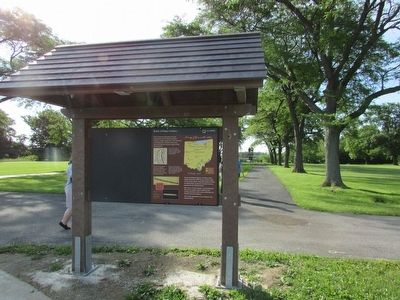
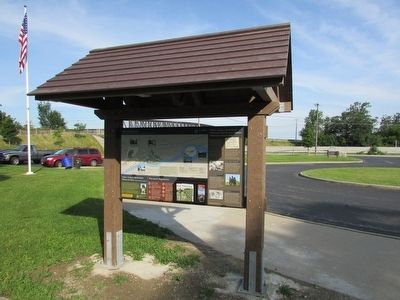
Battle of Fallen Timbers
Photographed by Bill Coughlin, July 18, 2015
1. Battle of Fallen Timbers Marker
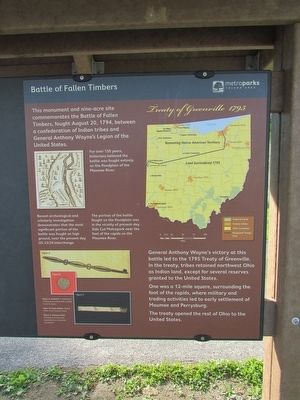
This monument and nine-acre site commemorates the Battle of Fallen Timbers, fought August 20, 1794, between a confederation of Indian tribes and General Anthony Wayne’s Legion of the United States.
Treaty of Greenville 1795
One was a 12-mile square, surrounding the foot of the rapids, where military and trading activities led to early settlement of Maumee and Perrysburg.
The treaty opened the rest of Ohio to the United States.
For over 150 years, historians believed the battle was fought entirely on the floodplain of the Maumee River. Recent archaeological and scholarly investigation demonstrates that the most significant portion of the battle was fought on high ground, near the present-day US 23/24 interchange. The portion of the battle fought on the floodplain was in the vicinity of present-day Metropark near the foot of the rapids on the Maumee River.
< Reverse Side : >
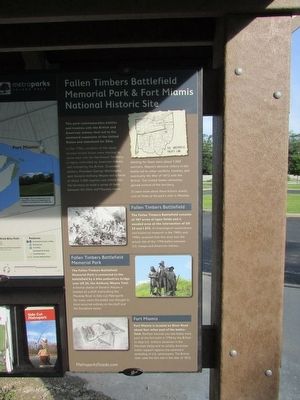
Fallen Timbers Battlefield Memorial Park & Fort Miamis National Historic Site
this page online
In the 1790s, residents of the newly formed United States were starting to move west into the Northwest Territory, a region controlled by American Indians and claimed by the British. To protect settlers, President George Washington sent General Anthony Wayne and a force of about 3,000 regulars and militia into the territory to build a series of forts between the Ohio and Maumee rivers. Waiting for them were about 1,000 warriors. Wayne’s decisive victory in the battle led to other conflicts, treaties, and eventually the War of 1812 with the British. The United States ultimately gained control of the territory.
To learn more about these historic events, visit all three of the park’s sites in Maumee.
Fallen Timbers Battlefield
Photographed by Bill Coughlin, July 18, 2015
2. Reverse Side of Marker
Fallen Timbers Battlefield Memorial Park
A bronze statue of General Wayne is located on a bluff overlooking the Maumee River in Side Cut Metropark. For many years the battle was thought to have occurred entirely on the bluff and the floodplain below.
Fort Miamis
Topics. This historical marker is listed in these topic lists: Indigenous Peoples and Communities • War, US Revolutionary. A significant historical date for this entry is August 20, 1794.
Location. 41° 32.639′ N, 83° 41.857′ W. Marker is in Maumee, Ohio, in Lucas County. It is on Fallen Timbers Lane, on the right when traveling east. Marker is located in Fallen
Photographed by Bill Coughlin, July 18, 2015
3. Battle of Fallen Timbers Marker

Regionally, this marker is on the Lake Erie Shore and in the Toledo Metropolitan Area. It is also in the American Midwest and in the Corn Belt. Globally, it is in North America, on the Great Lakes, in the Western Hemisphere, in the Western World, and in the Anglosphere. Historically, it finds itself in what was once the Viceroyalty of New France, the Haudenosaunee (Iroquois) Confederacy, the territory of the Mississippian Culture, and the Northwest Territory.
Other nearby markers. At least 8 other markers are within walking distance of this marker: American Indians at the Battle of Fallen Timbers (about 300 feet away, measured in a direct line); Turkey Foot Rock (about 300 feet away); Fallen Timbers Battle Memorial (about 400 feet away); Fallen Timbers Battle Monument (about 400 feet away); Fighting Forces (approx. 0.4 miles away); A Long March (approx. 0.4 miles away); a different marker also named Battle of Fallen Timbers (approx. 0.4 miles away); Early American Defeats
Photographed by Bill Coughlin, July 18, 2015
4. Battle of Fallen Timbers Marker
Other markers no longer nearby. Fallen Timbers (was a few steps from this marker but has been permanently removed); Maumee River Rapids (was approx. 0.3 miles away but has been permanently removed); Fallen Timbers Battlefield (was approx. 0.4 miles away but has been confirmed missing).
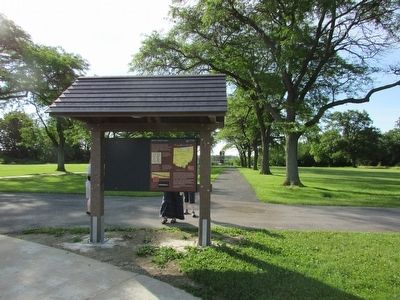
Photographed by Bill Coughlin, July 18, 2015
5. Marker at the Fallen Timbers Battlefield Memorial Park
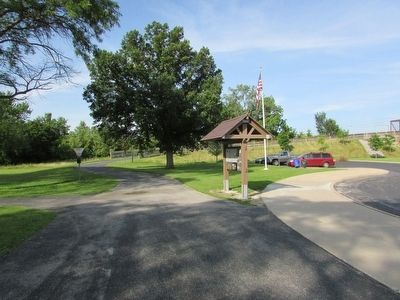
Photographed by Bill Coughlin, July 18, 2015
6. Marker at the Fallen Timbers Battlefield Memorial Park
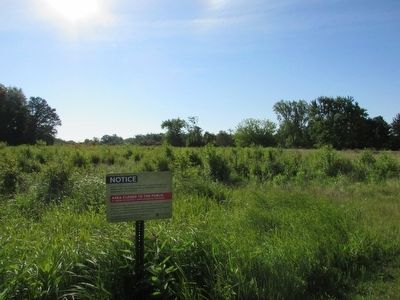
Photographed by Bill Coughlin, July 18, 2015
7. Fallen Timbers Marker Battlefield
The most intense fighting of the battle took place at this site, located ½ mile north of he marker.
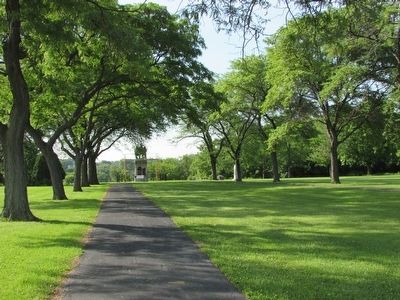
Photographed by Bill Coughlin, July 18, 2015
8. Battle of Fallen Timbers Monument Park
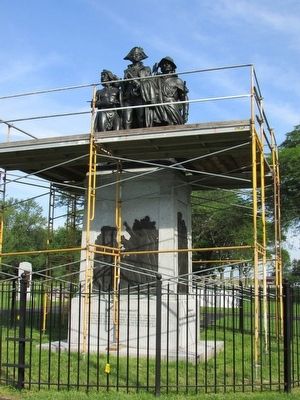
Photographed by Bill Coughlin, July 18, 2015
9. Battle of Fallen Timbers Monument
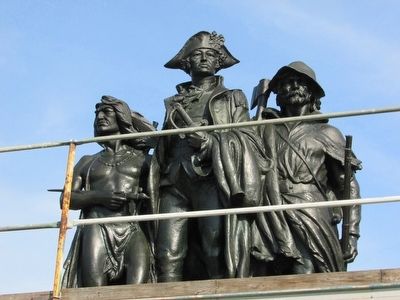
Photographed by Bill Coughlin, July 18, 2015
10. Closeup of Monument
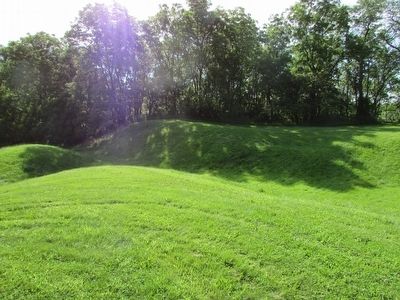
Photographed by Bill Coughlin, July 18, 2015
11. Fort Miamis
The earthworks seen here were built by the British in 1794. They used it during the Fallen Timbers battle and during the War of 1812.
Credits. This page was last revised on June 16, 2016. It was originally submitted on September 30, 2015, by Bill Coughlin of Woodland Park, New Jersey. This page has been viewed 995 times since then and 47 times this year. Photos: 1, 2, 3, 4, 5, 6, 7, 8, 9, 10, 11. submitted on September 30, 2015, by Bill Coughlin of Woodland Park, New Jersey.
