Longview in Gregg County, Texas — The American South (West South Central)
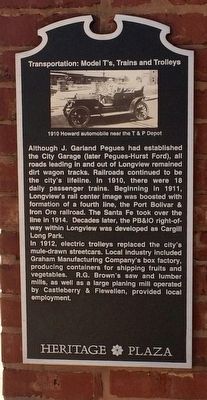
Transportation: Model T's, Trains & Trolleys
1910s
Photographed by Mark Hilton, September 17, 2015
1. Transportation: Model T's, Trains & Trolleys Marker
In 1912, electric trolleys replaced the city's mule-drawn streetcars. Local industry included Graham Manufacturing Company's box factory, producing containers for shipping fruits and vegetables. R.G. Brown's saw and lumber mills, as well as a large planing mill operated by Castleberry & Flewellen, provided local employment.
Erected 2000 by One Hundred Acres of Heritage, Inc.
Topics. This historical marker is listed in these topic lists: Industry & Commerce • Railroads & Streetcars • Roads & Vehicles. A significant historical year for this entry is 1910.
Location. 32° 29.744′ N, 94° 44.204′ W. Marker is in Longview, Texas, in Gregg County. It is at the intersection of North Green Street and East Methvin Street, on the right when traveling south on North Green Street. Touch for map. Marker is at or near this postal address: 219 East Methvin Street, Longview TX 75601, United States of America. Touch for directions.

Regionally, this marker is in the American South, specifically in the Deep South, and in the Piney Woods. Globally, it is in North America, a Gulf of Mexico state, the Western Hemisphere, the Western World, and the Anglosphere. Historically, it finds itself in what was once New Spain, the Republic of Texas, one of the Confederate States of America, and the Antebellum
this page online
Other nearby markers. At least 8 other markers are within walking distance of this marker: Longview Charters First Industry in Texas (here, next to this marker); The End of the Beginning (here, next to this marker); Technology Brings Modern Conveniences (here, next to this marker); The Oil Boom Brings Renewal (a few steps from this marker); World War II & Its Aftermath (a few steps from this marker); First Discovery Wells and Then the Boom! (a few steps from this marker); The Good Old Days (a few steps from this marker); Rails, Timber and Cotton Bring Growth (a few steps from this marker). Touch for a list and map of all markers in Longview.
Also see . . . Texas State Historical Association on Longview. (Submitted on October 2, 2015, by Mark Hilton of Montgomery, Alabama.)
Photographed by Mark Hilton, September 17, 2015
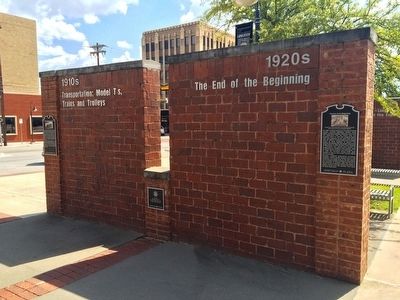
2. Transportation: Model T's, Trains & Trolleys 1910s
Photographed by Mark Hilton, September 17, 2015
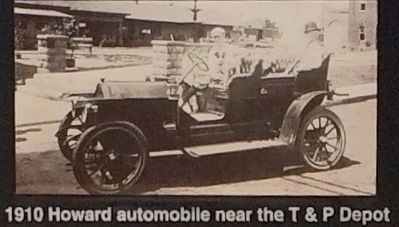
3. Photo from marker.
Photographed by Mark Hilton, September 17, 2015
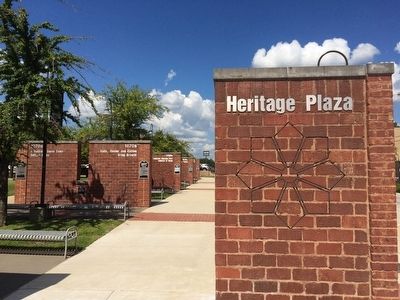
4. Heritage Plaza Park
Photographed by Mark Hilton, September 17, 2015
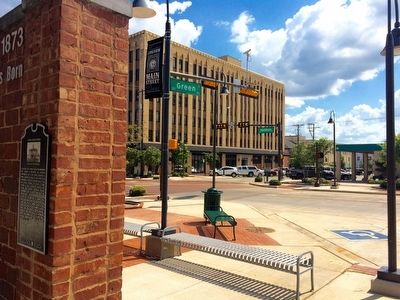
5. Intersection of Green & Methvin Streets
Photographed by Mark Hilton, September 17, 2015
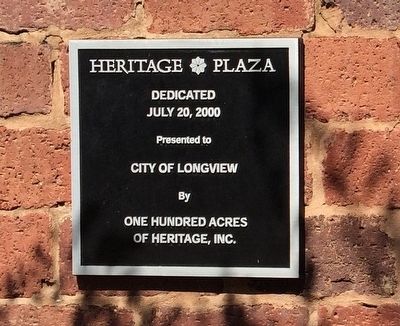
6. Heritage Plaza dedication plaque.
Credits. This page was last revised on June 16, 2016. It was originally submitted on October 2, 2015, by Mark Hilton of Montgomery, Alabama. This page has been viewed 552 times since then and 27 times this year. Photos: 1, 2, 3, 4, 5, 6. submitted on October 2, 2015, by Mark Hilton of Montgomery, Alabama.
