White Mills in Wayne County, Pennsylvania — The American Northeast (Mid-Atlantic)
The Canal and the Rails Spark the Growth of White Mills...
...Transporting Glass to Customers.
| — | The White Mills Community Trail | — |
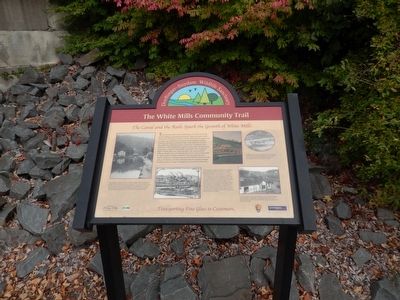
Photographed by Don Morfe, September 28, 2015
1. The Canal and the Rails Spark the Growth of White Mills... Marker
(Inscription beside the image in the lower center)
Transportation was valuable to many businesses, including the Honesdale Glass Works, in the village of Traceyville, which was on the D&H Canal two miles west of White Mills. Honesdale
this page online
(Inscription below the image in the upper right)
The original locks of the Delaware & Hudson Canal Company were 76 feet by 9 feet but were enlarged in 1850 to 100 feet by 15 feet. The tonnage that an individual boat could carry increased from 10 tons in 1828 to 40 tons in 1850.
(Inscription below the image in the lower right)
It is believed that the original Erie Railroad Depot was built in 1848 when rail service
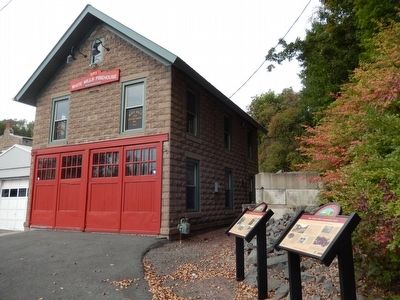
Photographed by Don Morfe, September 28, 2015
2. The Canal and the Rails Spark the Growth of White Mills... Marker
This marker is the marker on the left of the two markers.
Erected by Dorflinger-Suydam Wildlife Sanctuary, Lackawanna Heritage Valley, DCNR, Lackawanna Wonderful, and National Park Service.
Topics. This historical marker is listed in these topic lists: Industry & Commerce • Railroads & Streetcars • Waterways & Vessels. A significant historical year for this entry is 1868.
Location. 41° 31.558′ N, 75° 12.181′ W. Marker is in White Mills, Pennsylvania, in Wayne County. It is on Main Street (US 6-Texas Palmyra Hwy). The marker is next to the 1911 White Mills Firehouse. Touch for map. Marker is in this post office area: White Mills PA 18473, United States of America. Touch for directions.

Regionally, this marker is in Pennsylvania’s Pocono Mountains. It is also in the American Northeast, in the Mid-Atlantic, in Appalachia, and specifically in Northern Appalachia. Globally, it is in North America, the Western Hemisphere, the Western World, and the Anglosphere. Historically, it finds itself in what was once the Haudenosaunee
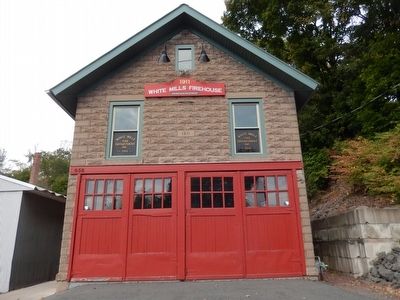
Photographed by Don Morfe, September 28, 2015
3. 1911 White Mills Firehouse
Other nearby markers. At least 8 other markers are within walking distance of this marker: Watching Over Their Livelihood and Their Homes (here, next to this marker); From Alsace, France to White Mills... (a few steps from this marker); Dorflinger Glass Works (within shouting distance of this marker); Dorflinger: America's Finest Glass... (within shouting distance of this marker); As the Company Prospered, So Did the Community. (about 300 feet away, measured in a direct line); When Christian Dorflinger Melded His Art with History... (about 400 feet away); Skills Passed Down through Generations... (about 400 feet away); There Was More to White Mills than Glass (about 500 feet away). Touch for a list and map of all markers in White Mills.
Credits. This page was last revised on June 4, 2017. It was originally submitted on October 9, 2015, by Don Morfe of Baltimore, Maryland. This page has been viewed 477 times since then and 21 times this year. Photos: 1, 2, 3. submitted on October 9, 2015, by Don Morfe of Baltimore, Maryland. • Bill Pfingsten was the editor who published this page.
