Near Enid in Garfield County, Oklahoma — The American South (West South Central)
Jesse Chisholm
(circa 1805-1868)
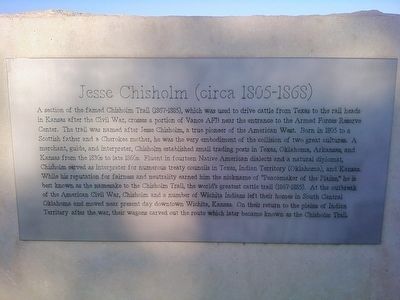
Photographed by Lee Hattabaugh, October 19, 2015
1. Jesse Chisholm Marker
this page online
Topics. This historical marker is listed in these topic lists: Indigenous Peoples and Communities • Industry & Commerce. A significant historical year for this entry is 1805.
Location. 36° 21.207′ N, 97° 54.064′ W. Marker is near Enid, Oklahoma, in Garfield County. It can be reached from Gott Road 0.7 miles south of West Southgate Road, on the right when traveling south. Marker is adjacent to the Vance AFB visitor center. Touch for map. Marker is in this post office area: Enid OK 73703, United States of America. Touch for directions.

Regionally, this marker is in Northwest Oklahoma — Red Carpet Country and specifically in Central Oklahoma—Frontier Country. It is also in the American South, specifically on the prairies, and on the Southern Plains. Globally, it is in North America, the Western Hemisphere, the Western World, and the Anglosphere. Historically, it finds itself in what was once the Comanchería, the territory of the Mississippian Culture, the Louisiana Purchase,
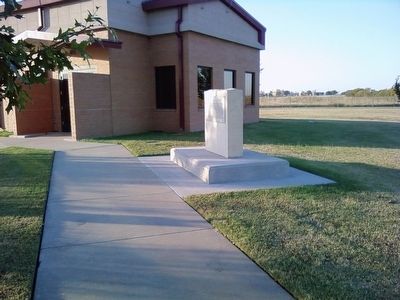
Photographed by Lee Hattabaugh, October 19, 2015
2. Jesse Chisholm Marker
Other nearby markers. At least 8 other markers are within 13 miles of this marker, measured as the crow flies: United States Land Office (approx. 3.1 miles away); Government Springs (approx. 3.2 miles away); Pioneers: Past, Present and Future (approx. 3.3 miles away); The Chisholm Trail (approx. 7.8 miles away); Buffalo Springs (approx. 9.6 miles away); The Missouri Compromise (approx. 10.3 miles away); Cherokee Strip (approx. 13.1 miles away); Run of '89 North Boundary (approx. 13.1 miles away). Touch for a list and map of all markers in Enid.
Credits. This page was last revised on December 31, 2024. It was originally submitted on October 21, 2015, by Lee Hattabaugh of Capshaw, Alabama. This page has been viewed 807 times since then and 34 times this year. Photos: 1, 2. submitted on October 21, 2015, by Lee Hattabaugh of Capshaw, Alabama. • Andrew Ruppenstein was the editor who published this page.
Editor’s want-list for this marker. Frontal photo of entire monument. • Can you help?
