Lexington in Lafayette County, Missouri — The American Midwest (Upper Plains)
The Steamboat Saluda Disaster
April 9, 1852
Photographed by Tom Bosse, October 29, 2015
1. The Steamboat Saluda Disaster Marker
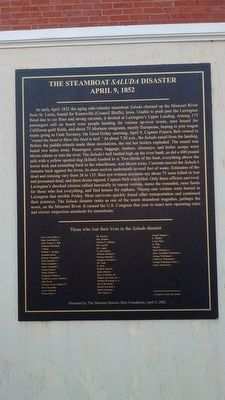
At about 7:30 a.m., the Saluda eased from the landing. Before the paddle-wheels made three revolutions, the red hot boilers exploded. The sound was heard two miles away, passengers, crew, baggage, timbers, chimneys, and boiler scraps were blown ashore or into the river. The Saluda's bell landed high up the river bank, as did a 600 pound safe with a yellow spotted dog (killed) leashed to it. Two-thirds of the boat, everything above the lower deck and extending back to the wheelhouse, was blown away. Currents moved the Saluda's remains back against the levee, its stern section underneath several feet of water.
Estimates of the dead and missing vary from 26 to 135. Best eye-witness accounts saw about 75 were killed or lost and presumed dead, and three dozen injured. Captain Belt was killed. Only three officers survived. Lexington's shocked citizens rallied heroically to rescue victims, nurse the wounded, raise funds for those who lost everything, and find homes for orphans. Twenty-one victims were buried in Lexington that terrible Friday. Most survivors quickly found other transportation and continued their journeys. The Saluda disaster ranks as one of the worst steamboat tragedies, perhaps the worst, on the Missouri River. It caused the U.S. Congress that year to enact new operation rules and stricter inspection
this page online
Those who lost their lives in the Saluda disaster
Lois Locke Bailey* • Mary Ann Bailey* • Capt. Francis T. Belt • Jonathan Blackburn • J. Brick • William J. Bridges • Jonathan Brock • Duncan Campbell* • Jane Campbell* • Neile Campbell* • James Campbell* • Josiah Clancey • Helen Dunbar* • Euphemia Dunbar* • Franklin Lorenzo Dunbar* • John Evans • Firemen on the Saluda (5) • Mr. Foleylinber • Lewis Guerette • Emma Henry* • Mr. Kramer • Mrs. Kramer • Charles S. LaBarge • Mr. Laynell • Mr. Legatt • N. McCallister • William Mitchell* • Preston Mitchell* • Josephine Mitchell* • Mr. Nash • R. Nash • William Roberts • Selina Roberts • Sons of Roberts (4) • William Rowland, Sr.* • William Rowland, Jr.* • David Rowland* • Rachel Rowland* • Sarah Rowland* • John Sargent* • Joseph Sargent* • E. Shaffer • Lewis Tebo • S. Wag.. • Wayley • Sister Whitaker* • Mary Gleadhail Whitehead* • George Whitehead* • Catherine Whitehead* • George Whitehead (Son) • Isabel Whitehead*
* Denotes Latter-day Saints
Erected 2002 by The Mormon Historic Sites Foundation.
Topics. This historical marker is listed in these topic

Photographed by Tom Bosse, October 29, 2015
2. Heritage Park - Saluda Memorial
This panel is on the leftmost panel of the lattice wall.
Location. 39° 11.077′ N, 93° 52.799′ W. Marker is in Lexington, Missouri, in Lafayette County. It is on 13th Street, on the left when traveling north. Touch for map. Marker is in this post office area: Lexington MO 64067, United States of America. Touch for directions.

Regionally, this marker is in the Missouri River Corridor. It is also in the American Midwest, in the Lewis & Clark Corridor, in the Corn Belt, and on the Santa Fe Trail Corridor. Globally, it is in North America, the Western Hemisphere, the Western World, and the Anglosphere. Historically, it finds itself in what was once the territory of the Mississippian Culture, the Louisiana Purchase, and the Antebellum South.
Other nearby markers. At least 8 other markers are within walking distance of this marker: William Morrison (here, next to this marker); Christ Church (within shouting distance of this marker); The Library Building (within shouting distance of this marker); Mount Vernon Foundation Stones (within shouting distance of this marker); Lexington (about 700 feet away, measured in a direct line); Lafayette County Courthouse (approx. 0.2 miles away); Lexington's First Public School Building

Photographed by Tom Bosse, October 29, 2015
3. Bell Tower Plaque
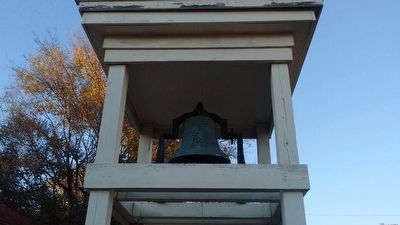
This bell tower stands in memory of the victims of the steamboat Saluda explosion on April 9, 1852. It also honors the many Lexington citizens who came to the aid of the passengers. The Saluda’s original 1949 bell now sits in front of the First Christian Church in Savannah, Missouri. This 1847 bell, with its similar Diana the Huntress design, wad donated to the Lexington Historical Association by Pierre Collobert. The tower was dedicated on April 9, 2002, with the participation of Saluda decedents.
More about this marker. Marker is located in Heritage Park
Additional commentary.
1. Cause of the explosion.
According to the written memoirs of David Cartwright, his partner Miles Holmes was on board the Saluda as he was traveling with the necessary supplies to outfit a group heading to the gold fields of California and survived the disaster. In the following passage Mr. Cartwright speaks first, and quotes Mr. Holmes. The name of the boat is incorrectly stated as the Seeloday but is assuredly the Saluda.
Soon after reaching St. Joseph, I received a letter from Mr. Holmes telling what day he expected to start from St. Louis, and that he would be on board the Seeloday. Our next news from St. Louis was that the boat, while on its way up the river, had been blown up, that four hundred lives had been lost, and that all of the freight was lost. A chill of horror ran through our hearts, as it did throughout the land. Many households were to bow in sorrow, if not in submission, at the loss of some loved one. Four hundred lives lost, and that our friend Holmes had escaped was scarcely to be thought of.Thus, according to this eye witness account, the captain intentionally caused the boiler explosion and admitted having done so to another boat!
All of the freight Iost! And we knew that our food stuffs were gone. The loss of Mr. Holmes would be a doubly great loss to me, for we, as partners in the undertaking, had been bound under a forfeiture of two hundred dollars each, to the nineteen men who started from my house with us, should we fail to take them through to California. Thar day a boat came in from down the river, but brought no word from Mr. Holmes, nor of him. I determined to go down the following day, to learn something about them; should it be good news or bad, we could wait no longer in suspense. A boat came up just before mine was to go down, and when it landed I saw our men upon her deck. ’Twas a joyful thoughtto Mr. Holmes that he had reached his men in safety, his eyes were as if still riveted on some awful scene. He took my hand with a warm grasp, but he was speechless. Large tears coursed unchecked over his manly face. I will not call them womanish tears; for ’twas manly to weep with those who wept, to weep for those bereaved.Photographed by Tom Bosse, October 29, 20154. Bell Tower
It was some little time before he could control his emotions, and could give us any detail of the disaster. When he did, it was with no parade of sensational narrative that he recounted to w us the events of the terrible catastrophe, but from an overburdened heart, still strangely horrified, that he said to us: “I saw, as I approached our boat, that it was very heavily loaded, I feared that it would give us trouble; but as I was to be only a passenger, and not wishing to make myself offensively conspicuous, I kept my fears in check. After we had started, and were in a bend in the river, at which point the stream was very rapid, and the boat could not, for its freight, work its way over the waves, and after it had made two attempts and failed, I said to the captain, ‘Throw out a line and let a hundred of us get out and pull on the rope, and help you over this.’
“‘No! I won’t. I’ll run it over myself, or blow her to h--l.’ ‘Have you ever blowed one up?’ I asked. ‘Yes, I have, and I done the old thing good justice, too.’ I went around to the engine room and saw that the safety valve was tied down. I said to Cole, ‘That boiler will burst and we’re a shipwrecked set. Let’s go to the stern.’
“We had scarcely reached it when the deck was raised, everything rose up, the boat was instantly shattered to pieces, and scattered upon the waste of waters. How we escaped I cannot tell. Hundreds of bodies of dead and dying were mingled in that sea of blood, for the blood of mangled bodies was flowing fast and free.
“The living were making loud moans, calling in their anguish for help; some calling for their friends, children for their parents, and the parent for her child. A mangled part of the captain’s body was found upon a shed about four hundred feet from the water. He had lost everything, and there was nothing but the few shreds of clothing left upon his body, and his upturned face, by which one could identify the perpetrator of that wicked deed.”
Holmes was determined to be a man and being no longer able to help any of the wreckers, he turned his attention to his own business. He had had the goods insured in St. Louis, and proposed that we sell the insurance to the merchant of whom we must get our supplies.
This is from Chapter 4, the “Cartwright Reminiscences,” in the 1929 book History, Tradition and Adventure in the Chippewa Valley by William W. Bartlett in the collection of and republished online by the Wisconsin Historical Society.
— Submitted May 19, 2025, by Patrick Thibado of Menomonie, Wisconsin.
Additional keywords. The Steamboat Saluda Disaster
Credits. This page was last revised on August 14, 2025. It was originally submitted on November 10, 2015, by Tom Bosse of Jefferson City, Tennessee. This page has been viewed 2,843 times since then and 385 times this year. Photos: 1, 2, 3, 4. submitted on November 10, 2015, by Tom Bosse of Jefferson City, Tennessee. • Bill Pfingsten was the editor who published this page.
