Florence in Omaha in Douglas County, Nebraska — The American Midwest (Upper Plains)
From Indian Lands to the Golden Gate
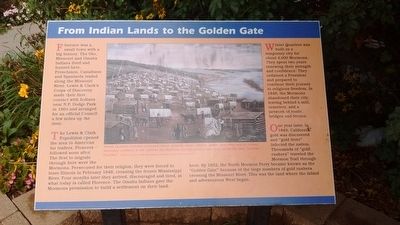
Photographed by Tom Bosse, September 8, 2015
1. From Indian Lands to the Golden Gate Marker
The Lewis and Clark Expedition opened the area to American fur traders. Pioneers followed soon after. The first to migrate through here were the Mormons. Persecuted for their religion, they were forced to leave Illinois in February 1846, crossing the frozen Mississippi River. Four months later they arrived, discouraged and tired, at what today is called Florence. The Omaha Indians gave the Mormons permission to build a settlement on their land.
Winter Quarters was built as a temporary city for about 4,000 Mormons. They spent two years renewing their strength and confidence. They ordained a President and prepared to continue their journey to religious freedom. In 1848, the Mormons abandoned their city, leaving behind a mill, cemetery, and a network of roads, bridges and ferries.
One
this page online
Winter Quarters included a Council House, gristmill, stores, schools, police, post office and an all-too-necessary cemetery. In the summer the Mormons farmed north of here and named the farm "Summer Quarters"
Artwork by C.C.A. Christensen. Courtesy of Museum of Church History and Art
Topics and series. This historical marker is listed in these topic lists: Exploration • Indigenous Peoples and Communities • Religion & Religious Structures • Settlements & Settlers. In addition, it is included in the Lewis & Clark Expedition, and the Mormon Pioneer Trail series lists. A significant historical year for this entry is 1804.
Location. 41° 20.263′ N, 95° 57.637′ W. Marker is in Omaha, Nebraska, in Douglas County. It is in Florence. It is on 30th Street, on the right when traveling north. Touch for map. Marker is in this post office area: Omaha NE 68112, United States of America. Touch for directions.

Regionally, this marker is in Eastern Nebraska. It is also in the American Midwest, in the Lewis & Clark Corridor, in the Corn Belt, and on the prairies. Globally, it is in North America, the Western Hemisphere, the Western World, and the Anglosphere. Historically, it finds itself in what was once the Louisiana Purchase.
Other nearby markers. At least 8 other markers are within walking distance of this marker: A Little Town That Dreamed of Greatness (here, next to this marker); The Bank of Florence (within shouting distance of this marker); Winter Quarters (about 700 feet away, measured in a direct line); The Mormon Pioneer Trail / A Meeting House For The Saints (approx. 0.3 miles away); A Meeting House for the Saints (approx. 0.3 miles away); The Florence Mill (approx. 0.4 miles away); The Road to Zion (approx. 0.4 miles away); Crossroads to the West: (approx. 0.4 miles away). Touch for a list and map of all markers in Omaha.
Other markers no longer nearby. Mormon Pioneer Memorial Bridge (was within shouting distance of this marker but has been confirmed missing); a different marker also named The Florence Mill (was approx. 0.4 miles away but has been confirmed missing).
Credits. This page was last revised on November 20, 2024. It was originally submitted on November 12, 2015, by Tom Bosse of Jefferson City, Tennessee. This page has been viewed 845 times since then and 47 times this year. Photo 1. submitted on November 12, 2015, by Tom Bosse of Jefferson City, Tennessee. • Bill Pfingsten was the editor who published this page.
Editor’s want-list for this marker. A wide shot of the marker and its surroundings. • Can you help?
