Washington Square West in Philadelphia in Philadelphia County, Pennsylvania — The American Northeast (Mid-Atlantic)
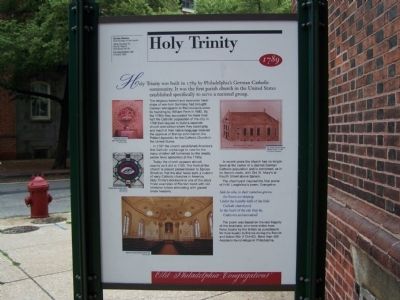
Holy Trinity
⎯⎯⎯
Old Philadelphia Congregations
Photographed by Beverly Pfingsten, July 5, 2008
1. Holy Trinity Marker
Holy Trinity was built in 1789 by Philadelphia's German Catholic community. It was the first parish church in the United States established specifically to serve a national group.
The religious turmoil and economic hardships of war-torn Germany had brought German immigrants to Pennsylvania since its founding by William Penn in 1682. By the 1780s they accounted for more than half the Catholic population of the city. In 1788 their request to build a separate church and school where they could pray and teach in their native language received the approval of Bishop John Carroll, the Prefect Apostolic for the Catholic Church in the United States.
In 1797 the church established America's first Catholic orphanage to care for the many children left homeless by the deadly yellow fever epidemics of the 1790s.
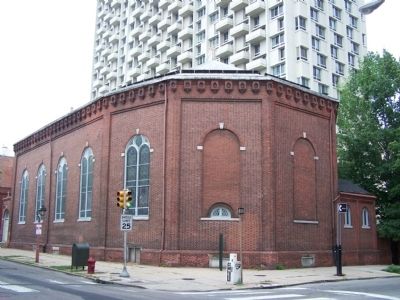
Today the church appears almost exactly as it did in 1789. The front of the church is placed perpendicular to Spruce Street so that the altar faces east, a custom of early Catholic churches in America. Holy Trinity's brickwork is one of the city's finest examples of Flemish bond with red stretcher bricks alternating
this page online
In recent years the church has no longer been at the center of a distinct German Catholic population and is combined, as in its historic roots with Old St. Mary's at Fourth Street above Spruce.
The churchyard inspired the final scene of H.W. Longfellow's poem, Evangeline.
Side by side, in their nameless graves,
the lovers are sleeping.
Under the humble walls of the little
Catholic churchyard,
In the heart of the city they lie,
Unknown and unnoticed.
The poem was based on the real tragedy of the Acadians, who were exiled from Nova Scotia by the British as punishment for their loyalty to France during the French and Indian War (1754-63). More than 450 Acadians found refuge in Philadelphia.
(other side)
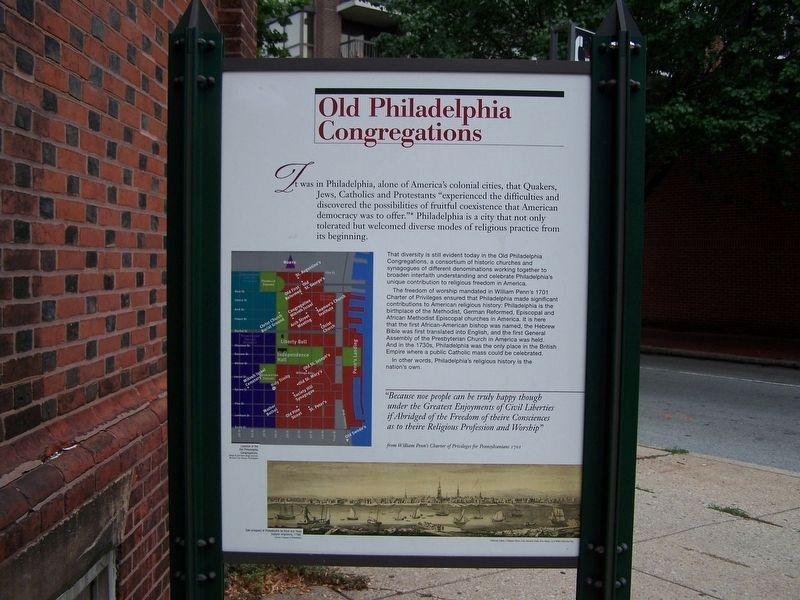
Old Philadelphia Congregations
It was in Philadelphia, alone of America's colonial cities, that Quakers, Jews, Catholics and Protestants "experienced the difficulties and discovered the possibilities of fruitful coexistence that American democracy was to offer." Philadelphia is a city that not only tolerated but welcomed diverse modes of religious practice from its beginning.
That diversity
Photographed by Beverly Pfingsten, July 5, 2008
2. Old Philadelphia Congregations side of the marker
The freedom of worship mandated in William Penn's 1701 Charter of Privileges ensured that Philadelphia made significant contributions to American religious history. Philadelphia is the birthplace of the Methodist Episcopal churches in America. It is here that the first African-American bishop was named, the Hebrew Bible was first translated into English and the first General Assembly of the Presbyterian Church in America was held. And in the 1730s, Philadelphia was the only place in the British Empire where a public Catholic mass could be celebrated.
In other words, Philadelphia's religious history is the nation's own.
"Because noe people can be truly happy though under the Greatest Enjoyments of Civil Liberties if Abridged of the Freedom of theire Consciences as to theire Religious Profession and Worship"
from William Penn's Charter of Privileges for Pennsylvanians
Photographed by Carolyn Martienssen, June 27, 2015
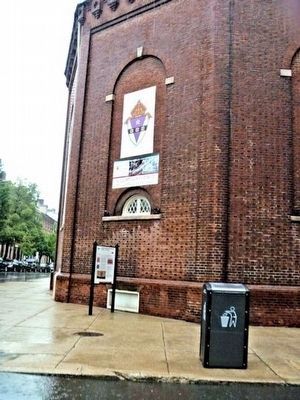
3. Holy Trinity Marker
Erected by Old Philadelphia Congregations.
Topics. This historical marker is listed in these topic lists: Arts, Letters, Music • Cemeteries & Burial Sites • Immigration • Religion & Religious Structures. A significant historical year for this entry is 1789.
Location. 39° 56.727′ N, 75° 9.103′ W. Marker is in Philadelphia, Pennsylvania, in Philadelphia County. It is in Washington Square West. It is at the intersection of 6th Street and Spruce Street, on the right when traveling south on 6th Street. Touch for map. Marker is in this post office area: Philadelphia PA 19106, United States of America. Touch for directions.

Regionally, this marker is in Southeast Pennsylvania. It is also in the American Northeast and in the Mid-Atlantic. Globally, it is in North America, the Western Hemisphere, the Western World, and the Anglosphere. Historically, it finds itself in what was once the Haudenosaunee (Iroquois) Confederacy, New Netherland, and one of the original Thirteen Colonies.
Other nearby markers. At least 8 other markers are within walking distance of this marker: Holy Trinity Roman Catholic Church
Photographed by Beverly Pfingsten, July 5, 2008
4. Holy Trinity Church
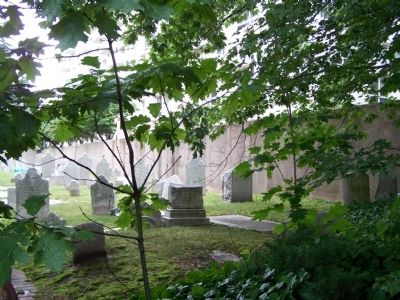
Photographed by Beverly Pfingsten, July 5, 2008
5. Holy Trinity Churchyard
Credits. This page was last revised on June 17, 2025. It was originally submitted on July 12, 2008, by Bill Pfingsten of Bel Air, Maryland. This page has been viewed 2,962 times since then and 157 times this year. Photos: 1, 2. submitted on July 12, 2008, by Bill Pfingsten of Bel Air, Maryland. 3. submitted on August 16, 2015, by Carolyn Martienssen of West Hazleton, Pennsylvania. 4, 5. submitted on July 12, 2008, by Bill Pfingsten of Bel Air, Maryland.
