Near St. Charles in Charles County, Maryland — The American Northeast (Mid-Atlantic)
John Wilkes Booth
Escape of an Assassin
| — | War on the Chesapeake Bay | — |
Photographed by Tom Fuchs, March 31, 2007
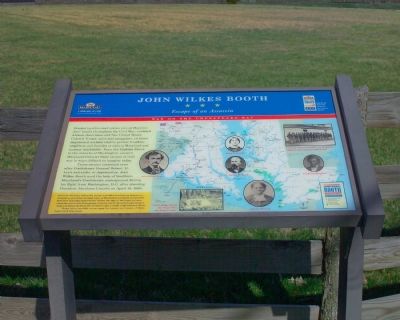
1. John Wilkes Booth Marker
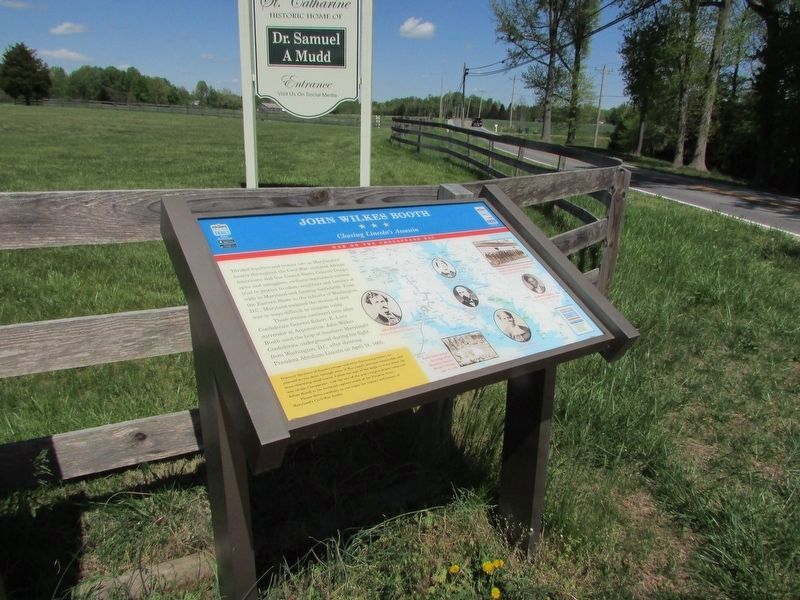
Those strains continued even after Confederate General Robert E. Lee’s surrender at Appomattox. John Wilkes Booth used the help of Southern Maryland’s Confederate underground during his flight from Washington, D.C. after shooting President Abraham Lincoln on April 14, 1865.
Discover the story of Booth’s escape and other fascinating history for yourself as you drive through some of Maryland's prettiest countryside and most charming small towns. Follow the sign of the bugle to learn about the war on the Chesapeake, visit the site of the war’s largest prison camp and follow Booth to his eventual capture south of the Potomac River.
Please drive carefully as you enjoy the history and beauty of
this page online
Photo Captions: John Wilkes Booth • Mary E. Surratt • Dr. Samuel A. Mudd • Company of the 4th USCT, one of several infantry units formed in Maryland • Frederick Douglass • Harriet Tubman • Booth limps across the stage after shooting Lincoln.
Topics and series. This historical marker is listed in this topic list: War, US Civil. In addition, it is included in the Booth's Escape, and the Maryland Civil War Trails series lists. A significant historical month for this entry is April 1826.
Location. 38° 36.567′ N, 76° 49.433′ W. Marker is near St. Charles, Maryland, in Charles County. It is on Dr. Samuel Mudd Road (Maryland Route 232) south of Poplar Hill Road ( Route 382). Touch for map. Marker is in this post office area: Waldorf MD 20601, United States of America. Touch for directions.

Regionally, this marker is in the Washington Metropolitan Area and in Southern Maryland. It is also in the American South, specifically in the Upper South, in the Mid-Atlantic, in the Tidewater, and on the Eastern Seaboard. Globally, it is in the North Atlantic Region, North America, the Western Hemisphere,
Photographed by Bill Coughlin, April 17, 2023
2. John Wilkes Booth Marker
Other nearby markers. At least 5 other markers are within 4 miles of this marker, measured as the crow flies: A different marker also named Dr. Samuel A. Mudd (here, next to this marker); Home of Dr. Samuel Mudd (a few steps from this marker); Dr. Samuel A. Mudd House (about 700 feet away, measured in a direct line); Dr. Mudd's House (approx. 3.1 miles away); a different marker also named Village of Bryantown (approx. 3.9 miles away). Touch for a list and map of all markers in St. Charles.
Other markers no longer nearby. Dr. Samuel A. Mudd (was here, next to this marker but has been replaced with another marker now near it); Village of Bryantown (was approx. 3.9 miles away but has been replaced with another marker now near it).
More about this marker. This marker is at the entrance to The Dr. Samuel Mudd House Museum.
Related markers. Click here for a list of markers that are related to this marker. To better understand the relationship, study each marker
Photographed by Bill Coughlin, April 17, 2023
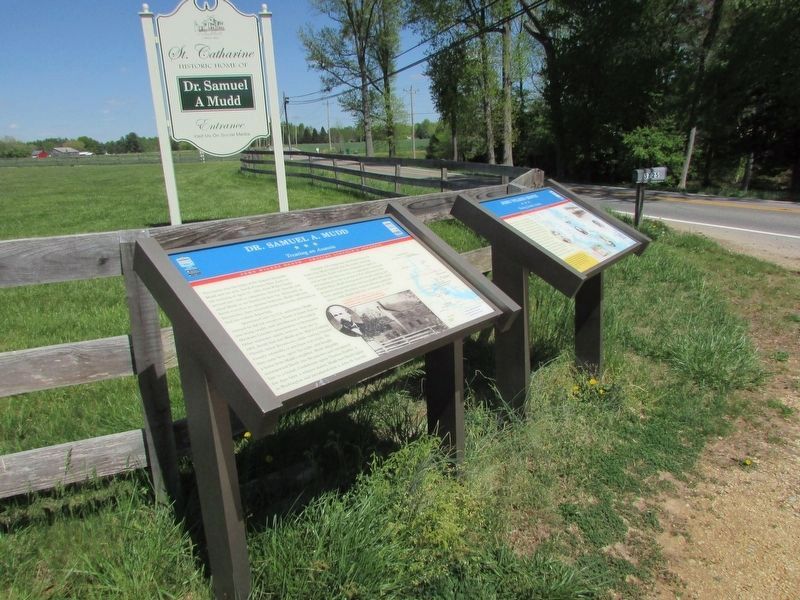
3. Markers at the Mudd House
There are two markers at this location. The John Wilkes Booth marker is seen here on the right.
Also see . . . John Wilkes Booth: Chasing Lincoln’s Assassin. Maryland Office of Tourism website entry (Submitted on August 19, 2019.)
Additional keywords. John Wilkes Booth Escape Route
Credits. This page was last revised on April 14, 2025. It was originally submitted on April 6, 2007, by Tom Fuchs of Greenbelt, Maryland. This page has been viewed 3,478 times since then and 58 times this year. Photos: 1. submitted on April 6, 2007, by Tom Fuchs of Greenbelt, Maryland. 2, 3. submitted on April 27, 2023, by Bill Coughlin of Woodland Park, New Jersey. • J. J. Prats was the editor who published this page.
