Collinsville in Canton in Capitol Region, Connecticut — The American Northeast (New England)
Charter Oak Offspring
Photographed by Alan M. Perrie, December 11, 2015
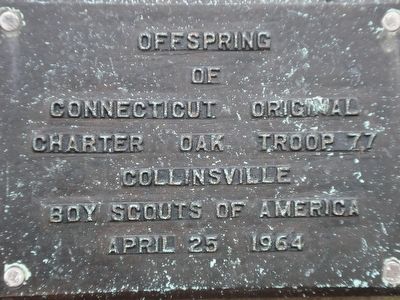
1. Charter Oak Offspring Marker
Troop 77 Collinsville
Boy Scouts of America
April 25, 1964
Erected 1964 by Troop 77 Collinsville, Boy Scouts of America.
Topics. This historical marker is listed in these topic lists: Colonial Era • Horticulture & Forestry. A significant historical date for this entry is April 25, 1964.
Location. 41° 48.667′ N, 72° 55.4′ W. Marker is in Canton in Capitol Region, Connecticut. It is in Collinsville. It is at the intersection of Bridge Street (Connecticut Route 179) and Bridge Street and Main Street, on the right when traveling east on Bridge Street. Next to the Collinsville Post Office. Touch for map. Marker is at or near this postal address: 44 Bridge St, Canton CT 06019, United States of America. Touch for directions.

Regionally, this marker is in the Connecticut River Valley, in Greater Hartford, and in the Knowledge Corridor. It is also in the American Northeast and in New England. Globally, it is in North America, the Western Hemisphere, the Western World, and the Anglosphere. Historically, it finds itself in what was once Hartford County and also
this page online
Other nearby markers. At least 8 other markers are within one mile of this marker, measured as the crow flies: Collinsville (here, next to this marker); Canton Soldiers Memorial (within shouting distance of this marker); The Collins Company Plow Building (about 400 feet away, measured in a direct line); Canton Veterans Memorial (about 600 feet away); Collinsville’s Powerhouse Station No. 3 (approx. 0.2 miles away); Collinsville, Town of Canton (approx. 0.3 miles away); a different marker also named Collinsville, Town of Canton (approx. 0.7 miles away); Constitution Oak (approx. one mile away). Touch for a list and map of all markers in Canton.
Regarding Charter Oak Offspring. In 1964, this Connecticut Charter Oak offspring was planted in Collinsville by the Boy Scouts. This white oak tree was called “Charter” because according to tradition, it was used to hide the Connecticut’s Royal Charter of 1662. When it fell down in 1856, people collected its acorns and planted the second generation. This Charter Oak came from a seedling distributed in 1962 on the 300th anniversary of the Royal Charter
Photographed by Alan M. Perrie, December 18, 2015
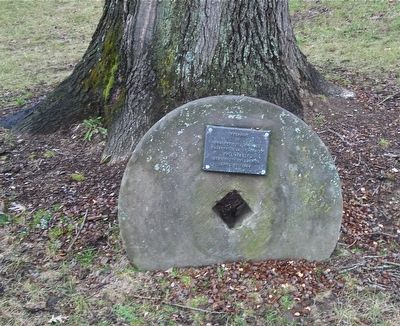
2. Second and third generations
The second generation of the Connecticut Charter Oak is behind the Marker. The third generation acorns cover the ground.
Also see . . .
1. Connecticut’s “The Legend of the Charter Oak”. Connecticut History website entry (Submitted on January 11, 2021, by Larry Gertner of New York, New York.)
2. Connecticut State Tree. Netscape entry (Submitted on February 1, 2016, by Alan M. Perrie of Unionville, Connecticut.)
3. The Charter Oak. Wikipedia entry (Submitted on February 1, 2016, by Alan M. Perrie of Unionville, Connecticut.)
Photographed by Alan M. Perrie, December 31, 2015
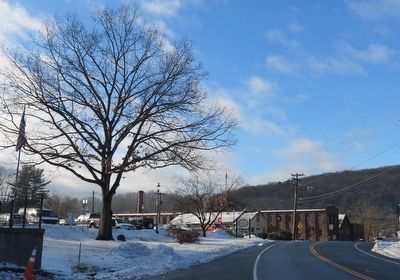
3. The white oak, quercus alba.
In 1947, the white oak became the state tree of Connecticut. This offspring of the Connecticut Charter Oak is a white oak and is located next to the Post Office on Bridge Street.
circa 2015
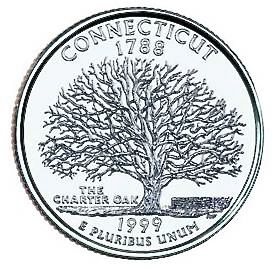
4. Connecticut State Quarter
On October 12, 1999 the Connecticut “Charter Oak” Quarter was issued. It was America’s fifth state quarter since it was the fifth state to ratify the US Constitution on January 9, 1788. The charter Oak was chosen because it was a symbol of freedom from oppression.
Credits. This page was last revised on May 19, 2026. It was originally submitted on February 1, 2016, by Alan M. Perrie of Unionville, Connecticut. This page has been viewed 930 times since then and 59 times this year. Photos: 1, 2, 3, 4. submitted on February 1, 2016, by Alan M. Perrie of Unionville, Connecticut. • Bill Pfingsten was the editor who published this page.
