Parrottsville in Cocke County, Tennessee — The American South (East South Central)
Johnson's Parrottsville Slaves
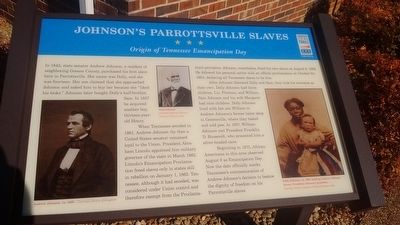
Origin of Tennessee Emancipation Day
Photographed by Tom Bosse, January 29, 2016
1. Johnson's Parrottsville Slaves Marker
When Tennessee seceded in 1861, Andrew Johnson (by then a United States senator) remained loyal to the Union. President Abraham Lincoln appointed him military governor of the state in March 1862. Lincoln's Emancipation Proclamation freed slaves only in states still in rebellion on January 1, 1863. Tennessee, although it had seceded, was considered under Union control and therefore exempt from the Proclamation's provisions. Johnson, nonetheless, freed his own slaves on August 8, 1863. He followed his personal action with an official proclamation on October 24, 1864, declaring all Tennessee slaves to be free.
After Johnson liberated Dolly and Sam, they took his surname as their own. Dolly Johnson had three children, Liz, Florence, and William. Sam
this page online
Beginning in 1875, African Americans in this area observed August 8 as Emancipation Day. Now the date officially marks Tennessee's commemoration of Andrew Johnson's decision to bestow the dignity of freedom on his Parrottsville slaves.
Erected 2015 by CivilWarTrails.org.
Topics and series. This historical marker is listed in these topic lists: Abolition & Underground RR • African Americans • War, US Civil. In addition, it is included in the Former U.S. Presidents: #17 Andrew Johnson, and the Tennessee Civil War Trails series lists. A significant historical date for this entry is January 1, 1863.
Location. 36° 0.509′ N, 83° 5.412′ W. Marker is in Parrottsville, Tennessee, in Cocke County. It is at the intersection of Tennessee Route 340 and Old Hwy 321, on the right when traveling north on Tennessee Route 340. Touch for map. Marker is in this post office

Photographed by Tom Bosse, January 29, 2016
2. Johnson's Parrottsville Slaves Marker

Regionally, this marker is in East Tennessee and in the Great Smoky Mountains. It is also in the American South, specifically in the Upper South, in Appalachia, and specifically in Southern Appalachia. Globally, it is in North America, the Western Hemisphere, the Western World, and the Anglosphere. Historically, it finds itself in what was once the original Cherokee Nation, the territory of the Mississippian Culture, one of the Confederate States of America, the State of Franklin, and the Antebellum South.
Other nearby markers. At least 8 other markers are within 6 miles of this marker, measured as the crow flies: The Hanging of Peter Reece (approx. 0.2 miles away); Swaggerty Fort (approx. 1.2 miles away); The Cross (approx. 5.8 miles away); The Warford (approx. 5.8 miles away); Swinging Bridge (approx. 5.8 miles away); Cocke County Organized - 1797 (approx. 6 miles away); City Hall (approx. 6 miles away); Cocke County War Memorial (approx. 6 miles away). Touch for a list and map of all markers in Parrottsville.
Credits. This page was last revised on November 10, 2024. It was originally submitted on February 6, 2016, by Tom Bosse of Jefferson City, Tennessee. This page has been viewed 2,346 times since then and 60 times this year. Photos: 1, 2. submitted on February 6, 2016, by Tom Bosse of Jefferson City, Tennessee. • Bill Pfingsten was the editor who published this page.
