William Penn Annex East in Philadelphia in Philadelphia County, Pennsylvania — The American Northeast (Mid-Atlantic)
Independence Square
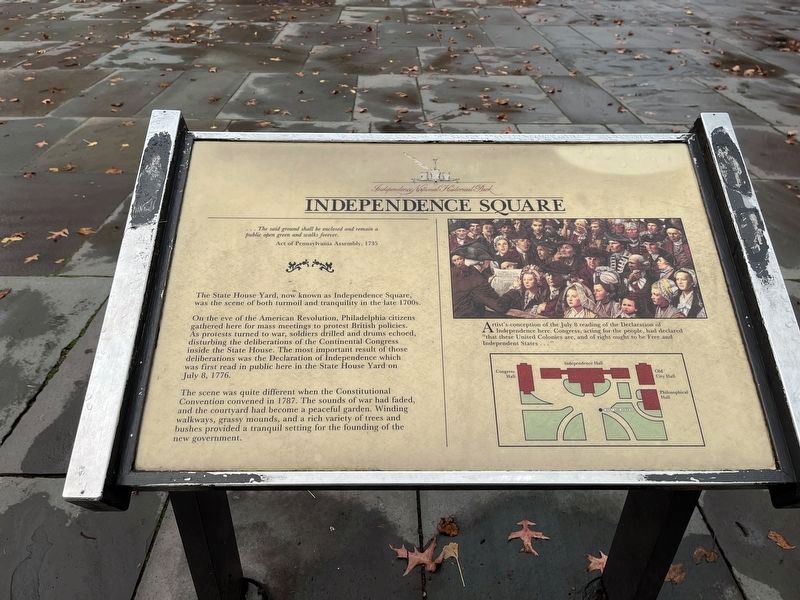
…The said ground shall be enclosed and remain a public open green and walks forever.
Act of Pennsylvania Assembly 1735
The State House Yard, now known as Independence Square, was the scene of both turmoil and tranquility in the late 1700s.
On the eve of the American Revolution, Philadelphia citizens gathered here for mass meetings to protest British policies. As protests turned to war, soldiers drilled and drums echoed, disturbing the deliberations of the Continental Congress inside the State House. The most important result of those deliberations was the Declaration of Independence which was first read in public here in the State House Yard on July 8, 1776.
The scene was quite different when the Constitutional Convention convened in 1787. The sounds of war had faded and the courtyard had become a peaceful garden. Winding walkways, grassy mounds, and a rich variety of trees and bushes provided a tranquil setting for the founding of the new government.
Erected by National Park Service, U.S. Department of the Interior.
Topics. This historical marker is listed in these topic lists: Government & Politics
this page online
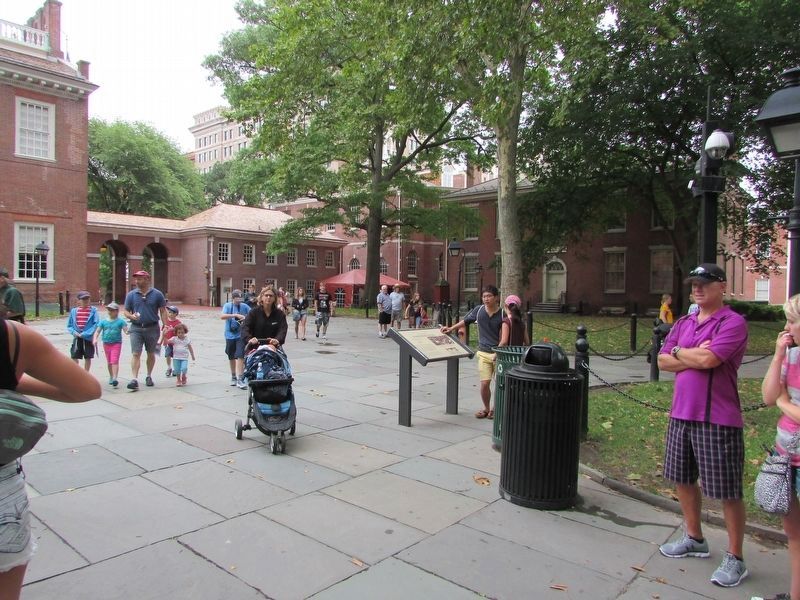
Location. Marker has been permanently removed. It was located near 39° 56.916′ N, 75° 9′ W. Marker was in Philadelphia, Pennsylvania, in Philadelphia County. It was in William Penn Annex East. It could be reached from South Independence Mall West. The marker stands near the center of Independence Square. Touch for map. Marker was at or near this postal address: 111 S Independence Mall W, Philadelphia PA 19106, United States of America.
We have been informed that this marker is no longer there and will not be replaced. This page is an archival view of what was.
Regionally, this marker was in Southeast Pennsylvania. It was also in the American Northeast and in the Mid-Atlantic. Globally, it was in North America, the Western Hemisphere, the Western World, and the Anglosphere. Historically, it found itself in what was once the Haudenosaunee (Iroquois) Confederacy, New Netherland, and one of the original Thirteen Colonies.

Other nearby markers. At least 8 other markers are within
Photographed by Beverly Pfingsten, July 5, 2008
2. Independence Square Marker
The marker used to have a cell phone tour sticker on the top right. It has since been removed.
Another marker is no longer nearby. Independence Hall (was a few steps from this marker but has been permanently removed).
Regarding Independence Square. Photo: Artist's conception of the July 8 reading of the Declaration of Independence here. Congress, acting for the people had declared "that these United Colonies are, and of right ought to be Free and Independent States..."
Diagram: Buildings in Independence Square.
Photographed by Bill Coughlin, July 25, 2017
3. Independence Square Marker
Credits. This page was last revised on June 3, 2024. It was originally submitted on July 17, 2008, by Bill Pfingsten of Bel Air, Maryland. This page has been viewed 1,540 times since then and 60 times this year. Photos: 1. submitted on December 19, 2022, by Devry Becker Jones of Washington, District of Columbia. 2. submitted on July 17, 2008, by Bill Pfingsten of Bel Air, Maryland. 3. submitted on August 1, 2017, by Bill Coughlin of Woodland Park, New Jersey.
