Niagara Falls in Niagara County, New York — The American Northeast (Mid-Atlantic)
A Bridge to Freedom
"There was now but 'one wide river to cross'..."
Photographed by Anton Schwarzmueller, March 13, 2016
1. A Bridge to Freedom Marker
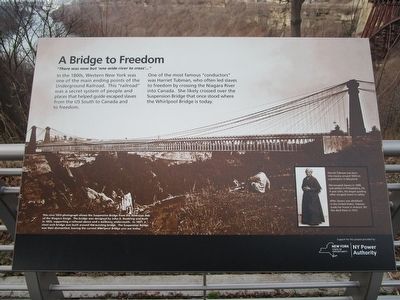
A Bridge to Freedom
"There was now but 'one wide river to cross'..."
In the 1800s, Western New York was one of the main ending points of the Underground Railroad. This "railroad" was a secret system of people and places that helped guide escaped slaves from the US South to Canada and to freedom.
One of the most famous "conductors" was Harriet Tubman, who often led slaves to freedom by crossing the Niagara River into Canada. She likely crossed over the Suspension Bridge that once stood where the Whirlpool Bridge is today.
This circa 1859 photograph shows the Suspension Bridge from the Americam side of the Niagara Gorge. The bridge was designed by John A. Roebling and built in 1855, supporting a railroad above and a walkway underneath. In 1897, a steel-arch bridge was built around the existing bridge. The Suspension Bridge was then dismantled, leaving the current Whirlpool Bridge you see today.
Harriet Tubman was born into slavery around 1820 on a plantation in Maryland.
She escaped slavery in 1849, and settled in Philadelphia, PA. A year later, she began guiding other escaped slaves to safety.
After slavery was abolished
this page online
Erected 2016 by New York Power Authority.
Topics. This historical marker is listed in these topic lists: Abolition & Underground RR • Bridges & Viaducts. A significant historical year for this entry is 1859.
Location. 43° 6.515′ N, 79° 3.366′ W. Marker is in Niagara Falls, New York, in Niagara County. It is at the intersection of Whirlpool Street and Ontario Avenue, on the right when traveling south on Whirlpool Street. Touch for map. Marker is in this post office area: Niagara Falls NY 14305, United States of America. Touch for directions.

Regionally, this marker is in Upstate New York, specifically in Western New York, and in the Buffalo Metropolitan Area. It is also in the American Northeast and in the Mid-Atlantic. Globally, it is in North America, on the Great Lakes, in the Western Hemisphere, in the Western World, and in the Anglosphere. Historically, it finds itself in what was once the Viceroyalty of New France, the Haudenosaunee (Iroquois) Confederacy, New Netherland, and one of the original Thirteen Colonies.
Other nearby markers. At
Photographed by Anton Schwarzmueller, March 13, 2016
2. Upriver
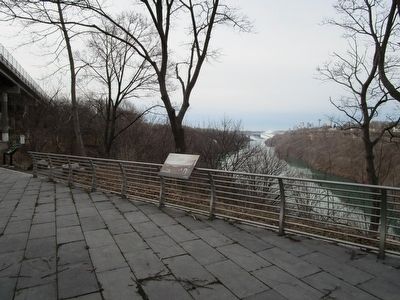
Marker is at a parking and viewing area that includes a Niagara gorge trailhead.
Also see . . . Niagara Falls Suspension Bridge - Wikipedia. (Submitted on March 14, 2016, by Anton Schwarzmueller of Wilson, New York.)
Photographed by Anton Schwarzmueller, March 13, 2016
3. Towards the Bridges
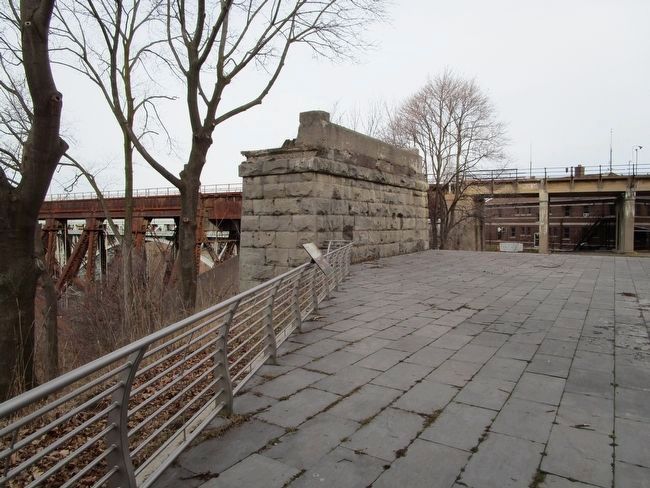
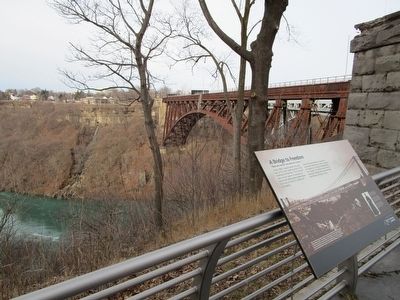
The rust colored bridge is the Niagara Railway Arch Bridge or Michigan Central Railroad Bridge, built 1925. It is abandoned due to the purchase and removal of the right-of-way in Canada by Niagara Falls Ontario from the Canadian Pacific Railway. In 2019 or 2020 the cement approach spans and pillars pictured here were removed. The gray colored bridge is the Whirlpool Rapids Bridge, owned by the Niagara Falls Bridge Commission, built 1897 as stated on the marker. The lower deck is restricted to NEXUS members only, no commercial traffic, no pedestrians, and its hours are 7 am to 11 pm. The upper deck is owned by Amtrak. The closer stone pillar once held a cantilever railroad bridge. The brick building is the current federal border inspections building - U.S. Customs & Border Protection.
Photographed by Anton Schwarzmueller, March 13, 2016
4. Marker & View to Canada
Credits. This page was last revised on June 20, 2020. It was originally submitted on March 14, 2016, by Anton Schwarzmueller of Wilson, New York. This page has been viewed 2,443 times since then and 133 times this year. Photos: 1, 2, 3, 4. submitted on March 14, 2016, by Anton Schwarzmueller of Wilson, New York.
